


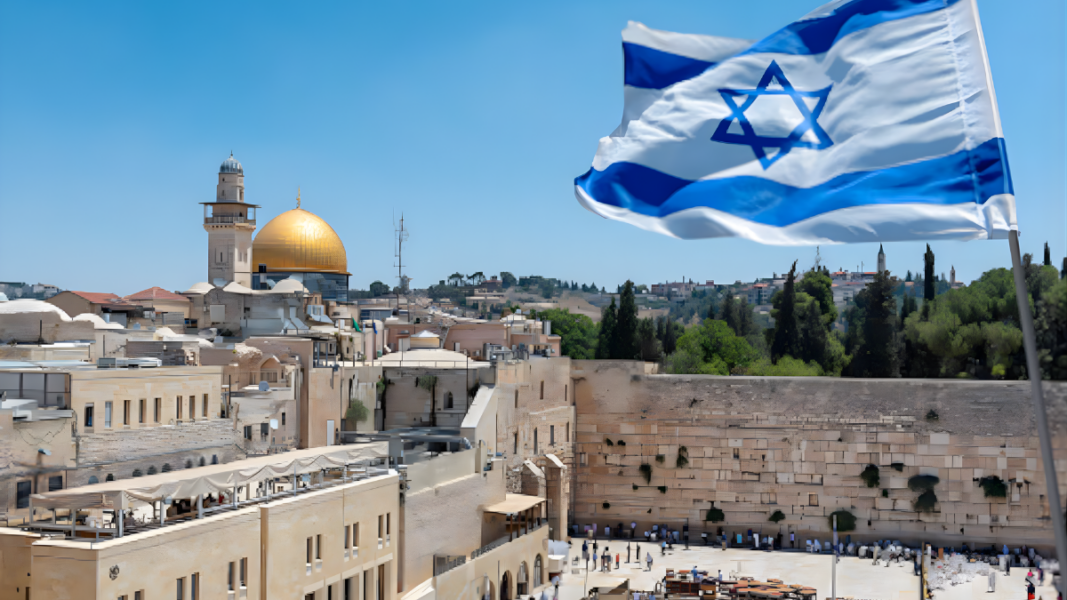
Today, among not a few Catholics, there exists a grave and persistent confusion between realities that are not equivalent: the biblical Israel of Revelation, the post-Christ Talmudic Judaism, and the modern State of Israel. This confusion, encouraged by a political reading of sacred history and by a poorly digested Zionism in a religious key, leads to doctrinal errors that affect the very heart of the Christian faith.
The Israel of the Old Testament was never merely an ethnic or political reality, but a people constituted by a divine Covenant ordered toward the coming of the Messiah. Its election did not aim to perpetuate itself in the flesh or in an earthly State, but to prepare for the Incarnation of the Word. With the coming of Christ, that Covenant reaches its definitive fulfillment. To deny this is to empty the economy of salvation of meaning and to turn sacred history into an unfinished tale.
The Church, founded by Christ, is the true Israel of God. This is taught consistently by the New Testament and the bimillennial Tradition: the promises made to Abraham are inherited through faith, not blood; through adherence to Christ, not belonging to a genealogy. To claim that the promises of the Old Testament remain valid in a parallel and autonomous way outside of Christ is to introduce a double path of salvation, incompatible with the Catholic faith.
Talmudic Judaism, which arose after the destruction of the Temple and the explicit denial of Jesus Christ as Messiah, is not the continuity of biblical Israel, but a distinct religion, structured on the expectation of a Messiah who has not yet come and on an interpretation of the Law separated from the incarnate Logos. To confuse this post-Christian Judaism with the Israel of Revelation is a grave theological error, not an act of charity.
Even more grave is to identify the modern State of Israel—a political entity born in 1948, product of geopolitical decisions, contemporary migrations, and international balances—with biblical Israel. No modern State, whatever its composition or founding narrative, can claim for itself the salvific promises of Scripture. To do so is to sacralize politics and disfigure the faith.
The Catholic is not called to hate any people nor to interpret geopolitics, but is obliged to confess the revealed truth without ambiguities. Fidelity to Christ demands rejecting any theology that, for ideological or sentimental reasons, substitutes the center of Christianity—Christ and his Church—with a political mythology clothed in biblical language.
To confuse biblical Israel with Talmudic Judaism or with the modern State of Israel is not an act of love or respect, but a silent renunciation of Catholic doctrine.