


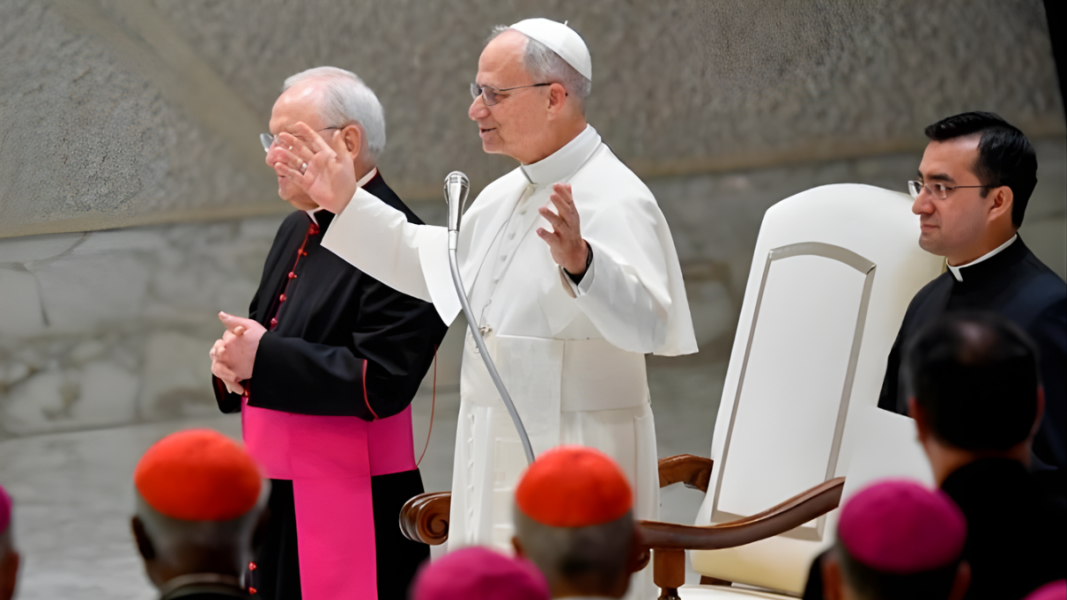
In the audience granted to the Roman Curia on the occasion of the exchange of Christmas greetings, held this December 22 in the Vatican Apostolic Palace, Pope Leo XIV centered his address on the Church’s evangelizing mission and the need to strengthen internal communion, especially in the curial service. In his speech, delivered on the vigil of Christmas, the Pontiff recalled the mystery of the Incarnation, evoked the figure and magisterium of his predecessor, Pope Francis, and exhorted a Curia that is more missionary, fraternal, and oriented toward the pastoral service of the particular Churches, in a context marked by internal divisions and conflicts in the world.
We leave below the full speech of Leo XIV:
Dear Cardinals,
venerable brothers in the episcopate and in the priesthood,
dear brothers and sisters:
The light of Christmas comes to meet us, inviting us to rediscover the novelty that, from the humble grotto of Bethlehem, runs through human history. Attracted by this novelty, which encompasses all creation, we walk with joy and hope, because a Savior has been born for us (cf. Lk 2:11): God has become flesh, has become our brother, and remains forever as the God-with-us.
With this joy in our hearts and with a deep sense of gratitude, we can look at the events that unfold, also in the life of the Church. Therefore, now that we are on the vigil of the Christmas festivities, as I cordially greet everyone and thank the Cardinal Dean for his words—always full of enthusiasm: today the Psalm tells us that our years are seventy, eighty for the more robust, so we celebrate also with you—I wish first of all to remember my dear predecessor, Pope Francis, who this year has concluded his earthly life. His prophetic voice, his pastoral style, and his rich magisterium have marked the Church’s path in these years, encouraging us mainly to return to placing God’s mercy at the center, to give greater impetus to evangelization, to be a joyful and rejoicing Church, welcoming to all, attentive to the poorest.
Inspired precisely by his Apostolic Exhortation Evangelii gaudium, I would like to return to two fundamental aspects of the Church’s life: the mission and the communion.
The Church is, by nature, extroverted, open to the world, missionary. She has received from Christ the gift of the Spirit to bring to all the good news of God’s love. As a living sign of this divine love for humanity, the Church exists to invite, call, and gather to the festive banquet that the Lord prepares for us, so that each one may discover himself as a beloved son, brother of the neighbor, new man in the image of Christ and, therefore, witness to the truth, justice, and peace.
Evangelii gaudium encourages us to advance in the missionary transformation of the Church, which finds its inexhaustible strength in the mandate of the Risen Christ. «In this ‘go’ of Jesus are present the scenarios and the ever new challenges of the Church’s evangelizing mission, and we are all called to this new missionary ‘outgoing’» (EG, 20). This state of mission derives from the fact that God himself, first, set out toward us and, in Christ, came to seek us. The mission begins in the heart of the Most Holy Trinity: God, in fact, consecrated and sent his Son into the world so that «everyone who believes in him may not perish but may have eternal life» (Jn 3:16). The first great “exodus,” therefore, is that of God, who comes out of himself to meet us. The mystery of Christmas announces precisely this: the mission of the Son consists in his coming into the world (cf. St. Augustine, The Trinity, IV, 20.28).
In this way, Jesus’ mission on earth, prolonged by the Holy Spirit in the mission of the Church, becomes a criterion of discernment for our life, for our journey of faith, for ecclesial practices, as well as for the service we carry out in the Roman Curia. Structures, in fact, must not hinder, stop the race of the Gospel or impede the dynamism of evangelization; on the contrary, we must «seek to make them all more missionary» (Evangelii gaudium, 27).
Therefore, in the spirit of baptismal co-responsibility, we are all called to participate in Christ’s mission. The work of the Curia too must be animated by this spirit and promote pastoral solicitude in the service of the particular Churches and their pastors. We need a Roman Curia that is increasingly missionary, where institutions, offices, and tasks are designed with attention to the great ecclesial, pastoral, and social challenges of today, and not only to guarantee ordinary administration.
At the same time, the mission in the life of the Church is closely linked to communion. The mystery of Christmas, in fact, while celebrating the mission of the Son of God among us, also contemplates its purpose: God has reconciled the world to himself through Christ (cf. 2 Cor 5:19) and, in him, has made us his children. Christmas reminds us that Jesus has come to reveal to us the true face of God as Father, so that we all might be his children and, therefore, brothers and sisters to one another. The Father’s love, which Jesus embodies and manifests in his gestures of liberation and in his preaching, makes us capable, in the Holy Spirit, of being a sign of a new humanity, not founded on the logic of selfishness and individualism, but on mutual love and reciprocal solidarity.
This is a task more urgent than ever ad intra and ad extra.
It is so ad intra, because communion in the Church remains always a challenge that calls us to conversion. Sometimes, behind an apparent tranquility, the ghosts of division stir. And these make us fall into the temptation to oscillate between two opposite extremes: to uniform everything without valuing differences or, on the contrary, to exasperate diversities and points of view instead of seeking communion. Thus, in interpersonal relations, in the internal dynamics of offices and roles, or in dealing with themes related to faith, liturgy, morals, or others, there is a risk of becoming victims of rigidity and ideology, with the oppositions that this implies.
But we are the Church of Christ, we are his members, his body. We are brothers and sisters in him. And in Christ, even though we are many and different, we are one: “In Illo uno unum”.
We are also called, and especially here in the Curia, to be builders of Christ’s communion, which must be configured as a synodal Church, where all collaborate and cooperate in the same mission, each according to their own charism and role received. But this is built more with gestures and concrete attitudes that must be manifested in the everyday, also in the work environment. I like to recall what St. Augustine wrote in his letter to Proba: «In all human affairs, nothing is pleasing to man if he does not have man as a friend». However, he wondered with a touch of bitterness: «Who can be found who is such a good friend that we can have certain security in this life of his intention and his habits?» (Letter 130, 4).
This bitterness sometimes makes its way among us when, perhaps after many years offered in the service of the Curia, we notice with disillusionment that some dynamics linked to the exercise of power, to the desire to stand out, to the care of one’s own interests, find it hard to change. And one wonders: is it possible to be friends in the Roman Curia, to have relations of fraternal friendship? In the daily effort, it is beautiful when we find friends in whom we can trust, when masks and deceptions fall, when people are not used and stepped over, when there is mutual help, when each one’s value and competence is recognized, avoiding generating dissatisfaction and resentments. There is a personal conversion that we must desire and pursue, so that in our relations the love of Christ that makes us brothers may shine through.
This also becomes a sign ad extra, in a world wounded by discords, violence, and conflicts, in which we also see an increase in aggressiveness and anger, often instrumentalized by the digital world and politics. The Lord’s Christmas brings with it the gift of peace and invites us to be a prophetic sign in a human and cultural context that is too fragmented. The work of the Curia and of the Church in general must also be thought of in this broad horizon: we are not small gardeners dedicated to caring for our own garden, but we are disciples and witnesses of the Kingdom of God, called to be in Christ leaven of universal fraternity, among different peoples, different religions, among women and men of every language and culture. And this happens if we are the first to live as brothers and make the light of communion shine in the world.
Dear brothers, the mission and communion are possible if we place Christ at the center. The Jubilee of this year has reminded us that only he is the hope that does not fade. And, precisely during the Holy Year, important celebrations have reminded us of two other events: the Council of Nicaea, which brings us back to the roots of our faith, and the Second Vatican Council, which, fixing its gaze on Christ, has consolidated the Church and impelled it to go out to meet the world, to listen to the joys and hopes, the sorrows and anxieties of the men of today (cf. Gaudium et spes, 1).
Finally, allow me to recall that fifty years ago, on the day of the Immaculate Conception, St. Paul VI promulgated the Apostolic Exhortation Evangelii nuntiandi, written after the Third Ordinary General Assembly of the Synod of Bishops. This emphasizes, among other things, two realities that we can highlight here: the fact that «the Church receives the mission to evangelize and […] the activity of each member constitutes something important for the whole» (n. 15); and, at the same time, the conviction that «the first means of evangelization consists in the witness of an authentically Christian life, given to God in a communion that nothing must interrupt and at the same time consecrated equally to the neighbor with unlimited zeal» (n. 41).
Let us also remember this in our curial service: the work of each one is important for the whole, and the witness of a Christian life, which is expressed in communion, is the first and greatest service we can offer.
Eminences, Excellencies, dear brothers and sisters, the Lord descends from heaven and humbles himself toward us. As Bonhoeffer wrote, meditating on the mystery of Christmas, “God is not ashamed of man’s lowliness, he enters into him […]. God loves what is lost, what no one considers, the insignificant, the marginalized, weak and downcast” (cf. D. Bonhoeffer, Recognizing God at the Center of Life, Brescia 2004, 12). May the Lord give us his same condescension, his same compassion, his love, so that every day we may be his disciples and witnesses.
I wish you all from the heart a Holy Christmas. May the Lord bring us his light and grant peace to the world.