


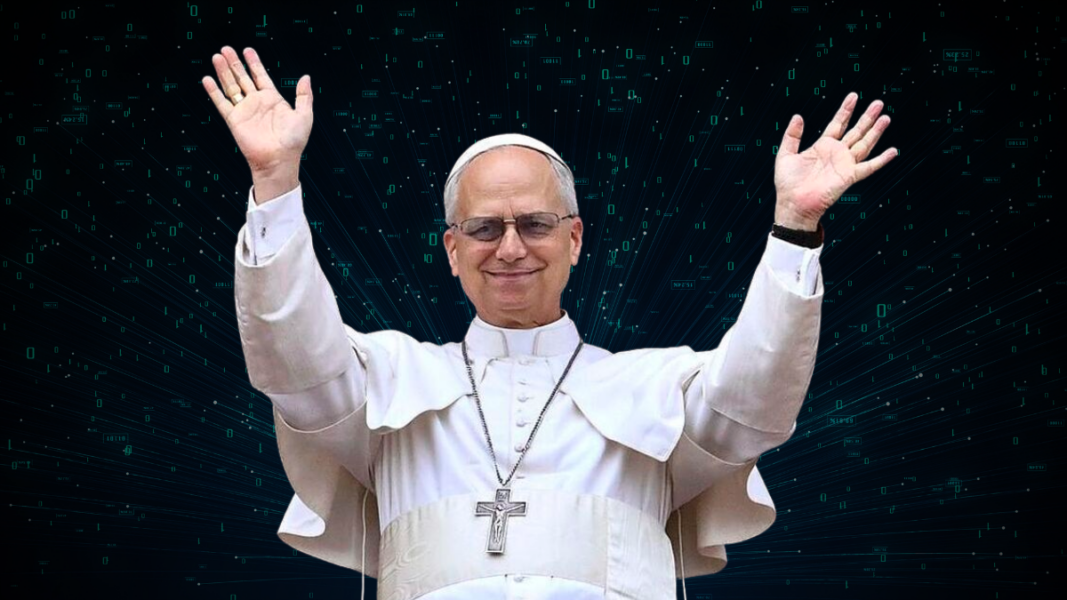
Pope Leo XIV has placed the reflection on artificial intelligence (AI) in direct continuity with the Church’s social tradition, emphasizing the primacy of human conscience over any form of moral delegation to technological systems. This is highlighted in an analysis published by The Catholic Herald, which frames the Pontiff’s first interventions on this matter in the wake of Leo XIII and his response to the industrial revolution.
From his first public words after his election, Leo XIV explained that the choice of his name was not casual, but an explicit homage to Leo XIII, author of the encyclical Rerum Novarum, the foundational text of the Church’s modern social doctrine. Just as the Church then prudently examined the impact of industrial development on work and human dignity, today the new Pontiff raises fundamental questions in the face of the advance of artificial intelligence.
The Church has not historically reacted to technology with fear, but with moral discernment. In the current context, the challenge is not factories or steam engines, but advanced computer systems capable of automating decisions, producing texts, generating codes, and displacing workers, all thanks to an exponential increase in computing capacity and massive access to data.
What is presented today as “artificial intelligence” is not intelligence in the proper sense, but statistical systems—like large language models—that predict word sequences from previous data. Despite their apparent sophistication, these systems lack understanding, consciousness, or moral judgment. Furthermore, the article notes that many of these models operate with enormous energy and economic costs, sustained more by financial expectations than by solid business models.
In this context, The Catholic Herald highlights that the central concern of Pope Leo XIV is not whether machines can think, but the risk that human beings stop exercising their own judgment. The progressive delegation of decisions—first practical, then moral—to automatic systems can weaken the habit of personal discernment, transforming conscience into an externalized function.
Shortly before the election of Leo XIV, the Vatican published the document Antiqua et Nova, dedicated to the relationship between artificial intelligence and human intelligence. It insists that AI is not a rival to man, but a product of his ingenuity, and that it can never become a substitute for conscience. This line has been reiterated by the Pope in his public interventions, where he has insisted that technology must always be at the service of the person and not the other way around.
The analysis concludes that the Pontiff’s response will not be a condemnation of technology, but a reaffirmation of the irreducible value of the human being. Against a functionalist view that measures dignity by capacities, Catholic teaching reminds us that man is valuable for what he is: a creature of God, endowed with a soul and morally responsible for his actions. The real question, therefore, is not whether machines will come to resemble man, but whether man will renounce the responsibility to think and decide for himself.