


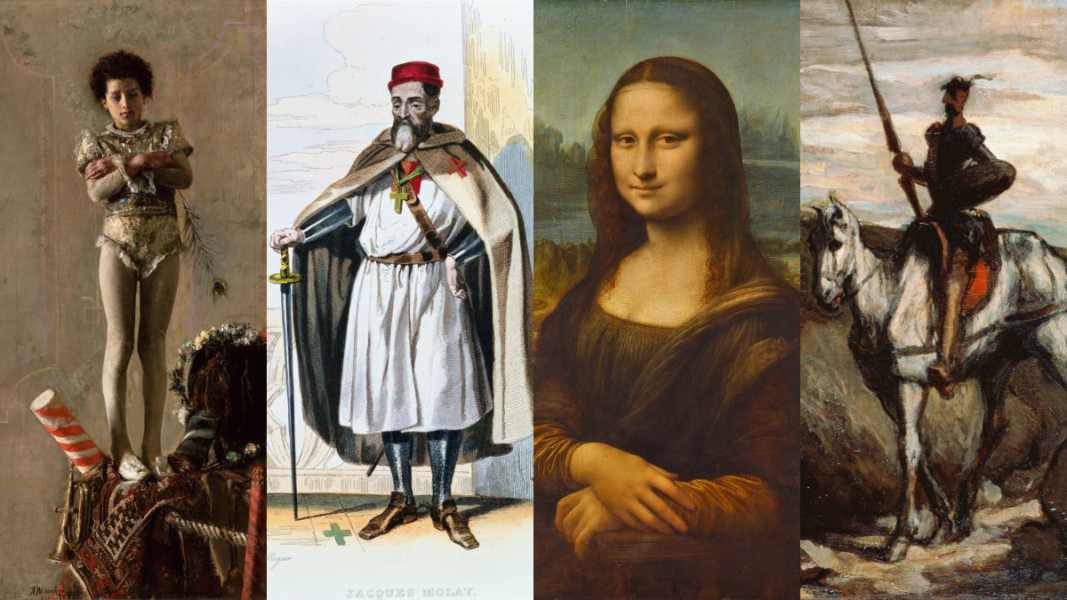
There are moments in ecclesiastical history when souls seem to blend like shadows in a stained glass window at sunset, pierced by the same Light; and others, like the present one—will the Lion straighten it, whose Davidic XIV arouses hope?—in which each human type is outlined with exuberant clarity, thus emerging, in the bimillennial theater of the Church, today so disoriented, four profiles, not chemically pure.
The Neocon today is, without a doubt, the most acrobatic figure in the cast. In the immediately preceding period, not easily recalled, he trained in a grotesque infinity of intellectual contortions that would leave trapeze artists, jugglers, and acrobats of every stripe dwarfed. He suffered more than a hundred doctrinal jolts; a hundred whims irritated his Eustachian tube; a hundred quia nominor Leo decisions disconcerted him (though he was no Leo); a hundred fifth-columnist appointments terrified him; but, faithful to his super-stupendous nature, he wrapped it all in pink hermeneutic cellophane. His specialty was—and is—turning the unacceptable into “constructive dialogue,” the trampling of the principle of non-contradiction into “new perspective,” and the sterilizing north wind into a “sign of spring.” Before each evidently lethal clash, divisive by nature, the Neocon, enchanted, described the collision as a “fruitful encounter,” and when the compass pointed south of south, he explained, with a syrupy accent, that in reality they had discovered an unprecedented orientation, ultimately “positive and enriching.” If he didn’t go so far as to pontificate, half-convinced by his spiritual director (whom he quotes whenever he can, half-closing his eyes) that it was “God’s surprises!” And the thing is, more or less consciously (depending on the degree of cerebral emasculation), the Neocon chose to live in possibilism, that subtle form of selective self-softening that no longer distinguishes between prudence and renunciation. He will never call evil by its name, lest—horror!—aesthetic communion be broken; he will chisel sophistries of impossible digestion until they fit into a mold that no longer expresses reality, but his cervine fear of facing it: if truth demands a firm step, he, stumbling, sees it as an ecumenical risk more than a moral exigency and declaration of upright manhood. His soul, constricted by so much centrifuging, faded and accustomed to cushioning everything, has ended up cultivating a Sèvres porcelain faith, so delicate that it can only be contemplated from afar so as not to break it, like one who fears that truth spoken aloud will crack its biscuit, hidden in a look-but-don’t-touch lantern. Impassive in demeanor (an expression he wouldn’t use on a bet), the Neocon harbors an intimate conviction he will never voice openly: that he—precisely he—is the one who truly “feels with the Church,” who inhabits the exact stripe of the magisterium, who embodies mature, “cadaveric” obedience, as he learned in some Exercises. The others, though he always smiles at them with his head tilted, are errant spirits: some sin by excess—poor zealots; others by defect—they lack formation. Thank goodness he walks the middle line of the Holy Spirit, because the others, off his track, slip toward disobedience, doctrinal hotheadedness, or a suspicious rigidity like a pickle in vinegar, a metaphor that still strikes him as very amusing, drawing a stolid smile. In the sieve of his throat, the virile clamor of eternal truths from the Elijahs and Baptists, the Hilarios and Athanasios, the Ghisleris and Sartos, was sifted into quince jelly voice.
The Integral, on the other hand, never understood those sleights of hand: his is not to cheat the scales by counterweighting, but to define, “à la romaine” as always. Fiery, clear, and robust soul, he cannot abide truth served sweetened and drop by drop. His frankness, today called intolerance by many, is nonetheless fresh water in the desert for others. There is in him an ancient nobility, without double bottom, an air of a disarmed but invincible crusader, like those old saints, half monk half soldier, who preferred a thousand times the open air to ambiguity, and seigneurial honor to morganatic vilification. But the Integral also has his edges: sometimes he confuses clarity with brusqueness, and his sincere uprightness can be glassy. He sees faith as a mountain to climb, not to synodalize, and that provokes nervousness in those who prefer the diplomatic comfort of assemblyism and goodistic equidistance, enemy of alpine risks. The Integral runs the risk of declaring everything essential, sidestepping hierarchy (with a lowercase h, eh?); of turning every skirmish into holy war; and of forgetting, sometimes, that other hearts have their own rhythms. Even so, in these years of darkness, he was one of the few who kept the lamp lit without blowing it out so as not to bother.
The Post-Progressive is another landscape. He is the son of an exhausted illusion: he believed that the Church, by becoming party flesh, would conquer the world; and he discovered that the world conquers nothing it cannot use and discard. He lives a kind of silent mourning: he has left behind pastel-colored enthusiasms, but it costs him to look straight at the dawning yellow and red: they are tones too vigorous. He has become so prudent and soft, so plural, so dialogical and empathetic, so Abu Dhabi and Pachamama..! His intimate truth is that he looks at the recent past with secret blush, but without the guts to amend it. He knows it, and on some sleepless night… he pities himself. His Gioconda-like skepticism is a way of saying “we’ll see” that commits nothing and saves no one. His capitulation—resigning himself to die for the failure of his recipe—is his irredeemably hemophilic wound: he weeps like a woman what he failed to defend like a man. He is not only a victim of an era: he is of himself. More than that, behind his weary countenance and in the little shop of his bored and lonely heart beats still that hesitant hope that one day clarity will be something beautiful again and not “problematic.”
And the Traditionalist, in short, also has his shadows. His love for the heritage honors him, his worship of the sacred fire sustains him, his virile piety ennobles him; but he does not always distinguish between living tradition and aged custom. His risk is to confuse trauma with prophecy: to carry real wounds inside, but to turn them into a universal lens. His scholium is bitter zeal: to live too much on grievances, comparisons, a purism that cannot bear human fissures. But if he has not resigned from laughing, singing, and toasting, there is in him also an endearing fidelity: that of one who caresses faith with a trembling hand and hidden tears, with that mixture of pain and forgiveness known to those who have been unjustly marginalized. Because the tradi has suffered an undeniable historical injustice: he was left alone. And beaten. And stigmatized. And caricatured. Treated like a plague victim in a Church where everyone fits, everyone, everyone, except him, expelled from the tea room where sworn and deleterious enemies are received with rendez-vous. The tradi has been ignored for preserving while others were prebended for dissolving. And even so, he, with his large and united family, has continued to love and serve the Church with a perseverance proscribed from diocesan pages, like a sentinel no one applauds, a guardian no one recognizes, a cornerstone that supports without displaying or charging.
All four types, with their lights and cracks, now walk in a new climate that some receive with relief and others with a silence one doesn’t know if it’s prudence or fear. Perhaps in all four beats simply the same faith and the same grace, but it would be a mistake to turn that affirmation into an alibi for goodistic and uncritical irresponsibility. Because there are attitudes that strengthen the Church and attitudes that weaken it, fidelities that sustain and “fidelities” that anesthetize. The horizon of eternal life does not cloud our temporal confusion.