


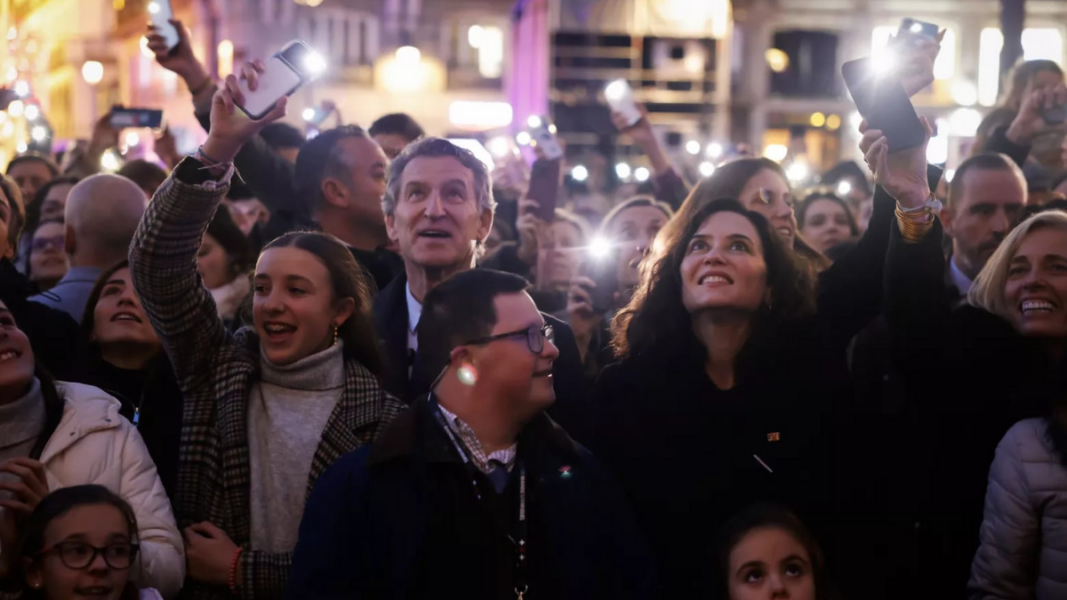
The Community of Madrid organized, on the Christmas afternoon-evening, a concert by the Catholic pop group Hakuna in Puerta del Sol, one of the most emblematic spaces in the capital, in an event framed within the official Christmas programming of the regional Government presided over by Isabel Díaz Ayuso. The event, of a massive nature, brought together thousands of people and had extensive institutional and media coverage, presenting itself as one of the central events of the Christmas celebrations in Madrid.
The presence of Hakuna at a Christmas concert from the balcony of Puerta del Sol, with Díaz Ayuso and Nuñez Feijóo as hosts in the front row, can be interpreted as a positive normalization of Christianity in the public space. However, a minimal analysis requires pointing out a fundamental contradiction that cannot be dismissed as a mere cultural anecdote.
An unequivocally pro-LGBT government
We are not dealing with a neutral or merely tolerant Executive. Ayuso’s Government has explicitly assumed the LGBT agenda as a hallmark of its political and cultural identity. The Community of Madrid has been repeatedly presented by its president as a reference for Pride, not only in terms of civil coexistence, but as an ideological model of «freedom and modernity.»
Ayuso has publicly defended Pride as one of Madrid’s great “values,” has celebrated its international impact, and has linked its promotion to the idea of social progress. Under her mandate, Madrid’s institutions have supported acts, campaigns, and speeches that unreservedly assume the gender anthropology, incompatible with the Christian view of the person, sexuality, and family.
This is not about avoiding persecution—something no Catholic defends—but about noting that the LGBT cultural framework has been fully internalized and promoted from regional political power.
Abortion as a guaranteed right
On abortion issues, Ayuso’s position is equally clear. Beyond rhetorical nuances, she has defended abortion as a freedom that must be guaranteed by public authorities, rejecting any measure that could limit its effective access in public healthcare and even showing support for its free access to minors.
Ayuso has maintained that abortion must be legal, accessible, and safe, opposing mechanisms that hinder its practice. Although she has occasionally stated that “it is not something desirable,” she has not framed it as an objective moral evil, but as a legitimate option within the catalog of individual rights.
From the Catholic doctrinal point of view, this position is not ambiguous: it is openly pro-abortion.
The photo with Hakuna: an objective contradiction
In this context, the image of Ayuso associated with a Catholic pop group like Hakuna is profoundly contradictory. Not because Christian music cannot be played in a public space, but because it generates a confusion between two incompatible worldviews.
A government that promotes the LGBT agenda and guarantees abortion as a right cannot present itself—without incurring incoherence—alongside a movement that publicly identifies as Catholic, especially in a Christmas and symbolic context.
The issue is not aesthetic, but moral and cultural:
Is a religious phenomenon being used to whitewash a political agenda alien—and even contrary—to Christianity?
Hakuna: musical success and doctrinal gaps
It is worth saying it clearly. Hakuna, as a musical phenomenon, works. Its emotional pop connects with thousands of young people, and its mobilizing capacity is undeniable. What happened in Sol demonstrates it again.
But as a spiritual and neo-charismatic phenomenon, it presents serious gaps that cannot be ignored.
The main one is a pronounced emotivism, where subjective experience takes center stage, displacing the objective dimension of faith. In its language, aesthetics, and way of presenting worship, a latent anthropocentrism frequently appears: it seems that God is at the service of man’s experience, and not man surrendered before the majesty of God.
It is worth remembering:
It is not God who worships us; it is we who worship God.
This imbalance is also expressed in the treatment of the Most Blessed Sacrament. The banalization of sacred space, aesthetic improvisation—Ikea tabernacles, expositions of the Most Blessed Sacrament in improper contexts like backstages, beaches, or parties—are not secondary details. In Catholic tradition, form expresses substance. And here the substance is weakened.
Not everything is a matter of taste. There are limits that directly affect the meaning of worship and the respect due to the real presence of Christ in the Eucharist.
The risk of confusion
When a Catholic movement—already theologically weak in some aspects—exposes itself without critical distance alongside a clearly pro-LGBT and pro-abortion political power, the risk is twofold.
On one hand, the politician obtains a friendly photo that softens their ideological profile before a believing audience. On the other, the faithful—especially the young—may internalize the false idea that there is no real contradiction between Catholic faith and dominant cultural agendas.
That confusion is not neutral. It is profoundly harmful.
Clarity over emotions
Music moves emotions, concerts mobilize, and Christmas lights create atmosphere. But Catholic faith is not built on emotions or photographs, but on truth.
And the truth is clear: a pro-LGBT and pro-abortion agenda is not compatible with the Christian worldview. Not even if religious music plays in the background. Not even if it is dressed in Christmas.