


By John M. Grondelski
A Catholic parish in a Boston suburb sparked controversy this Advent when its outdoor nativity scene replaced the figure of the Baby Jesus in the manger with a sign that read: “ICE was here.” The pastor maintains that the installation goes “beyond static traditional figures and elicits emotion and dialogue.”
A new front line is emerging in the “war on Christmas.” For years, the “war on Christmas” was mainly a confrontation with invasive secularism: the first encounter many Americans had with the “naked public square” was the town hall park from which the traditional nativity scene had been expelled, usually by court order. As wokeness spread, “Happy holidays” became the euphemism for the holiday that dared not speak its name.
But the “war on Christmas” seems to have taken on a new front line: Christians who want to appropriate Christian symbolism as agitprop for political causes. The cause célèbre of 2025 is the enforcement of immigration law.
Press reports confirm that the use of nativity scenes as partisan props is not limited to Massachusetts. In Illinois, a nativity scene apparently features a Baby Jesus with hands bound by zip ties, the detention technique used by ICE. Another shows Jesus with a gas mask, an allusion to tactics employed to disperse those who illegally obstruct federal activities.
As is typical of many current controversies, we are presented with the claim that there are two sides to the issue. Critics label these actions sacrilegious, for using religious symbols for ideological purposes. Their defenders speak of adapting the Gospel message to contemporary problems, forcing people to confront the application of Jesus’s teachings to the present day.
But there is a limit to this perspectivism. In Fiddler on the Roof, every time Tevye’s daughters challenge him with a new issue, he is shown mulling: “On the one hand…,” “on the other…,” “on the other other….” But there comes a moment when, as Chava marries outside the faith, he raises his arms in a powerful gesture and shouts: “No! There is no other side!”
The Boston suburb and other Catholic spheres in this noble country need a Tevye.
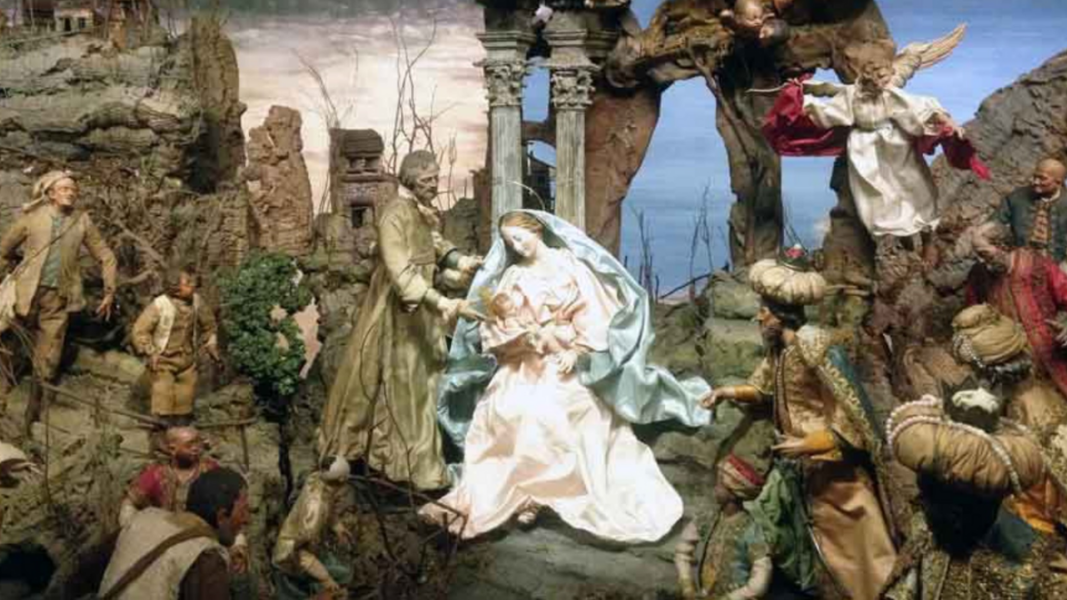
A nativity scene—especially a public one—has one single purpose: to give public and visible witness to the truth of Christ’s Incarnation: the Son of God made man. That is the purpose of every nativity scene. Anything that gets in the way of that message—whether by displacing it, diluting it, or distracting from it—does not belong there.
Certain strands of “political Catholics”—especially those prone to “accompanying” the Zeitgeist—seem afflicted with a peculiar form of ecclesiastical narcissism. They seem to forget that a not insignificant part of the world does not share their faith in God, much less in Christ, and even less in their political caricature of Christ.
In many Western societies, God, for a growing number of people, is as fictional as Santa Claus. Pope Leo warned against a “neo-Arianism” that emphasizes Jesus as a great humanistic and ethical teacher, or prophet—perhaps even as an icon of political causes—but remains silent when it comes to professing his divinity.
When that is the way of the world, Catholics who superimpose on the clarity of that religious message other messages—including messages they may consider “religious,” but which are arguably secondary—compromise the Gospel. Such gestures divide the Church.
Media coverage sometimes suggests this, noting how Catholics flock to the South Dedham nativity scene to “take sides” about it. No Catholic should have to “take sides” before a nativity scene. No Catholic who contemplates it should be forced to confess a political position alongside their profession of faith.
If that happens, something is gravely wrong. It is not about denying the Church’s social doctrine or the corporal works of mercy, but about defending the integrity of Catholic devotional symbolism.
The last two pontificates placed great value on “ecclesial unity,” which has mainly meant suppressing any manifestation of sympathy for the traditional Latin Mass. What about politicized nativity scenes that divide Catholics who should go to them to pray?
It is said that the Archdiocese of Boston has instructed the pastor to modify his nativity scene, but so far he has refused, appealing to “dialogue,” while the curia has done nothing yet.
Let me say that I dismiss his appeal to “dialogue.” And, from examples elsewhere, we know that bishops can make things happen when they want to.
There is an old Latin adage applicable to this case: extrema se tangunt, “opposites touch.” Secularists would banish nativity scenes from public visibility because they believe religion has no place in public political life. The “ecclesiastical front” of the war on Christmas, paradoxically, grants a similar primacy to politics by using religious symbols to push a partisan agenda in public.
What is missing in both cases is letting religion be religion in its purest sense, without any political alloy. A nativity scene is not an argument; it is a proclamation.
About the author
John Grondelski (Ph.D., Fordham) is a former associate dean of the School of Theology at Seton Hall University in South Orange, New Jersey. All opinions expressed here are exclusively his own.