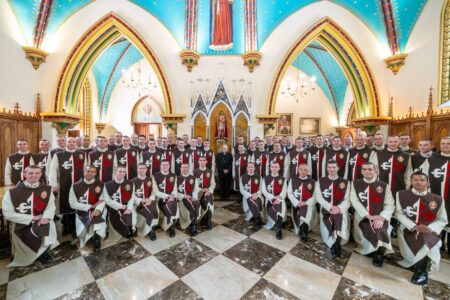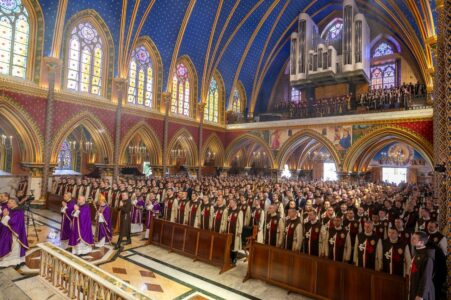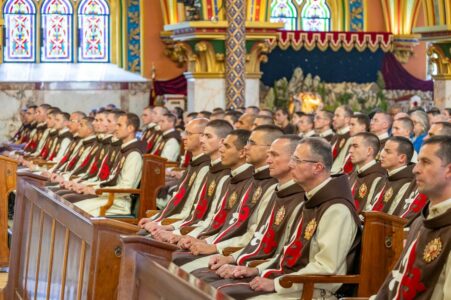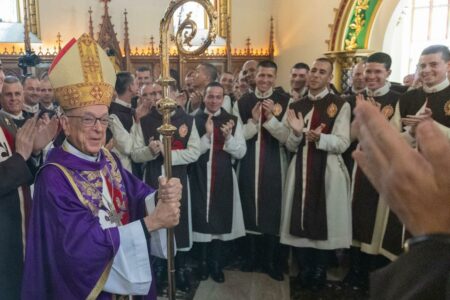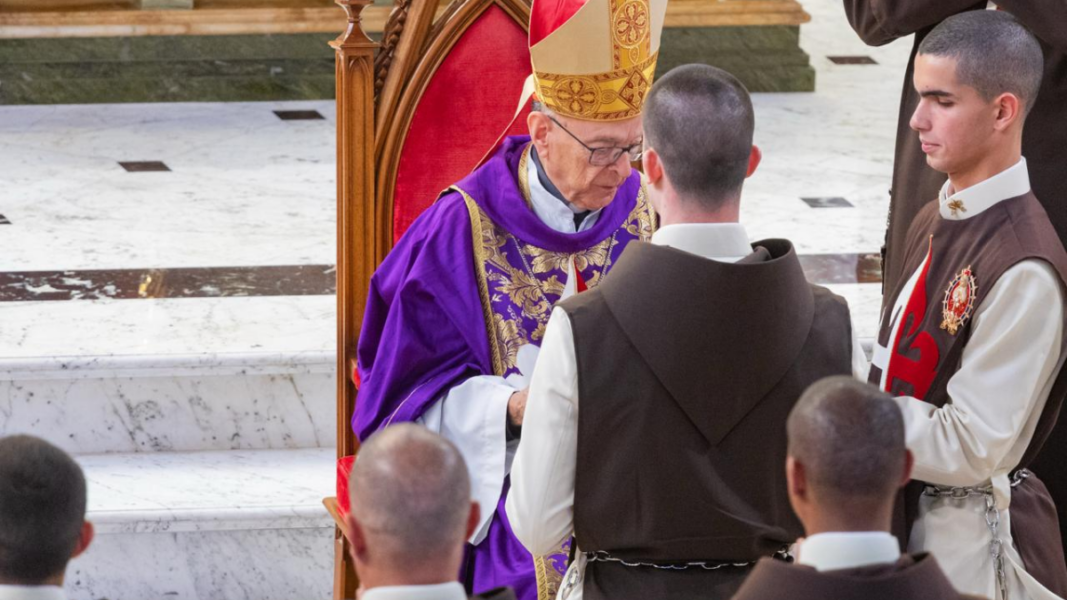
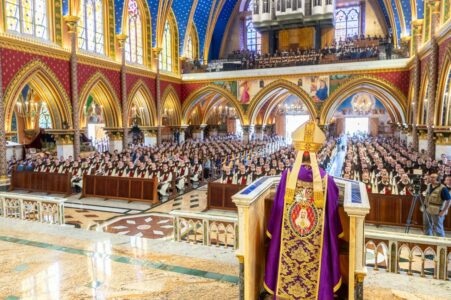
Last Saturday, a solemn Mass was celebrated in the Basilica of Our Lady of the Rosary, belonging to the Heralds of the Gospel, during which Cardinal Damasceno, Pontifical Commissioner of the institution, conferred the ministries of lectorate and acolyte on a total of 69 members.
The celebration holds special relevance not only due to the high number of instituted candidates—an unusual fact in the current context—but also because of the ecclesial moment in which it occurs, following several years marked by the commissariat and the paralysis of ordinary internal governance processes.
The ministries of lectorate and acolyte, which in the current discipline of the Church have replaced the ancient minor orders, constitute a canonically necessary step in the journey of those preparing for the priesthood. In this sense, the ceremony represents an objective advancement in the formation processes, especially significant in an institution whose ordinations have remained suspended for a long period.
During the homily, Cardinal Damasceno spoke words that did not go unnoticed:
“I have hope that in the near future we will be able to confer sacred orders on those who are duly prepared”.
These statements carry particular weight considering that the cardinal recently submitted his resignation from the position of Pontifical Commissioner. However, in light of the facts, said resignation has not been accepted by the Holy Father, at least for the moment, allowing the cardinal to continue in the effective exercise of his functions.
This fact is also framed within another relevant element: on December 4, a few days after the resignation was presented, Pope Leo XIV received Cardinal Damasceno in private audience, in a meeting that, according to various sources, had a longer duration than usual. Since then, no formal decision has been made public regarding the change in the commissariat.
The institution of ministries this weekend, carried out precisely by the one who continues to act as Commissioner, seems to indicate that the process is not only not halted, but is advancing visibly in some of its most sensitive aspects.
Interpretive Keys and a Reasonably Optimistic Scenario
In light of these facts, it is legitimate to propose a more serene and hopeful reading of the current situation.
First, the allusion to the “hope” of future ordinations, far from indicating a denial or a new blockage, can be understood as an expression of institutional prudence. Everything points to Pope Leo XIV opting to avoid abrupt decisions and favor a conclusion to the process that fully respects canonical and curial channels.
In this line, it cannot be ruled out that the Holy Father has asked Cardinal Damasceno to formally transmit to the Dicastery for Institutes of Consecrated Life and Societies of Apostolic Life the contents of what was discussed in the audience, in order to obtain the necessary support to definitively close the commissariat stage.
That closure would require, in accordance with common law and the institution’s own legal configuration, the convocation of the General Assembly of the Association of the Faithful and the holding of the chapters of the two societies of apostolic life, clerical and feminine. It is worth recalling that these bodies were blocked in 2024 by decisions of the then prefect of the Dicastery, Cardinal Braz de Aviz, a circumstance that led to an anomalous prolongation of the commissariat.
If this hypothesis were confirmed, the leading role would return to the Dicastery and its current prefect, Sr. Simona Brambilla, also reopening the ecclesiological debate on the exercise of regime power; an issue increasingly present in theological discussion and which could emerge in the extraordinary consistory convened by the Holy Father.
In any case, the essential fact remains: the ministries have been conferred, the candidates are advancing in their formation, and the Pontifical Commissioner is acting normally. All of this allows the recent events to be interpreted as concrete signs of a progressive normalization, after years of exceptionalism and institutional wear and tear.
If this trend is confirmed, the pontificate of Leo XIV could find here an emblematic occasion to mark a change of style, restoring stability and closing open wounds in an institution that many consider unjustly harmed. A horizon that, with foundation, explains the hope with which broad sectors of the Catholic world are already looking toward the year 2026.