


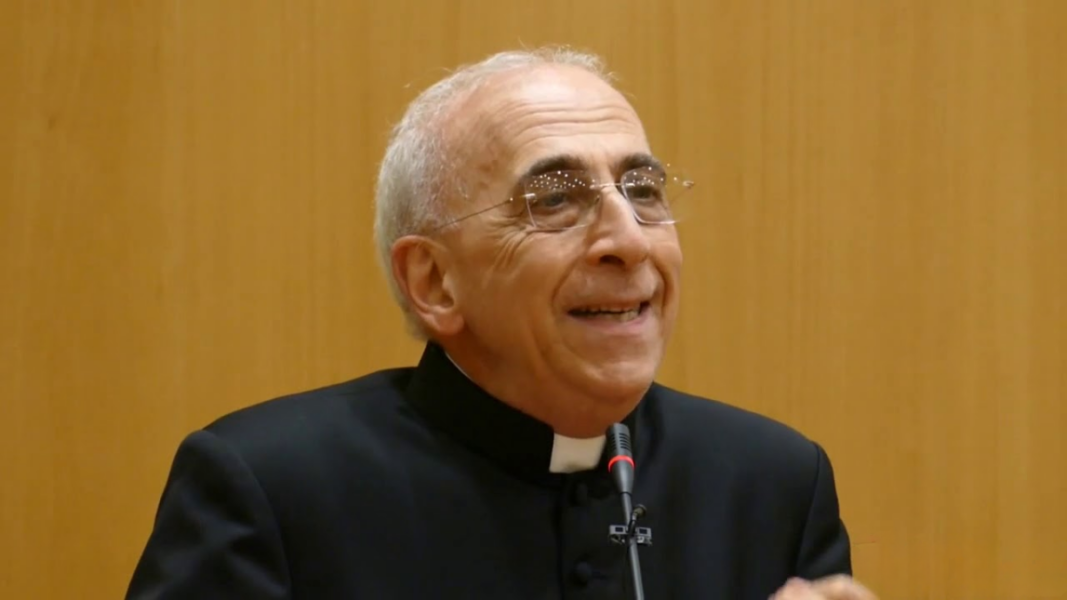
The crisis facing the Church cannot be reduced to a superficial clash between supposed “conservatives” and “progressives.” The underlying conflict is deeper and more decisive: a confrontation between Reality and Utopia, between Christian realism and ideology. This is what theologian Msgr. Nicola Bux and essayist Vito Palmiotti argue in a recent dialogue organized by La Nuova Bussola Quotidiana, dedicated precisely to this central axis of contemporary ecclesial debate.
The conversation, led by Stefano Chiappalone as part of the Venerdì della Bussola, revolved around the book Realtà e Utopia nella Chiesa, published by the same Italian outlet and which also includes a previously unpublished epistolary exchange between Msgr. Nicola Bux and Emeritus Pope Benedict XVI.
Beyond political labels
According to the authors, the use of categories borrowed from political language has contributed to hiding the real problem. It is not a dispute of sensitivities, but a progressive disconnection from Christian reality, which has a proper name: Jesus Christ.
Bux expresses it clearly: ideology has displaced reality to the point that Christ has become the great absentee from Christianity. People speak of peace, justice, fraternity, or welcome, but avoid naming their source. “Reality belongs to Christ,” the theologian reminds us, quoting the Letter to the Colossians, and yet that elementary fact has been relegated by increasingly abstract and humanitarian ecclesial discourse.
For decades— he warns— emphasis has been placed on “values” detached from their supernatural root, trusting that they would suffice on their own. The result has been the opposite: values without Christ turn into utopias, incapable of taking root in the real life of the faithful.
Humanitarianism as a substitute for faith
Bux emphasizes that John Paul II and Benedict XVI already perceived this shift. Cardinal Giacomo Biffi warned early of the risk of a Church reduced to a humanitarian agency, more concerned with being acceptable to the world than with announcing salvation. Christ— Bux recalls— did not come to solve the socio-political problems of his time, but to reveal God and open the path of redemption. The transformation of the world is a consequence, not the starting point.
John Paul II’s experience under communism reinforces this thesis: the great values proclaimed by ideological regimes do not liberate man if they do not spring from faith. The authentic solidarity that gave rise to Solidarność arose from the Eucharist, not from slogans.
Utopia, reinterpretation, and dissolution
Palmiotti addresses the other side of the problem: the ecclesial utopia that, under the guise of pastoral care, ends up emptying the content of the faith. He points to a line of continuity between certain formulations of Msgr. Tonino Bello and the language of Francis’s pontificate, where Christ often appears as a pretext for discourses alien to the Christian core.
Concepts such as religious pluralism, the “conviviality of differences,” or criticism of evangelizing mission have been accompanied— according to Palmiotti— by a devaluation of the liturgy, even presented as “tired.” But if the liturgy is an act of love, how can it be considered obsolete?
The result of this process is a Church that no longer liberates the world, but allows itself to be judged by it, to the point of renouncing its own mission. When the divine is eliminated, a more human Christianity does not emerge, but a succession of new moralisms and artificial guilts.
The return of reality
Both authors agree that reality ends up imposing itself. Bux interprets the beginning of Leo XIV‘s pontificate as part of a awakening of Christian identity, visible also in the West, especially among young people. Figures on religious practice show a weakened Church, but also a hunger for truth seeking authentic answers.
The growing interest in divine worship, including traditional liturgy, confirms— according to Bux— that man is tired of discourses centered on himself. As Soviet dissidents used to say: “We are fed up with them talking to us about man; we want them to talk to us about God.” Utopias promise paradises on earth; Christian faith offers the truth that saves.
Palmiotti, for his part, calls for prudence. The Church is not reformed by rupture or artificial accelerations. Thinking of an immediate change would be, once again, falling into utopia. The path is long and requires patience, fidelity, and a reform of the liturgical reform that restores centrality to God.
The Christian prophecy
Recalling Benedict XVI, Bux concludes with a decisive clarification: Christian prophecy does not consist in foreseeing the future, but in speaking to men “face to face” in the name of Christ. There is no need to reinvent the Church or discover unprecedented novelties, but to return to the reality that should never have been lost.
Because when the Church abandons reality to pursue utopias, it dissolves. When it returns to Christ, it recognizes itself.