


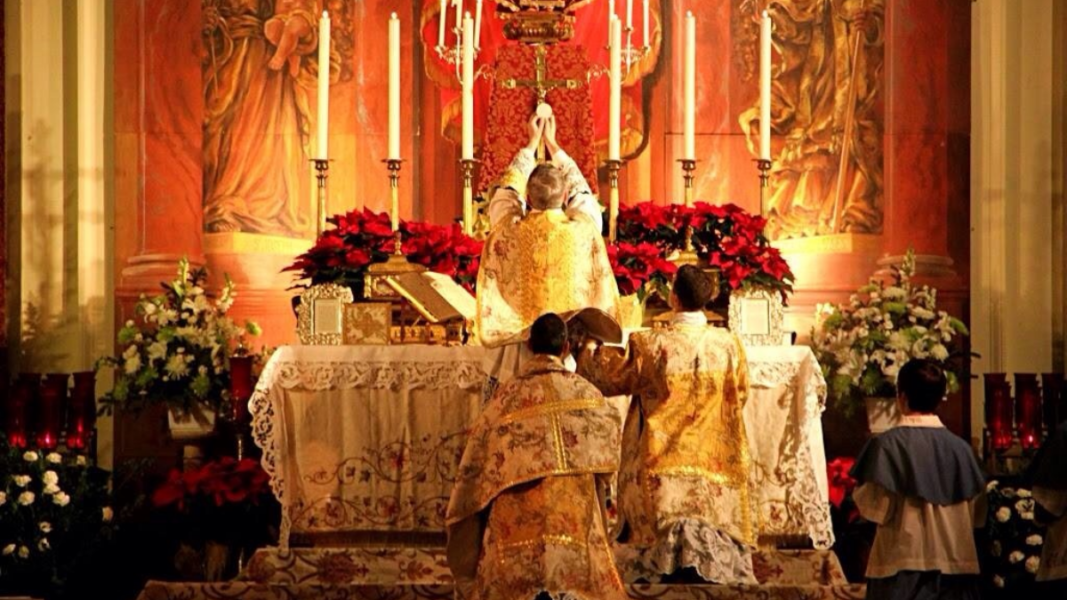
That the Spanish mainstream television channel La Sexta —through its program La Sexta Columna— has dedicated part of its program to explaining the rise of the Traditional Mass is not a minor detail. It is, rather, a sign that a phenomenon that until recently was considered marginal is starting to be visible enough to enter the radar of mainstream media, and moreover with a greater objectivity than might have been expected.
A relevant fact from the report is not only the approach, but the explicit acknowledgment of the phenomenon from within the Church hierarchy itself. The president of the Spanish Episcopal Conference, Luis Argüello, made this statement in the program itself: «the youth movements that are growing the most are, precisely, those linked to traditional liturgy.» This is not an external impression or a biased reading; all instances are aware of the phenomenon.
Alongside Argüello, the program gathered opinions from «experts» more or less oriented like Cristina López Schlichting and Jesús Bastante. But the fact deserves to be emphasized for a simple reason: no one denies the existence of the phenomenon anymore. With nuances and different approaches, the starting point was beyond discussion: there is real growth, especially among young people, and there is social and ecclesial interest that can no longer be dismissed with clichés.
The program highlighted some of the keys that explain why this liturgy attracts. It speaks of a greater presence of men in these celebrations, the search for a clearer differentiation between the sacred and the profane, and the appeal of a bimillennial ritual that connects with the historical continuity of the Church. For many young people —and especially for young families— the value lies there: not in a «tailored» experience, but in something received, stable, objective, that does not depend on the celebrant’s taste or the cultural climate of the moment.
In Spain, the phenomenon has not yet exploded on a massive scale. There is, yes, a growing reality, but concentrated: milestones like the peregrimage to Covadonga, and specific chapels or parishes with notable liturgical and community life. Even so, everything indicates that the trend is far from exhausted. To a large extent, it is still just beginning.
Beyond our borders, the pattern is already known. In France, in United States and in other countries, the spread of traditional liturgy has been accompanied by a pastoral fact that is hard to ignore: seminaries filling up again where this liturgical form has found space and normality. It is not the only factor, but it is a recurring indicator: where liturgy is lived with depth, there is more vocational availability; where the mystery is diluted, the call becomes rarer and more fragile.
That mainstream media are starting to sense it is, in some way, an «irremediable» sign that this is coming with force. The ecclesial agenda also reflects it: the consistory of cardinals on January 7 and 8 will address this topic. And in the meantime, in the cultural sphere —which today largely passes through the digital— content associated with the Traditional Mass accumulates millions and millions of impacts on social networks, with a particularly intense presence among younger generations.
At bottom, this liturgical return expresses something deeper: a generational correction. Many young people perceive that they inherited a way of celebrating that, often, became soft, excessively horizontal, superficial in symbols, and poor in sacred language. When liturgy turns into an informal conversation or an act indistinguishable from any social gathering, it stops offering what it promises: transcendence, mystery, orientation of life toward God.
That has had consequences. Not only in aesthetics or subjective experience, but in the capacity to generate vocations and to propose a robust Christian identity. A liturgy that continually lowers the bar tends to produce weakened communities, with less missionary impulse and less appeal to broad profiles. The perception of many young people is that this dynamic has contributed to emptying seminaries and impoverishing ecclesial life.
The Traditional Mass appears to them as the opposite: silence, trascendence, objective beauty, discipline and a symbolic language that does not ask permission from the era. It does not offer a «personalized» experience; it offers a framework that educates, demands, and sustains. And precisely for that reason, in a time of dispersion and cultural fatigue, it turns out to be strangely liberating.
For all these reasons, the return of traditional liturgy does not seem like a passing fad or a minority whim. It is a symptom of a cycle change. And the question that opens up for the Church in Spain is no longer whether this phenomenon exists —because even in La Sexta it has been narrated clearly and with Argüello‘s own statement within the program—, but how it will know how to channel it: with pastoral intelligence, without caricatures and without fear of recognizing that, for a growing part of Catholic youth, tradition is not a refuge, but a promise of the future.