


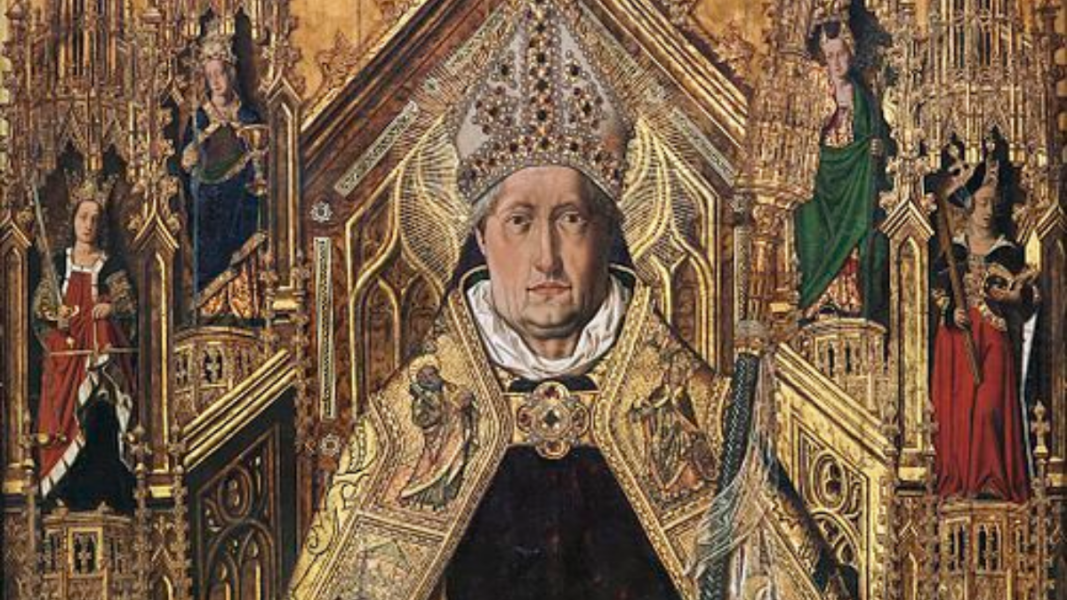
Santo Domingo de Silos (c. 1000–1073) is one of the great figures of Spanish medieval monasticism, and whose feast we celebrate today, December 20. His life clearly summarizes the decisive role that monasteries played in the spiritual, cultural, and social reconstruction of Castile in the 11th century, in a context marked by political instability and the constant threat of Islam.
Born in Cañas, in present-day La Rioja, Domingo Manso began his life as a shepherd. After training and being ordained a priest, he entered the Benedictine monastery of San Millán de la Cogolla, where he stood out for his austere life and his capacity for government. Appointed prior, he firmly defended the monastery’s assets against the confiscatory claims of King García Sánchez III of Navarre. This fidelity to the Church cost him exile, but it opened a decisive stage in his life.
Refugee in Castile, he was welcomed by King Fernando I, who in 1041 entrusted him with the restoration of the monastery of San Sebastián de Silos, then in a state of ruin after Muslim incursions. Domingo assumed the position of abbot and undertook a profound reform: he rebuilt the monastery, reestablished the strict observance of the Rule of Saint Benedict, and turned Silos into a reference spiritual center. Under his government, the monastery integrated into the Cluniac reform movement and received important royal and noble donations, consolidating itself as a religious and cultural focus in medieval Castile.
The influence of Santo Domingo de Silos went beyond his abbey. Respected by kings and bishops, he acted as a spiritual advisor and contributed to the renewal of Spanish monasticism in a key era. The monastery of Silos became a center of liturgical, artistic, and cultural irradiation, with an active scriptorium and an exemplary choral life, laying the foundations for its later Romanesque splendor.
Santo Domingo died on December 20, 1073. Three years later he was canonized, and his tomb became a place of pilgrimage. Soon his fame as a thaumaturge spread, especially as an intercessor in the liberation of Christian captives. Tradition also attributes to him intercession in favor of sterile women, with the famous case of Doña Juana de Aza, mother of Saint Dominic de Guzmán, founder of the Order of Preachers.
The legacy of Santo Domingo de Silos remains alive in the monastery that bears his name. Its famous Romanesque cloister, its early contribution to the Castilian language, and especially its fidelity to the liturgy and Gregorian chant have made Silos a symbol of spiritual continuity. Even in recent times, the monastery has reminded the world that the Church’s liturgical tradition is not a relic of the past, but a living source of beauty and evangelization.