


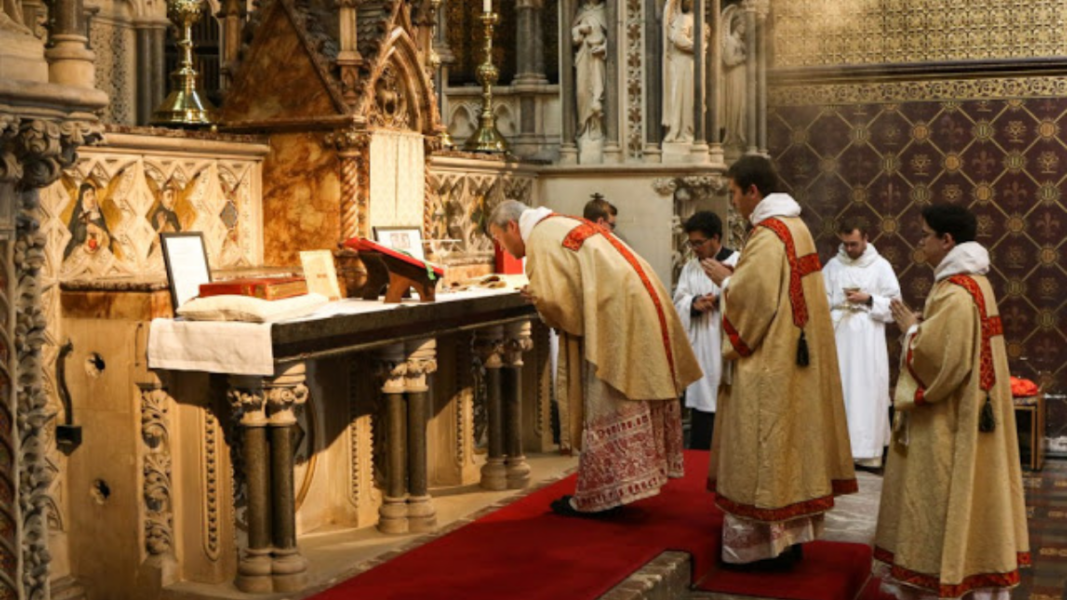
In several French dioceses, a generation of young Catholics is emerging who attend indifferently the traditional Latin Mass and the ordinary rite, without identifying with the historical divisions between both liturgical worlds. This is covered in a report published by La Croix, which analyzes the phenomenon based on testimonies and recent data.
In the parish of Saint-Georges, in the historic neighborhood of Lyon, while the Gregorian chants still echo, several young families gather in the square after Mass. Among them is Grégoire, 31 years old, who began frequenting the parish five years ago following his wife, linked to the traditional liturgy. With initial prejudices toward what he himself describes as “the traditionalist world”, today he claims to alternate without difficulty between both rites, highlighting the silence, contemplation, and spiritual strength of Latin.
Young, urban, and without labels
According to a Bayard-La Croix study conducted by Ifop, 9% of habitual practicing Catholics say that the Latin Mass is their favorite, while 25% declare appreciating it as much as the Mass in the vernacular. Overall, 67% of those who attend Mass every week express no objection to the Tridentine rite.
These data confirm, according to La Croix, the emergence of a generation of “bi-ritual” faithful, mostly under 35 years old and residents of large cities, where the liturgical offer allows choice. Far from seeing themselves as members of a “parallel Church” —an expression used by Pope Francis in 2021 to justify restrictions on the traditional liturgy—, many of them reject labels and emphasize the spiritual complementarity of both forms of the Roman rite.
Beauty, silence, and mystery
Robin, a 33-year-old Parisian converted a decade ago, explains that he attends both the Tridentine Mass at Saint-Eugène-Sainte-Cécile and the ordinary Mass at Saint-Roch, where both forms are celebrated. His criterion is clear: the beauty of the liturgy. “Beauty is part of the Church’s mission”, he states, emphasizing the importance of Latin, sacred music, kneeling adoration, and an atmosphere that facilitates prayer and the sense of the sacred.
Other testimonies point in the same direction. For many young people, the ancient rite offers a visual and symbolic catechesis —the gestures, colors, silence, liturgical orientation—, while the ordinary rite provides homilies more connected to daily life and a greater communal emphasis.
A search for transcendence
Florence, a 27-year-old engineer from a non-practicing family, discovered the traditional Mass through online encounters. She claims to have been inwardly marked by a form of the sacred centered on meditation and transcendence. At the same time, she values in the Paul VI Mass the communal participation and the exposition of the Most Blessed Sacrament. Like other young people quoted by La Croix, she insists on receiving Communion on the tongue and from the hands of the priest, a gesture she associates with a greater sense of reverence.
The report emphasizes that the appeal of the traditional liturgy is not limited to “identitarian” environments, as also demonstrated by the growing attendance at the Chartres pilgrimage, which gathers very diverse faithful. In this context, the coexistence of both rites appears for many young people not as a contradiction, but as a spiritual richness that nourishes their faith.