


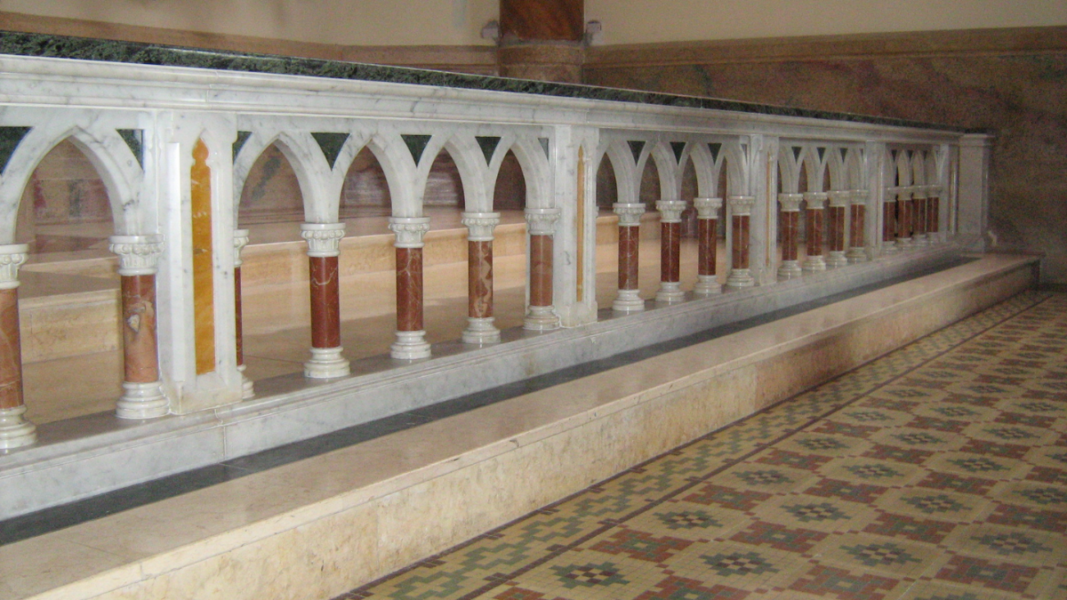
In the wake of the controversy over the ban on communion rails by the Bishop of Charlotte, in contrast to their recovery by the Bishop of Portland, an interesting reflection opens up. In many churches, the communion rail has disappeared quietly and almost without explanation, as if it were a dispensable relic from another time. However, a serene look—free of prejudices and nostalgias—shows that recovering its use has clear advantages, both from the liturgical, pastoral, and practical points of view. Far from being a mere decorative element, the communion rail responds to a logic deeply coherent with the nature of the act it welcomes: the reception of the Body of Christ. These are five practical arguments for recovering its use.
1. Order and fluidity in a central moment of the Mass
The communion rail introduces a simple and effective order: the faithful take their place at the foot of the altar, and it is the priest who moves continuously and without interruptions through the space of Communion. This scheme avoids unnecessary displacements, disorderly crossings, and dead times.
The result is a more agile, more serene distribution, and, paradoxically, briefer, which allows preserving the prayerful atmosphere proper to one of the most sacred moments of the Eucharistic celebration.
2. A sober solution that reduces the need for extraordinary ministers
When Communion is distributed with order and constant rhythm, a single priest (preferably assisted by an acolyte with the paten) can attend to a large number of faithful without difficulty. The communion rail makes this possible.
Thus, the recourse to extraordinary ministers ceases to become a habitual solution and recovers its truly exceptional character, in accordance with the spirit of the liturgy. It is not about excluding, but about placing each ministry in its proper place.
3. A space that helps interior recollection
The communion rail naturally invites the posture of kneeling, a bodily sign of adoration deeply rooted in the Christian tradition. This posture is not a formalism, but a silent pedagogy that disposes the heart.
With the disappearance of haste, noise, and concern for movements, the faithful can pause for an instant, adore, and receive Communion with greater attention and awareness. The body, once again, helps the soul to pray.
4. Greater care and custody of the Most Blessed Sacrament
Communion received at the communion rail, normally in the mouth and under the direct attention of the priest and the acolyte, significantly reduces the risk of drops, loss of particles, or improper handling.
In a time when these problems cannot be ignored, the communion rail does not respond to fear, but to prudence. It is a concrete and effective way to express, also in gestures, the respect due to the Most Blessed Sacrament.
5. A silent catechesis on the centrality of the Eucharist
Without words or explanations, the communion rail teaches. The kneeling faithful and the priest administering Communion make visible what the Church believes: that Christ is really and truly present in the Eucharist.
The arrangement of the space thus becomes living catechesis. Liturgical architecture, far from being neutral, helps to transmit the faith and to remind that Communion is not a routine gesture, but a sacred encounter.
It is not an aesthetic issue
The communion rail is not an aesthetic issue or an ideological banner. It is a liturgical tool that brings order, recollection, and clarity to one of the most delicate moments of the Mass.
Recovering it, wherever possible, does not mean looking to the past, but caring for the present of the liturgy and helping Communion to be lived again—also exteriorly—with the reverence it deserves.