


By Michele McAloon
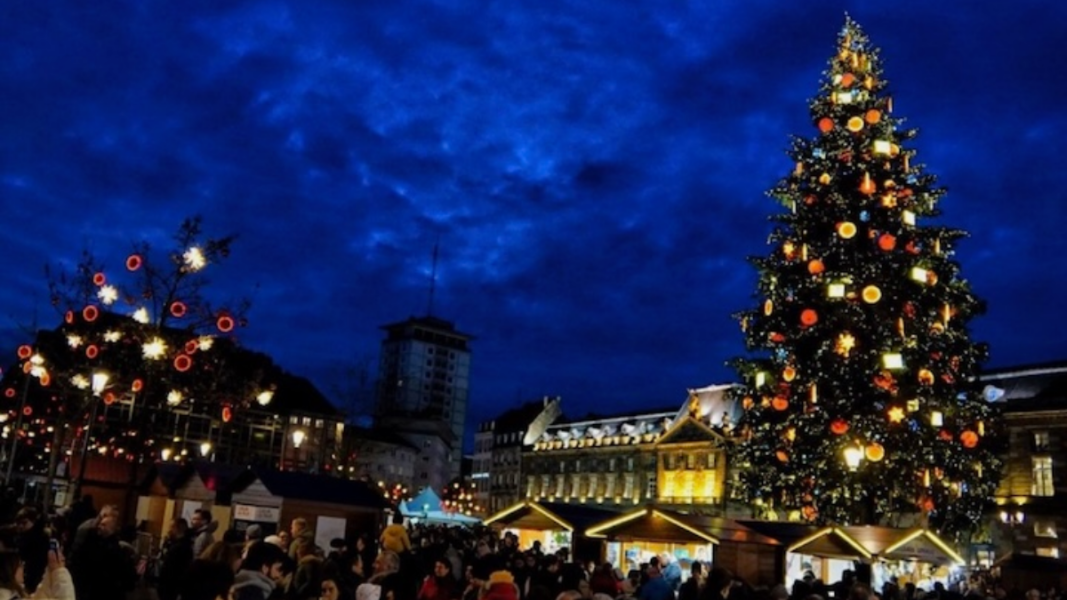
Advent in Germany is illuminated by its world-famous Christmas markets. The aroma of grilled sausage, the renowned German glühwein, and gingerbread (Lebkuchen) mingle under multicolored lights, creating a joyful experience in anticipation of Christ’s birth. Whether it’s a two-day gathering at a local monastery or the village fire station, or one of the huge metropolitan markets in Munich, Berlin, or Dresden, Christmas markets, today as centuries ago, are an integral part of Germany’s economic and social fabric, and a possible sign of hope. Although they are currently also threatened by dark shadows.
Tragically, in the last ten years, the festivities have been marred by violence. Terrorists have murdered attendees at markets in Magdeburg, Trier, Berlin, and several markets in France. German and French authorities have now been forced to take measures to prevent these threats almost everywhere.
Nowadays, pedestrian zones usually feature rigid barriers to prevent vehicles from ramming crowds. In many markets, access is strictly controlled through bag checks and body searches. Unusually for Germany, where police are rarely seen in everyday life, there is a strong police presence and surveillance cameras watching every corner of the markets.
Fortunately, terrorism has not intimidated people. This year, attendance at Christmas markets is expected to break records, finally returning to pre-pandemic levels.
Despite everything, more than 3,000 Christkindlmarkt or Weihnachtsmarkt are celebrated in Germany today, as they are called depending on the region. Generating billions of euros, these markets are vital for a struggling German economy. And this is nothing new. Although today they are associated with Christmas, the oldest Christmas markets began as secular, not religious, events. Medieval communities gathered in late autumn and early winter to sell goods and acquire necessary supplies before the arrival of the harsh winter months.
Market days used to coincide with Christian feast days. Local inhabitants walked to the city to attend worship and then stayed to shop at the market. Before the Protestant Reformation, December 6, the feast of St. Nicholas, was a traditional date for children to receive gifts. Parents bought toys at the market and left them in their children’s shoes overnight to honor the good bishop of Myra (a charming custom, but also a precursor to Western consumerism).
Dresden’s Christmas market is known as the Striezelmarkt and began in 1434, not as a Christmas market, but as a meat market where citizens could buy roasts for Christmas and thus break the Advent fast. Liturgical Christmas symbols were gradually adapted and integrated as these December markets grew in popularity.
The relationship between the Church and Christmas markets has always been somewhat ambivalent. Catholic and Protestant clergy understood both the spiritual and economic importance of these markets. They encouraged worship during the season but were also willing to charge rent for vendors’ stalls, which were often located in the church atrium or cemetery.
Today’s German bishops are notoriously reluctant to evangelize in public spaces. But at least some see the markets as an opportunity, as a place where symbols of the Christian faith can be openly welcomed. And, as some German bishops will privately tell a sympathetic American, the widespread sense of the failure of progressivism is an opening for faith, if the Church has the wisdom to seize it.
So perhaps it’s not so surprising that, in the center of almost every market in secular and progressive Germany, there is still a nativity scene and a Christmas tree, although in some places the reference to Christ is minimized. For example, a few years ago in Wiesbaden, a small city near Frankfurt, the city council decided to change the name of the Christmas market to the «Shooting Star» market to be more «inclusive.» Other places have made similar changes—and have been ridiculed in the media for these woke adaptations. But, whatever that means, there is usually still a nativity scene, and neighbors continue to call it Weihnachtsmarkt or Christmas market. And these nativity scenes are often quite elaborate, with real animals and actors or hand-carved statues by local artisans.
Since reunification, a new tradition has come to western Germany. Cities erect large Christmas pyramids, the Weihnachtspyramiden. These multi-level wooden structures, originating from the eastern mountains, are decorated with liturgical symbols, saints, and scenes from the Birth of Our Lord.
Traditions are hard to eradicate, especially Christmas traditions. Dirk Spenneman, a German cultural historian born in Mainz and raised in Frankfurt, grew up in a family that attended Christmas markets. In his opinion, the cultural importance of these markets cannot be underestimated in weaving bonds between families and communities; in creating and preserving a cultural heritage when much of it seems to be disappearing.
For him, as for generations of German children, being under the twinkling lights, hearing the joyful sounds of family, and smelling the delicious market foods left a powerful impression that Spenneman appreciates and hopes will be passed on to future generations.
Ironically, some of Europe’s most beautiful and ancient markets are not in Germany, but in Alsace, the eastern region of France that borders Germany. Even small towns usually have a Christkindelsmärik, which in the Alsatian dialect translates to the Christ Child Market.
French Catholics throw themselves into Advent celebrations with Gallic enthusiasm. Along with the greater emphasis on liturgical celebrations that has recently emerged in France, there are public Christmas displays in front of homes, with elaborate decorations.
In fact, the first parish record of the purchase of a Christmas tree dates back to 1521 in Sélestat, France, while in Germany it only appears in 1605 at the Strasbourg Cathedral (then a German city). Originally, these Christmas trees were suspended from a roof beam. The decorations consisted of red apples, as a reminder of temptation, and communion wafers, which symbolized Redemption. Today, the Strasbourg market’s Christmas tree, firmly planted on the ground, is considered the tallest in France.
Despite the many challenges facing faith in the modern world, holding a steaming cup of glühwein, standing under an ancient bell tower or cathedral spire, in the midst of a Christmas market, allows one to viscerally understand a depth of warmth and light that ultimately emanates from the Child Jesus. Many despair of Christianity in Germany, but the endurance of Christmas markets can be a sign of hope in the darkness of a winter night.
About the author
Michele McAloon lives in Europe. She is a canonist and host of the Crossword podcast. Her work can be found at Book Clues.