


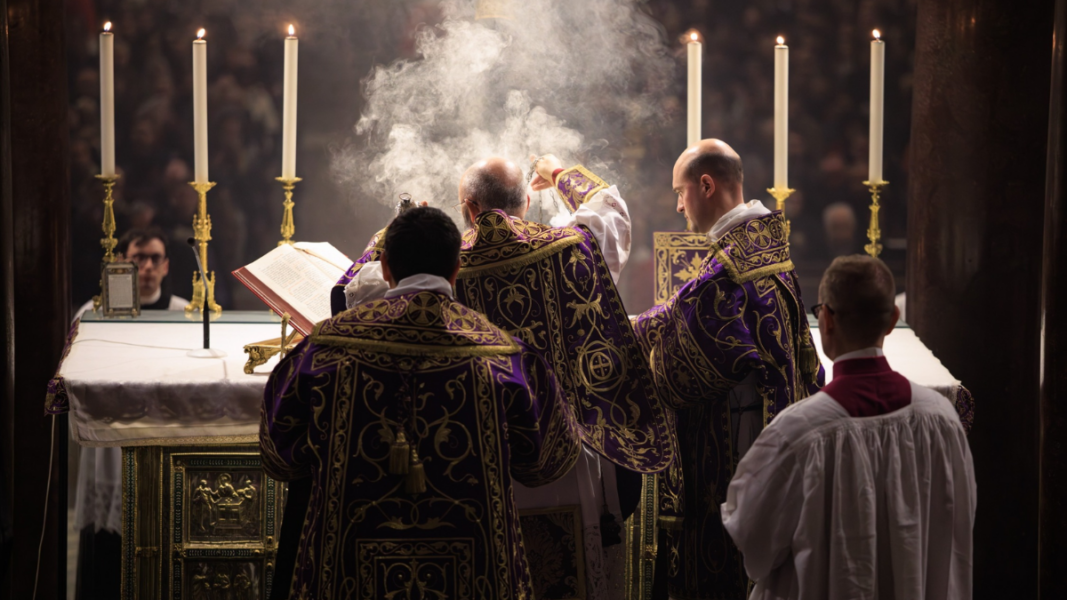
Last Sunday, a solemn Mass according to the traditional Ambrosian rite was celebrated in the Basilica of Saint Ambrose in Milan, one of the city’s oldest and most emblematic temples. According to the New Liturgical Movement, the celebration took place as a special occasion for the Jubilee Year and had the permission of the mitred abbot of the basilica, Monsignor Carlo Faccendini.
The Holy Mass was presided over by Monsignor Francesco Braschi, honorary canon of the basilica, and featured the collaboration of Nicola de’ Grandi as master of ceremonies, known for his sustained work over the years in favor of preserving the Ambrosian rite. Members of the Confraternity of the Most Holy Sacrament of Vanzaghello, a locality located about 40 kilometers from Milan, also attended the celebration.
The Ambrosian rite, proper to the Milanese archdiocese and distinct from the Roman one, preserves its own liturgical characteristics that date back to Christian antiquity. In this case, the celebration corresponded to the fifth Sunday of Ambrosian Advent—which begins two weeks before the Roman one—so purple-colored vestments were used, without there being an equivalent to the Sunday Gaudete.
A liturgy with distinctive features
During the celebration, various characteristic elements of the Ambrosian rite could be appreciated, such as the arrangement of the sacred ministers on both sides of the altar, the use of a lidless thurible—which swings in wide movements—or the placement of the Creed after the Offertory, and not after the Gospel, as in the Roman rite.
Traditional elements were also maintained, such as the apparels on the subdeacon’s alb, the final proclamation Benedicamus Domino instead of the Ite, missa est, and the celebrant’s gesture of extending his arms in the form of a cross during the Unde et memores, a medieval-origin practice historically linked to the Ambrosian liturgy.
The Basilica of Saint Ambrose, whose ciborium of the main altar dates from the 9th century, also houses a famous apse mosaic from the same period, reconstructed after the damage suffered during the Second World War. It depicts Christ enthroned alongside the archangels Michael and Gabriel and the martyrs Gervasius and Protasius, with figures of saints linked to Saint Ambrose in the lower part.
The solemn celebration highlighted the liturgical richness of a proper tradition that, far from being a marginal exception, is a living part of the patrimony of the Latin Church and continues to be celebrated with fidelity and dignity in its proper context.