


There are gestures that betray more than a hundred homilies or a thousand synodal documents. In the liturgy, gestures are not neutral: they confess.
Bishop Michael Martin, who arrived in Charlotte (USA) in 2024, was not appointed to rebuild a diocese in ruins. Quite the opposite. He received a local Church overflowing with vocations, full parishes, young faithful, large families, and a visible, public, and unapologetic Eucharistic piety. A functioning diocese. And it’s well known: in certain ecclesial environments, that is unforgivable.
Since his arrival, the roadmap has been clear: suffocate the Traditional Mass, harass fervent communities, and, as the latest episode, prohibit communion rails and kneeling for Communion. The problem, we are told, is not contemporary irreverence—that which runs rampant without restraint—but the “excessive” devotion of some faithful conveniently labeled as ultras.
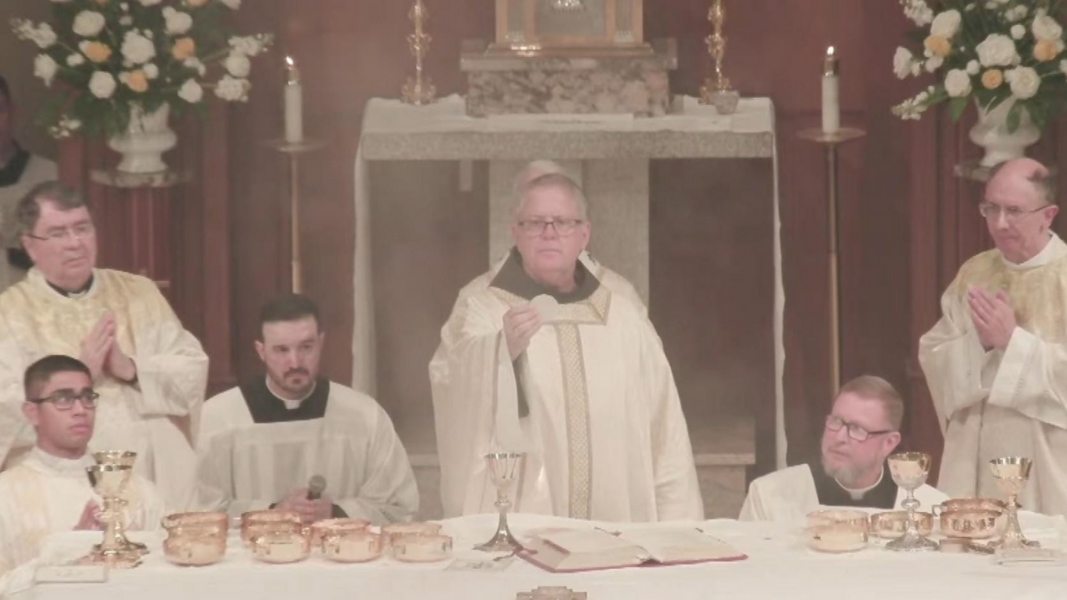
To understand what is happening in Charlotte and to find the origin of this obsession against kneeling for Communion, it seemed interesting to me to observe how Bishop Martin himself celebrates Holy Mass. See it for yourselves.
After pronouncing the words of consecration, he holds the consecrated Host with one hand and, without any reverence, raises it just a few centimeters, always keeping it below his chin. There is no true elevation, but a minimal and disdainful gesture. There is no visible adoration, but containment. There is no solemnity, but discomfort. It gives the impression that something bothers him, that something weighs on him, that something—literally—burns him.
The contrast is hard to ignore: almost pathological obsession with those who kneel, systematic persecution of tradition, manifest allergy to any form of reverence… and, at the same time, a bodily tense relationship with the Most Holy Sacrament. A lot of vigilance over the postures of the faithful and very little attention to one’s own interior posture.
The Church Fathers taught that the body prays what the soul believes. And when the body avoids, withdraws, or reduces the gesture to the indispensable minimum, it is legitimate to ask what is happening in the depths.
Perhaps it’s that when one does not believe… or when one believes, but what is held confronts one’s own contradictions too much, lifting up Christ becomes profoundly uncomfortable.
Because there are fires that illuminate.
And there are fires that burn.