


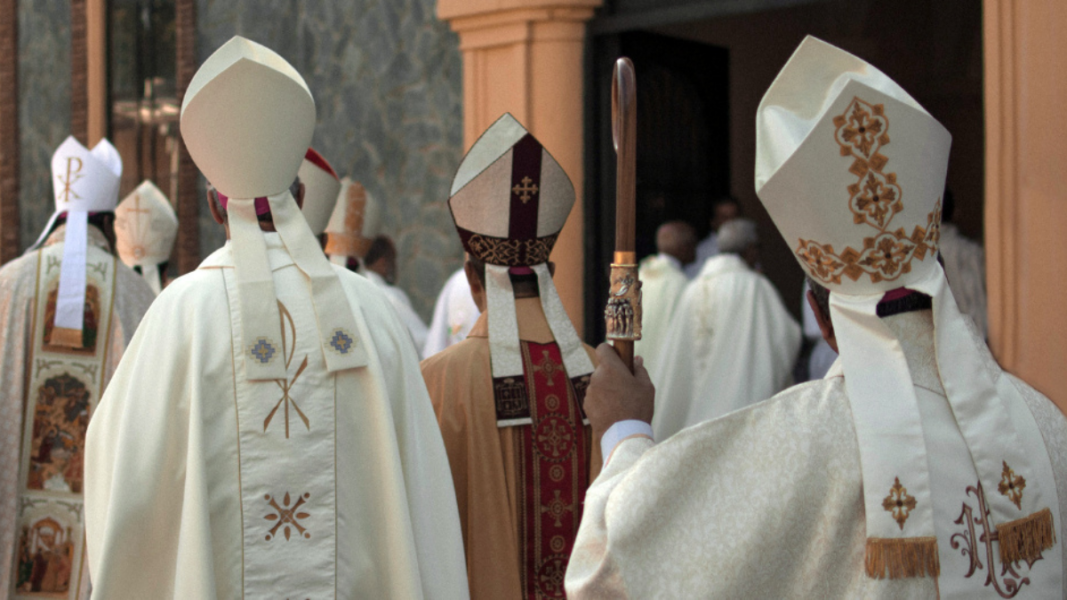
There’s a very effective way to waste talent: setting an expiration date by decree. And in the Church, we do it with a bureaucratic serenity that Social Security would envy. At 75 years old, the bishop submits his resignation. Not because he’s incapacitated. Not because he’s lost his faith, his mind, or his voice. Simply because he’s getting older. As if the Holy Spirit—sorry: the calendar—blew with special intensity on the candles of the 75th.
The idea, moreover, comes with a label of «modern» reform: it was consolidated in the time of Paul VI, when it was decided that pastoral matters should be handled with the same enthusiasm as retirements are managed at a window. It looks very reasonable on paper: «resign at 75.» What doesn’t look so reasonable is the obvious question: why 75? Why not 72, 78, or «when you can no longer bear the soul»? The real answer is usually a mix of pragmatism, control, and uniformity. And the consequence is equally real: shepherds are extinguished in their best stage of governance.
The Theology of the ID
The problem isn’t that resignation exists. The problem is the mental automatism that’s taken hold: at a certain age, the pastor suddenly becomes a «china vase.» From one day to the next, the bishop turns into that venerable gentleman for whom tributes are organized, a little book with photos is printed, and he’s put to rest… even though inside he still has clarity, experience, moral authority, and pastoral pulse.
And here it’s best to say it without anesthesia: many men reach their true intellectual and spiritual maturity between 60 and 80. At that age, they’ve seen it all, they’re no longer impressed by activism, they distinguish the important from the urgent, and if they’re saints, they’ve even learned to be silent when it suits. Just when they could finally govern without complexes (sorry), we send them into retirement so they can «enjoy.»
Enjoy what? Watching how their successor undoes half the episcopate in two years? Observing from the sidelines as the diocese turns into a laboratory?
The Rule That Only Falls on Some
And then there’s the most amusing part: it doesn’t apply to everyone.
It doesn’t bind the Pope.
It doesn’t bind the Superior General of the Jesuits.
It doesn’t bind the prelate of Opus Dei (with canonical and practical nuances: it doesn’t work like the regime of a diocesan bishop).
It does bind the bishop. Always. By default. By age.
In other words: the rule is presented as «prudence,» but it functions as a selective filter where some positions can continue while others are replaced with Swiss clock discipline. If age were intrinsically incapacitating, it would be for everyone. But since it’s not, what we have is something else: an administrative mechanism to manage handovers.
And of course: if it’s handover management, then what’s rewarded isn’t necessarily holiness or spiritual paternity, but the ability to fit into the system.
«Spiritual Fathers» Turned into «Stepfathers»
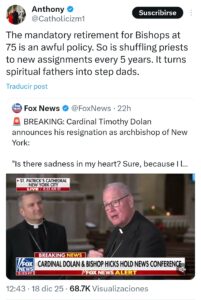
In the screenshot that’s circulating (and that’s worth more than many synodal reports), someone summed up with a brutal phrase what’s also happening with priests: moving them every X years—the mentality of «permanent rotation»—ends up turning shepherds into stepfathers. There’s no rooting, no long paternity, no shared memory. There are «assignments.»
Something similar happens with bishops: the diocese stops being a family and becomes an org chart. You change the father at 75, you change the priests every few years, and then we wonder why there are communities without identity, without continuity, without living tradition. Well, because they’re governed as if they were franchises.
What Would Be Sensible?
What would be sensible is what the Church has always known how to do when it doesn’t let itself be hypnotized by modernity: discern persons, not ages.
Keep resignation at 75 as a possibility, not as an automatic rite.
Evaluate for real: health, capacity, fruits, diocesan stability, need for continuity.
Avoid replacement by «turn,» as if the episcopate were an administrative career.
Because otherwise, the implicit message is devastating: experience gets in the way, paternity is a nuisance, and authority is tolerated only while it’s young and manageable.
And in the end, what’s left is a Church that boasts of tradition… but organizes its handovers with a spirit surprisingly close to that of any institution that distrusts man and prefers to trust in the rule.
At 75, thanks for your services rendered. Now, please make room. Talent—and the cross—will be managed by someone else. Even if they don’t know how. Even if they can’t. Even if they haven’t yet learned to be a father.