


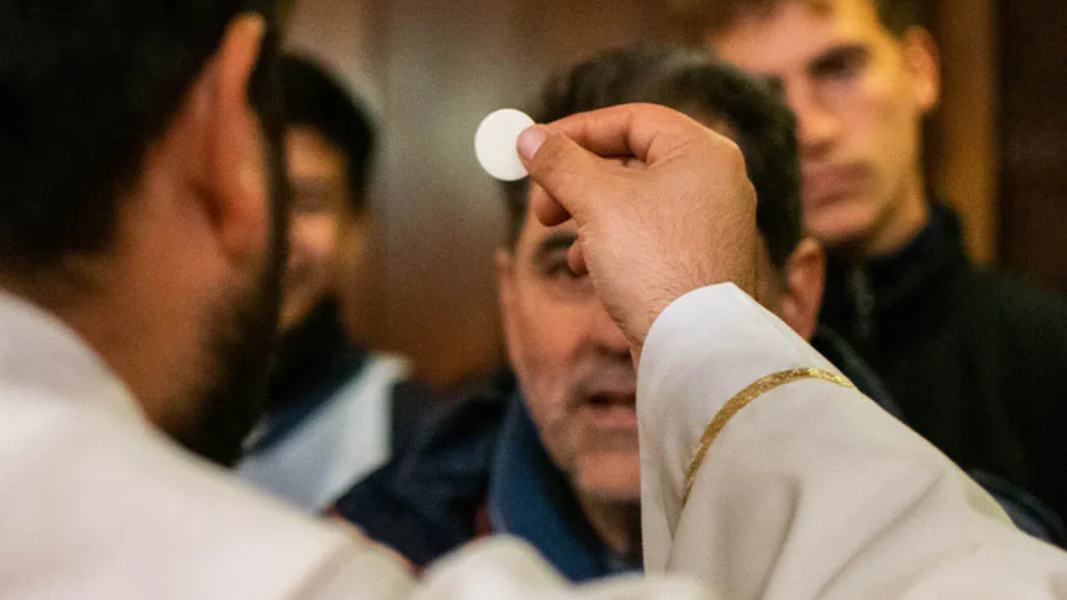
The Bishop of Charlotte (United States), Monsignor Michael Martin, has published a pastoral letter in which he establishes new norms on the reception of Holy Communion that include the imposition of the standing posture as the ordinary practice and the mandatory removal of kneelers and communion rails in all public celebrations of the diocese before January 16, 2026.
Although the document formally recognizes the right of the faithful to receive Communion kneeling—a right explicitly protected by the universal norms of the Church—in practice it disauthorizes any promotion of this posture by prohibiting priests or catechists from presenting it as a «better» or more reverent option.
The letter argues that the common standing posture favors «unity» and the processional dimension of Communion, and states that the use of kneelers or rails constitutes a visible contradiction of the liturgical norms established by the United States Conference of Catholic Bishops. Consequently, it orders the elimination of both fixed and movable elements intended to facilitate reception kneeling.
Liturgical unity or forced uniformity?
The measure has raised questions among the faithful and priests, as it is understood as an indirect restriction on traditional gestures of Eucharistic worship that the Church has never prohibited. In fact, documents such as Redemptionis Sacramentum remind us that no faithful person can be rebuked or discriminated against for kneeling when receiving the Body of Christ.
Genuflection—historically associated with worship, humility, and faith in the Real Presence—has been promoted for centuries as a visible expression of reverence, especially in contexts where Eucharistic awareness has been sought to be reinforced. The suppression of the material means that allow this posture raises the question of whether this is authentic liturgical freedom or uniformity imposed under the pretext of communal communion.
Removal of rails: a gesture loaded with meaning
The elimination of communion rails is not merely a practical matter. For many faithful, these elements represent a theology of the Sacrament centered on worship and on the distinction between the sanctuary and the nave, as well as a liturgical pedagogy that underscores the sacred nature of the act of receiving Communion.
By ordering their removal, the bishop argues that Communion should be experienced as a gesture of the «pilgrim people,» minimizing any gesture that could be interpreted as individual or «preferential.» However, critics of this view warn that liturgy is not reduced to a sign of collective march, but also demands a clear expression of faith before the mystery that is received.
A broader context of liturgical debate
The pastoral letter also includes a recommendation to recover Communion under both species and expands the use of extraordinary ministers of Holy Communion, measures that, along with the suppression of kneelers, are inscribed in a conception of liturgy marked by functionality and uniformity.
At a time when numerous faithful seek to recover traditional gestures as a sign of faith and reparation, the Bishop of Charlotte’s decision reignites the debate on whether the so-called «liturgical unity» is being used to discourage legitimate expressions of Eucharistic piety, supported by Church tradition and law.