


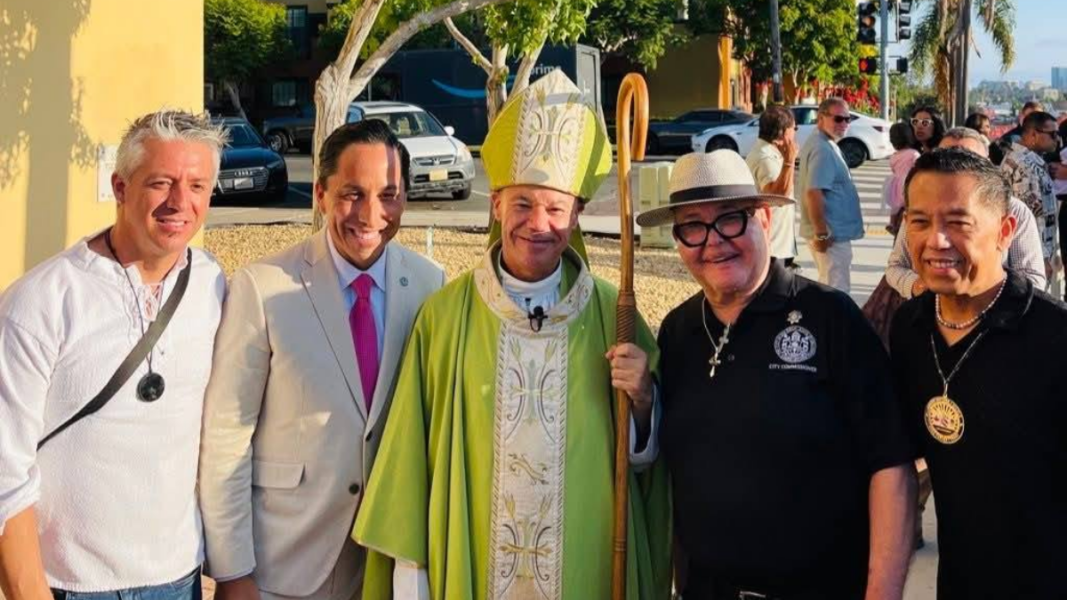
Pope Leo XIV has recently appointed Monsignor Ramón Bejarano as the new bishop of Monterey, in California, after having served as auxiliary bishop of San Diego.
Born on July 17, 1969, in Laredo, Texas, and with his ecclesiastical studies carried out at the Diocesan Seminary of Tijuana (Mexico) and at Mount Angel Seminary (Oregon), he was ordained a priest on August 15, 1998, for the diocese of Stockton. He served as parochial vicar in Saint George (Stockton) and Sacred Heart (Turlock), and later as pastor in Holy Family and Saint Stanislaus, both in Modesto. He was also a member of the Presbyteral Council and the College of Consultors.
On February 27, 2020, he was appointed titular bishop of Carpi and auxiliary of San Diego, receiving episcopal consecration on July 14 of that same year.
Blessing of a “drag queen” in a Pro-LGBT Mass
One of the most controversial aspects of his episcopate in San Diego has been his relationship with initiatives linked to LGBT pastoral care. In particular, his participation as the main celebrant in the so-called “All Are Welcome Mass”, organized by the LGBT ministry of St. John the Evangelist parish, generated a strong reaction in Catholic sectors concerned about doctrinal clarity.
The celebration on July 13, 2025, linked to the context of Pride LGBT, was especially controversial due to the intervention during the Mass of a well-known LGBT activist who publicly presents himself as a drag queen. The permissiveness of this gesture within the framework of an Eucharistic liturgy was interpreted by critics as a breach of the traditional boundaries between pastoral welcome and the legitimization of an ideological agenda contrary to Catholic morality.
In his homily and in public gestures associated with this type of celebrations, Bejarano has insisted on messages of welcome, affirming that God loves all people and recognizing the suffering of those who feel rejected by the Church. These words have been widely disseminated and praised by LGBT pastoral groups
Pastoral Profile
Monsignor Ramón Bejarano embodies the profile of a bishop formed at the crossroads between Hispanic reality, the migrant world, and contemporary cultural debates in the United States. His trajectory shows coherence in the option for social margins, but also reveals a form of pastoral exercise that has raised legitimate questions about the relationship between mercy, truth, and fidelity to the doctrinal tradition of the Church.