


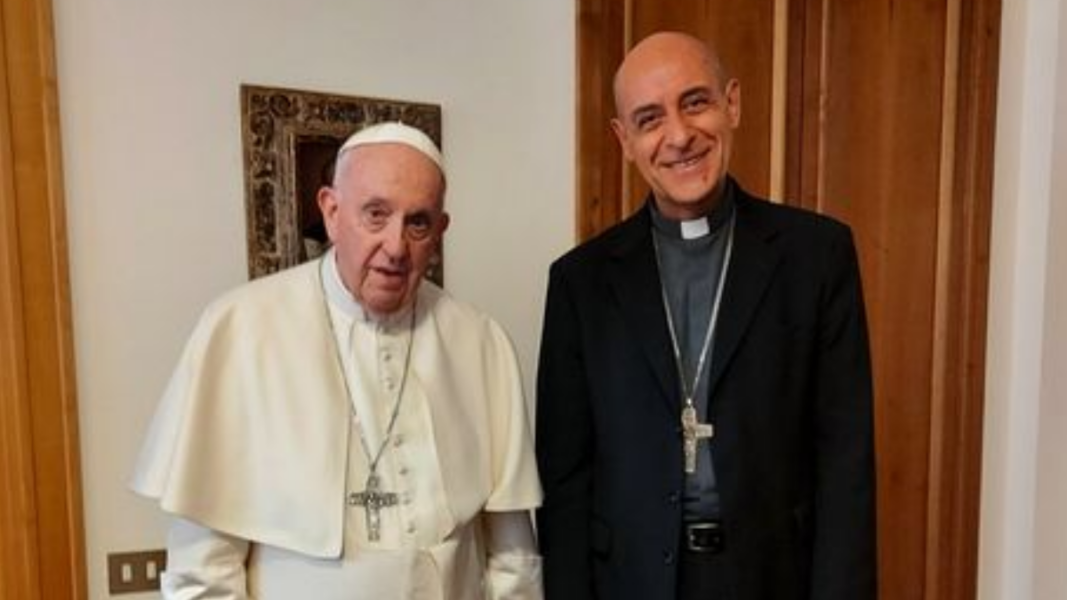
On December 18, 2023, the Dicastery for the Doctrine of the Faith (DDF), headed by Cardinal Fernández, published the declaration Fiducia supplicans, approved and signed by Francis. The initiative arose from internal consultations and reflections, including contributions from experts and discussions with the Holy Father, in response to formal and informal questions about the possibility of blessing couples in situations considered irregular, such as same-sex couples or divorced and remarried individuals
Two years have passed and far from appeasing pastoral tensions, the text has caused one of the greatest internal fractures in the Church in recent decades, with explicit rejection reactions from bishops and episcopal conferences around the world and persistent confusion among the faithful.
The document, officially presented as a “pastoral clarification” on the meaning of blessings, introduced the possibility of blessing—in a non-liturgical and non-ritualized way—couples in irregular situations and same-sex couples, provided that such blessings are not interpreted as a validation of the union nor resemble sacramental marriage. That distinction, central to the text, has been precisely the core of the conflict.
A text born amid ambiguities
Fiducia supplicans came after doctrinal and pastoral tensions that had already been brewing in the Synod on Synodality, especially from sectors of the European episcopate—with Germany at the forefront—that demanded an explicit change in the Church’s practice regarding homosexual couples. It was also preceded by the dubia presented by five cardinals in 2023, in which they directly asked if it was possible to bless this type of union.
The Dicastery opted for an ambiguous formula: to reiterate that the doctrine on marriage does not change, but to open the door to “pastoral” blessings for couples objectively in situations contrary to Catholic morality. The text states that the union is not blessed, but the persons; a distinction that, in practice, has proven impossible to sustain without generating scandal.
However, the document cannot be understood as an inevitable response to external pressures nor as a gesture forced by circumstances outside the Vatican. The responsibility for the document is clear; it was elaborated under the direction of Fernández and approved by Francis.
Immediate reactions: global rejection and progressive enthusiasm
The reaction was immediate. Just one day after publication, the bishops of Kazakhstan, led by Msgr. Tomash Peta and Msgr. Athanasius Schneider, denounced the document as “a great deception” contrary to divine Revelation. In Africa, the episcopal conferences of Nigeria, Malawi, Zambia, Cameroon, Uganda, and other countries explicitly prohibited their priests from imparting this type of blessing, emphasizing that they were incompatible with the Catholic faith and their cultural contexts.
In Eastern Europe, Poland and Hungary formally rejected the application of Fiducia supplicans. In Latin America, Cardinal Daniel Sturla, Archbishop of Montevideo, was blunt: in his archdiocese, same-sex couples and irregular unions will not be blessed.
In the face of this majority rejection outside the West, some European episcopates celebrated the document. In Austria, its episcopal president went so far as to say that priests should feel “obligated” to impart these blessings. In the United States, figures like Cardinal Blase Cupich hailed it as “a step forward,” although the Episcopal Conference insisted that the doctrine had not changed.
Clarifications from Rome… and more confusion
In the face of the magnitude of the controversy, the DDF published a statement in January 2024 insisting that Fiducia supplicans does not modify the Church’s teaching and recalling that the 2021 Responsum denying the possibility of blessing homosexual unions remains in force.
Francis and Tucho had to go all out in interviews and addresses to re-interpret their own declaration. Days later, the Pope explained in an interview that “no one is scandalized if I give a blessing to a businessman who exploits people – and that is a very serious sin –; but they are scandalized if I give it to a homosexual. That’s hypocrisy!”. He insisted: “I do not bless a ‘homosexual marriage’; I bless two people who love each other”. With this example, Francis defended the logic of Fiducia supplicans – blessing the sinner who seeks God, not the structure of sin – and called hypocrites those who oppose blessing homosexuals but tolerate blessings for other public sinners.
Far from resolving the problem, these clarifications reinforced the perception of ambiguity. If a papal document allows something that many bishops consider impossible to apply without betraying the doctrine, the inevitable consequence is fragmentation.
Cardinal Gerhard Müller, emeritus prefect of the Dicastery, was one of the most forceful critics. He denounced that Fiducia supplicans deepens doctrinal confusion and represents a concession to LGBT ideology, warning that the Church’s mission is not to “cheapen grace” nor to obscure Christ’s teaching with sophistic distinctions.
Two years later
Two years after its publication, the balance remains one of confusion, ambiguity, and fragmentation. In practice, Fiducia supplicans has not generated a universal practice, but rather a fragmented ecclesial map. It has become a text that claims to be pastoral, but ends up weakening doctrinal clarity, eroding ecclesial unity, and generating an alternative path that has gained more strength: the consolidation of a Synodal Conference in Germany, the LGBT pilgrimage in Rome, and a countless number of interpretations according to each priest’s «pastoral inspiration.»