


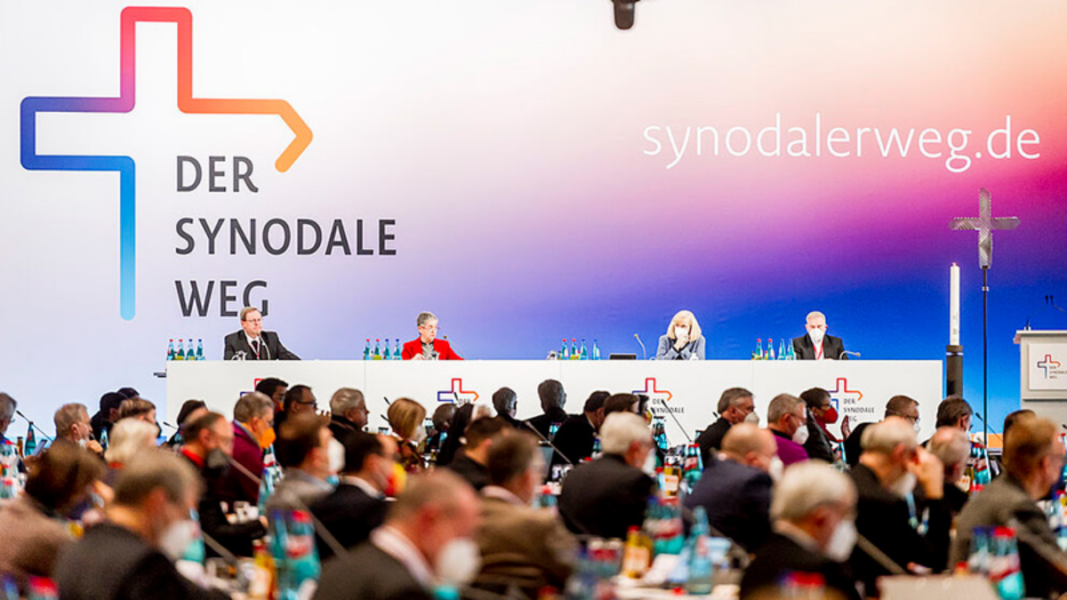
One of the most delicate issues that Pope Leo XIV will have on the table in 2026 will be the fate of the new national body for the Church in Germany, known as the “synodal conference”, conceived as the institutional heir to the controversial Synodal Way German.
Although its first meeting already has a date—November 6 and 7, 2026 in Stuttgart—and a second is scheduled for April 2027 in Würzburg, the body still does not exist legally and cannot be established without the express approval of Rome.
What is the synodal conference
The so-called synodal conference seeks to give permanent status to the Synodal Way, an initiative promoted jointly by the German Episcopal Conference and the Central Committee of German Catholics (ZdK), which between 2020 and 2023 held five assemblies with proposals of profound doctrinal and disciplinary impact.
From those meetings emerged resolutions that called for, among other things, the female diaconate, the revision of priestly celibacy, lay preaching at Mass, greater lay involvement in the appointment of bishops, and changes to the Catechism on homosexuality.
The most controversial proposal was the creation of a permanent body with the capacity for “decision-making” on pastoral and financial issues at the supradiocesan level, initially called the synodal council. Rome warned that such an organism would undermine episcopal authority and contradict the ecclesiology of the Second Vatican Council.
After several Vatican interventions and direct meetings with the Curia, the German bishops agreed to change the name of the body and commit to not creating it without the recognitio of the Holy See. In November 2025, the provisional synodal committee approved the statutes of the new organism—renamed the synodal conference—which were subsequently ratified by the ZdK.
The next step will be its vote in the plenary assembly of the German bishops, scheduled for February 2026. If unanimity is required, the statutes will not prosper; if a qualified majority suffices, their approval is practically guaranteed, despite the explicit opposition of four diocesan bishops.
What Leo XIV has said
During his first months of pontificate, Leo XIV has been prudent in his statements about Germany. In September 2025, he criticized ritual blessings of same-sex couples in northern Europe, in implicit reference to practices widespread in Germany. Subsequently, when asked directly about the synodal conference, he limited himself to responding: “We’ll see.”
His most extensive statements came on the return flight from his trip to Turkey and Lebanon. The Pope emphasized that synodality is not exclusive to Germany, but warned of significant differences between the German process and the path followed by the universal Church. He acknowledged legitimate inculturation, but alerted to the risk of rupture.
In addition, he pointed out that many German Catholics do not feel represented by the Synodal Way and called for more internal dialogue to prevent the most influential voices from silencing other numerous but marginalized sectors.
A project increasingly exclusive
An analysis by The Pillar focuses on a structural problem: the scant real representativeness of the process. In a country with nearly 20 million Catholics, the synodal assemblies had only 230 participants with voting rights. The provisional committee was reduced to 74 members, and the future synodal conference would consist of only 81 people, with a widely homogeneous ideological profile.
Critical voices gradually disappeared over the years, between resignations and episcopal boycotts, until reaching a provisional body that approved the statutes unanimously, making it clear that the synodal conference would be a markedly progressive organism, with little room for internal dissent.
What Rome can do
Leo XIV is unlikely to give automatic approval. His words suggest that he might demand adjustments, especially mechanisms that guarantee broader listening within the German Church. However, redoing the process from scratch—the only way for true representativeness—would imply breaking the control of the ZdK and provoking a major ecclesial crisis.
According to The Pillar, the most likely scenario is conditional approval, after introducing minor changes and with a slower processing than the project promoters expect. A compromise solution that avoids open conflict, but leaves many underlying tensions in the German Church intact.