


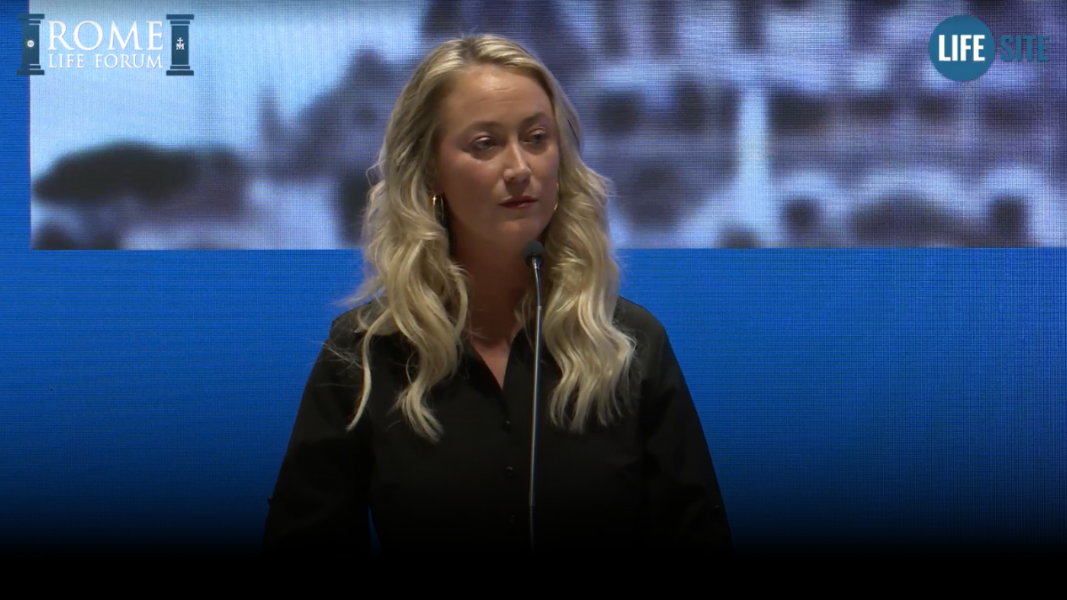
In the framework of the Rome Life Forum, organized by LifeSiteNews and held in Rome on December 4 and 5, 2025, the American Rachel Mastrogiacomo gave her public testimony in which she denounced having been a victim of satanic ritual abuses committed by a Catholic priest, as well as a subsequent cover-up by members of the ecclesiastical hierarchy.
Mastrogiacomo’s case has been disseminated in recent years as a warning against the abuse of power and cover-up by the ecclesial hierarchy; however, recalling what happened
Abuses Committed by a Priest Trained in Rome
Mastrogiacomo, who lived and studied in Rome in the late 2000s, recounted how she was a victim in 2010 of ritual, sexual, and psychological abuses by the priest Jacob Bertrand, then a recent graduate of the Pontifical North American College in Rome. According to her testimony, the events occurred in a context of spiritual manipulation, use of sacrilegious rites, and profanation of the Eucharist, elements that—she claimed—were subsequently recognized both in canonical proceedings and in civil court.
“At 23, I was naive, full of religious zeal. I went to daily Mass, loved the Church, and wanted to be a saint. That was the weak point he used against me,” she stated to the attendees.
She maintained that Bertrand not only sexually abused her, but did so in a ritual and sacrilegious context, using elements of the Catholic liturgy and subjecting her to a prolonged process of psychological and spiritual manipulation.
“I was satanic, ritual, and sexually abused during the central sacrifice of the Catholic Church: the Holy Mass. It was completely ritualistic and sectarian in nature,” she declared.
According to the testimony, the priest confessed the abuses to ecclesiastical authorities and later pleaded guilty in a civil court, although the victim maintains that the conviction did not reflect the true magnitude of the events.
Denunciation of Cover-Up and Episcopal Promotion
One of the central axes of her intervention was the denunciation of institutional cover-up. Mastrogiacomo directly accused Cardinal Robert McElroy, then bishop of San Diego, of having obstructed the civil and ecclesiastical investigation of her case.
“They refused to hand over key documents to the police. That cover-up was even documented by the Wall Street Journal,” she affirmed.
She decided to break the silence definitively when, despite these antecedents, McElroy was first promoted to the cardinalate and subsequently appointed to Washington.
“It wasn’t just a slap in the face to the victims. It was a spit in the face of Our Eucharistic Lord,” she said emphatically.
A Broader Problem Within the Church
In her intervention, Mastrogiacomo linked her personal experience to a broader phenomenon of ideological and moral infiltration in the Church, citing warnings from St. Pius X, Leo XIII, and testimonies from contemporary exorcists. She also recalled recent episodes that occurred in the Vatican which, in her opinion, would have favored an increase in diabolical activity, and affirmed that ritual abuse “is not an isolated incident,” but a practice that affects multiple victims in different countries.
“Ritual abuse exists within the Church. It is not a conspiracy theory. I know because I was a victim,” she affirmed.
As she explained, these cases share common elements: indoctrination processes, rituals committed during Mass, use of sacred vestments, and subsequent pressures to discredit or silence the victims.
Remaining in the Church and Defending It from Within
Despite the harshness of her denunciations, Mastrogiacomo concluded her testimony by reaffirming her fidelity to the Catholic Church and her decision not to abandon it.
“The Church is the Bride of Christ. Precisely because I love her, I will not stop fighting to defend her from those who corrupt her from within,” she affirmed.
She closed her intervention with an explicit reference to Fatima and to the hope in the final triumph of good:
“We are in the hour of the Church’s crucifixion. But in the end, the Immaculate Heart of Mary will triumph”
The Rome Life Forum, promoted by LifeSiteNews, brought together pro-life activists, journalists, and international speakers, and served as a platform for denunciations that bring to the table the debate on transparency, episcopal accountability, and the need for a deep moral purification within the Church.