


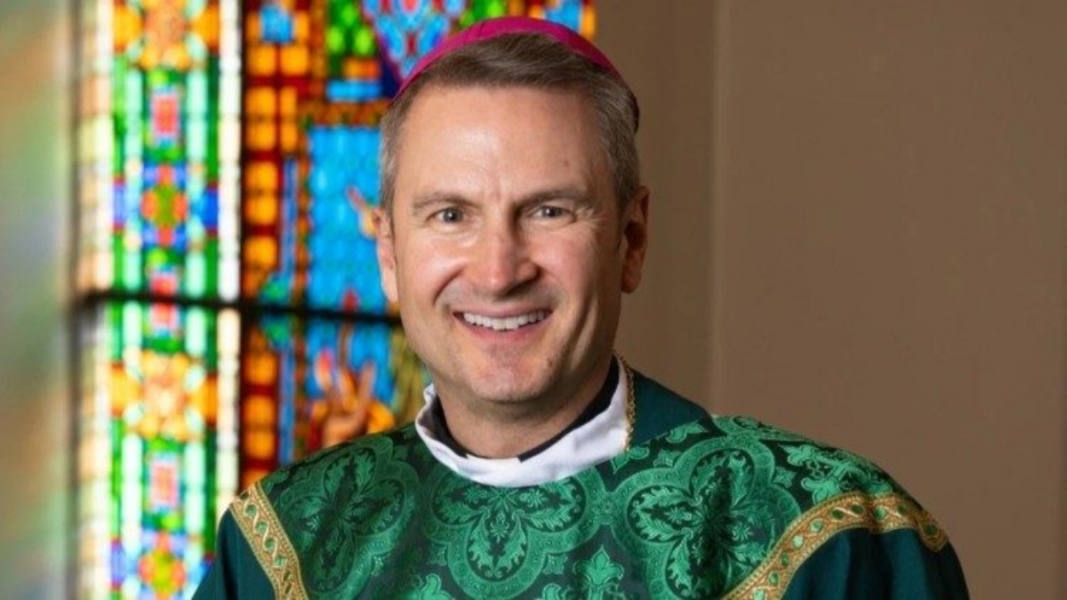
The recent appointment of Mons. Ronald A. Hicks to the Diocese of New York (United States), in addition to being a neuralgic point in the North American Church, came with an anticipated wave of assumptions about his new role. Today the Bollettino della Santa Sede has made the appointment official, thus confirming that Leo XIV signs, in one of the most important sees in the United States, the former vicar of Cardinal Cupich.
Biography and Career
Ronald Aldon Hicks was born on August 4, 1967, in Harvey, Illinois (United States). He grew up in an ecumenical family of faith – his father Catholic and his mother Lutheran – where he learned from childhood to respect different Christian traditions and to keep God at the center of family life. During his school years in South Holland (Illinois), he attended the St. Jude the Apostle parish school and entered the Quigley South minor seminary in Chicago, an environment that fostered prayer, good works, and integral formation. His mother recalls that Ron felt the call as early as seventh grade, after a summer vocational program, and decided on his own to continue in the seminary during high school.
After graduating in 1985, Hicks discerned that, if he was going to serve as a priest in Chicago, he needed to speak Spanish. He postponed his entry into the major seminary to serve as a volunteer in an orphanage in Mexico with the organization Nuestros Pequeños Hermanos (NPH) during 1989. That experience marked his life: “Working and being in solidarity with the poor… shows how we are all part of God’s family,” he later recounted. The priests in charge – including Father William Wasson, founder of NPH – inspired him with their dedicated love for orphaned children, reinforcing in Hicks the conviction that this was “a life worth living.” Back in Illinois, he obtained his bachelor’s degree in Philosophy from Loyola University Chicago in 1989 and then entered the major seminary at the University of St. Mary of the Lake (Mundelein Seminary), where he completed his Master of Divinity in 1994.
Hicks was ordained a priest on May 21, 1994 in the Chicago cathedral by Cardinal Joseph Bernardin. His first years of ministry were spent as a parochial vicar in Our Lady of Mercy (Chicago) (1994-1996) and then in St. Elizabeth Seton (Orland Hills) (1996-1999). In 1999 he was appointed dean of formation at Chicago’s St. Joseph College Seminary, a position he held until 2005. At the same time, he continued his academic formation and obtained the Doctor of Ministry in 2003, also at Mundelein.
True to his missionary spirit, in 2005 he requested and obtained permission from Cardinal Francis George to serve again with Nuestros Pequeños Hermanos, this time as regional director of NPH in Central America. He moved to El Salvador, where for five years he oversaw homes for thousands of orphaned children in nine Latin American countries. “NPH is an extraordinary mission… it is a joy to be part of this extended family that gives children from terrible situations a second chance and hope”, Hicks recounted about that stage in an interview conducted by Catholic Profiles. In 2010, upon concluding his missionary service, Hicks returned to Chicago. Cardinal George appointed him again as formator at Mundelein Seminary (2010-2014), where he also assisted by celebrating Mass on weekends at St. Jerome parish, in a neighborhood with a strong Hispanic presence.
His Encounter with Blase J. Cupich
The arrival of Cardinal Blase J. Cupich in Chicago marked a turning point in Hicks’s career. On January 1, 2015, Cupich appointed him Vicar General of the Archdiocese of Chicago, making him his closest collaborator in pastoral administration. In July 2018, Pope Francis appointed Hicks as Auxiliary Bishop of Chicago (titular of Munatiana), a position in which he was consecrated on September 17, 2018, in the Chicago cathedral. The ceremony was presided over by Cardinal Cupich himself, accompanied by Bishops Francis Kane and George Rassas as co-consecrators.. At 51 years old, Ron Hicks became a bishop. “I really want to develop a pastoral heart; I want to make sure I am not separated from the people, but with them”, he stated in those days prior to his episcopal ordination in the local newspaper Chicago Catholic. In fact, he continued serving simultaneously as Vicar General after becoming auxiliary bishop, and adopted the practice of celebrating the Eucharist every Sunday in a different parish, to remain close to God’s people throughout the archdiocese.
Francis took notice of him again in 2020. On July 17 of that year, the Pope appointed Ronald A. Hicks as Bishop of Joliet, a suburban diocese neighboring Chicago. Hicks would succeed Mons. R. Daniel Conlon – who had resigned early for health reasons – thus becoming the sixth bishop of Joliet. Cupich, in announcing the news, expressed: “We congratulate Bishop Hicks on his appointment… I will personally miss him, as he has served as my Vicario General these last six years with competence and distinction. The people of Joliet receive a firm, loving, and wise leader, and we look forward to continuing to collaborate with him in the years to come in the Catholic Conference of Illinois”. Hicks was installed as Bishop of Joliet on September 29, 2020 in the Cathedral of St. Raymond Nonnatus, in a reduced ceremony due to pandemic restrictions. The apostolic nuncio, Mons. Christophe Pierre, and Cardinal Cupich were present, as well as close family and friends, although most of the faithful followed the installation Mass virtually.
Trends and Influences within the Church
Hicks aligns with the pastoral and reformist sector of the Church in the United States, in tune with Pope Francis’s priorities. His career under the mentorship of Cardinal Cupich – one of the prominent prelates of the more progressive wing – and his direct experience in missions with the most needy, have shaped a profile of an open and close pastor, rather than a rigidly doctrinal figure.
From his first steps as auxiliary bishop, Hicks has cultivated close relationships with several members of the United States episcopate, especially Cupich. Cupich was not only his archbishop and direct superior in Chicago, but also a clear promoter of his rise. It was Cupich who trusted him with the delicate task of Vicar General and later presented him to Pope Francis as an ideal candidate for the episcopate. The admiration is mutual: Cupich publicly praised Hicks as a collaborator “of competence and distinction” and expressed sorrow at his departure to Joliet. At the installation Mass in Joliet, Cupich was present to accompany his former vicar, evidencing the friendship and pastoral harmony between them. Hicks has been described as “protégé” or disciple of Cupich, comparing them in pastoral style and vision of the Church. However, Hicks has also forged his own circle of relationships beyond Chicago.
Liturgical Stance and Traditionis Custodes
Regarding liturgical issues, Hicks positions himself in a line of fidelity to the Second Vatican Council and to the Pope’s orientations, with an inclusive attitude toward cultural diversity. He celebrates the liturgy in both English and Spanish, reflecting the bilingual composition of his diocese. He places great emphasis on the active and conscious participation of the faithful in the Mass.
Regarding the extraordinary form of the Roman Rite (Tridentine Mass), Hicks has shown a balanced attitude: he complied with the provisions of Pope Francis (Traditionis Custodes, 2021) but without abrupt gestures toward the faithful of this liturgy. In the Diocese of Joliet, there are stable communities of traditional Mass (such as the one served by the Priestly Fraternity of St. Peter, FSSP) and the bishop has not suppressed them, allowing them to continue their worship under the current guidelines. When in 2023-24 parishes had to be reorganized, one of them was personal for the traditional form; in response to the faithful’s concerns, Hicks guaranteed that said community would continue to be pastorally attended, although its parish would be administratively reconfigured. However, his own liturgical practice is framed within the post-conciliar ordinary form.