


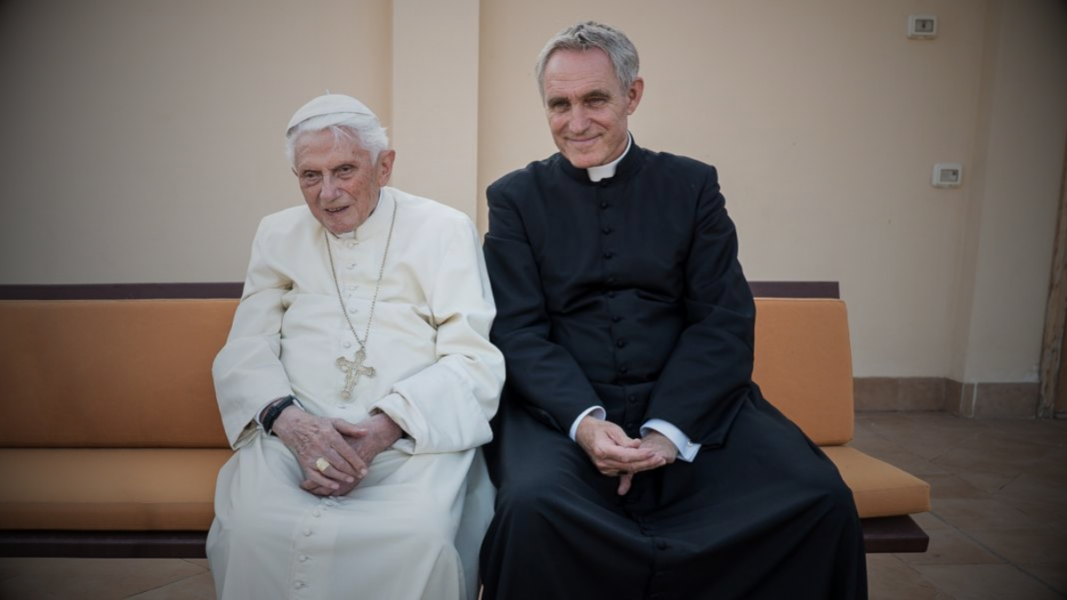
Georg Gänswein, former personal secretary to Benedicto XVI and current apostolic nuncio in the Baltic countries, has spoken openly about the treatment received after the death of the Pope emeritus, a period he describes as marked by marginalization and misunderstanding within the Vatican. In an extensive interview granted to Il Tempo, the German prelate also offers his assessment of the current pontificate of León XIV, in which he highlights the clear return of the centrality of Christ in preaching and the magisterium.
Gänswein recounts that, after the funeral rites of Benedicto XVI, the then Pope Francisco ordered him to return immediately to his diocese of origin, Freiburg, without assigning him any specific task, an unusual decision for the secretary of a deceased pontiff. He acknowledges that even people not close to him admitted that the treatment had been “excessively harsh”.
The turn with the nunciature
The situation changed a year later, in December 2023, when he returned to Rome to celebrate Mass on the first anniversary of Benedicto XVI’s death. Encouraged by the Memores Domini, he requested an audience with Pope Francisco, which was granted immediately. During that meeting, Gänswein frankly explained his personal and spiritual situation. Months later, he received the appointment as apostolic nuncio in Lithuania, Latvia, and Estonia, a completely new diplomatic mission for him.
The archbishop acknowledges that he was not trained at the Ecclesiastical Academy for diplomats, but emphasizes that his years in direct service to Benedicto XVI and as prefect of the Papal Household allowed him to closely understand international dynamics and assume this responsibility with a spirit of service.
Benedicto XVI, a prophetic pontiff
In the interview, Gänswein dwells with particular depth on the figure of Joseph Ratzinger, whom he presents as a man endowed with an uncommon intellectual and spiritual lucidity, capable of anticipating decades in advance the cultural and religious drifts of the West. Far from conjunctural interpretations, the archbishop emphasizes that the prophetic dimension of Benedicto XVI permeates his entire trajectory, from his early years as a university professor to his pontificate and his time as Pope emeritus.
Among the texts he mentions, he highlights the lecture delivered in 2004 titled La autodenigración de Occidente, in which Ratzinger warned that Europe had ceased to recognize itself, no longer able to value the true, the beautiful, and the sacred in its own tradition. A reflection that, according to Gänswein, is especially relevant today, in a context marked by accelerated de-Christianization and the loss of stable cultural references.
The nuncio also recalls even earlier writings, such as an article published in 1958 on what he called “the new pagans,” where Ratzinger precisely analyzed the process of internal secularization of the European continent. Texts that, read today, seem to describe the current situation with remarkable accuracy, confirming —in the judgment of his former secretary— the German Pope’s ability to read the signs of the times without concessions to the spirit of the world.
In this context, Gänswein reveals a previously unknown fact: during the years of Benedicto XVI as Pope emeritus, he and the Memores Domini discreetly recorded his Sunday homilies, delivered in the Mater Ecclesiae monastery. The goal was to preserve an oral magisterium that they considered of great spiritual and theological value. From that silent work emerged the subsequent unpublished volumes of sermons, including Dios es la verdadera realidad, a work that —according to Gänswein— especially clearly condenses the core of Joseph Ratzinger’s thought: the primacy of God and the centrality of truth against contemporary relativism.
Liturgy, music, and sanctity
The nuncio emphasizes the importance that Benedicto XVI placed on liturgy and sacred music, considered by him privileged expressions of the mystery of faith and the respect due to God. Not surprisingly, Gänswein reveals, the Pope emeritus wanted the first volume of his Opera Omnia to be dedicated precisely to liturgy, even before theology or ecclesiology.
Regarding a possible beatification cause, he confirms that he has begun to collect testimonies of alleged favors obtained through the intercession of Benedicto XVI, although he recalls that, according to canon law, at least five years must pass from the death before formally opening a process.
León XIV and the return of the centrality of Christ
Asked about his impressions of the current Pontiff, Gänswein states that from the first public appearance of León XIV he perceived a clear change compared to the previous twelve years. He highlights his serenity, his pastoral tone, and, above all, that in these first months of pontificate “the centrality of Christ has returned strongly to the forefront of the homilies and words of the universal pastor of the Church”.