


I just watched a video on Instagram of an Opus Dei influencer who has become very famous in recent years talking about dating, marriage, and sex from a neoconservative perspective, which turned my stomach.
A respectable-looking gentleman, husband and father, who in a few years has gone from his dental practice to giving talks every weekend all over Spain and parts of Iberoamerica preaching on these topics in which we are supposed to think he is an expert, who says, without blushing: “Having sexual relations, for a Catholic, is making prayer. That’s why I say to my wife: ‘let’s pray, but right now’”.
Evidently, it lacks context, as he is orthodox preaching chastity until marriage. But that doesn’t take away from the fact that the invention of an entire theology of sex by neoconservatives based on, supposedly, the catecheses of St. John Paul II on theology of the body, is turning into a full-blown sexual revolution within the Catholic Church, with the usual connivance of the hierarchy.
That sexual relations in marriage can be spoken of in this way implies a loss of decency, shame, and modesty that had always characterized the Catholic Church; modesty, on which Alice von Hildebrand said that the French used “a word that seemed wonderful to her to grasp the covering of one’s own intimate feelings that stem from a true sense of shame: ‘pudeur’, a ‘sacred timidity’”.
Since I don’t know enough about the Theology of the Body, but this omnipresent approach among influencers and new neoconservative movements in the Church does seem problematic and even scandalous to me, I am going to follow the arguments of Dr. Alice von Hildreband in her work “The Dark Night of the Body”, with the aim of “shedding a modest light on the sublime Catholic teaching with respect to the mystery of the intimate sphere” and the controversial hypersexualized approach to neoconservative theology of the body.
Alice von Hildebrand contextualizes how, since the Second Vatican Council, the Church has experienced a severe and multiple crisis: a crisis of faith, a crisis of authority, an intellectual crisis (there is widespread confusion), and a moral crisis. In the context of this crisis, the Theology of the Body developed, and Dr. von Hildebrand legitimately wonders whether we are faced with a development of doctrine or with a “revolution”; because no revolution in the Catholic Church is legitimate; it cannot happen. Divine revelation ended with the death of the apostles. The Church’s mission is to spread the divine message and clarify it again and again over the years.
As we have mentioned, the discourse that various neoconservative movements and influencers elaborate and preach on dating, marriage, and sex is based on the 129 catecheses that St. John Paul II gave on the Theology of the Body, a cycle of teachings on the human being and his vocation to love that the Polish pope preached between 1979 and 1984 based on the biblical account of the creation of man and woman, expounding human love in the divine plan. The theology of the body originated as a response to what Paul VI stated in the encyclical Humanae Vitae: “the problem of birth, like any other concerning human life, must be considered, beyond partial perspectives, in the light of an integral vision of man and his vocation, not only natural and earthly, but also supernatural and eternal” (HV 7).
From this, in his catecheses, St. John Paul II deals with man’s response to God’s love in concrete love, which requires man’s free self-giving, which can be done in two distinct but complementary ways: Christian virginity and Christian marriage. The pope’s reflections aim to situate everything from the “adequate anthropology” and the “language of the body”. This implies trying to answer how man can understand himself in Christ, which responds to three vital questions: Who am I? What am I called to? And what does it mean to be a human person?
In these catecheses, St. John Paul II used a novel language, with no known parallels in magisterial texts, which already sounded revolutionary at that time. From terms like “language of the body”, “adequate anthropology”, “remembrance of the beginning”, “spousal meaning of the body”, among others, specific theological concepts are deepened. The catecheses appear as a treatise on the person, marriage, and family, with their intrinsic and fundamental relationship to consecrated virginity. The Theology of the Body aims to reconstruct an adequate anthropology that provides the bases for understanding man’s vocation to love as God loves.
As we were saying, from the beginning of the preaching of these catecheses, many wondered whether it was a development of doctrine or an innovation; whether what was novel was the language or the content itself. Christopher West, founder of The Body Institute, on whose teachings those of Regnum Christi are based, the maximum exponent in Spain and Iberoamerica of the dissemination of the Theology of the Body, quotes the provocative statement that George Weigel made about John Paul II’s theology of the body being a ‘theological time bomb’.
But, what does this mean? Does it mean that ‘Christians must finish what the sexual revolution started’, as West proposed on the Nightline television program? Even the very influential Weigel has in his favor having written that ‘a sex-saturated culture imagines that the sexual revolution has been liberating. The opposite is the truth’, in the foreword to one of Christopher West’s books. Words like ‘revolution’ and equally bombastic expressions are attractive, but irresponsible, affirms Alice von Hildebrand.
Thus, we have seen the omnipresence of issues about marriage, dating, and sex in the activities of neoconservative movements and influencers; and we have also very quickly reviewed the fundamental principles on which they claim to be based, the catecheses of St. John Paul II on the so-called Theology of the Body.
Now, as we have already hinted, it is a matter of asking whether we are faced with a doctrinal development or an innovation or revolution; and whether, in reality, the great quantity of courses, talks, and self-proclaimed specialists in theology of the body are based on the catecheses of St. John Paul II or have developed something different, as happened after the Second Vatican Council with its application according to the “spirit of the council”. It seems clear that Christopher West’s interpretation of the Polish pope’s catecheses has sparked great controversy from the beginning. Could it be – Alice von Hildebrand wonders – because West has misinterpreted it in the most essential aspects and, worse still, because he has used his own offensive language and ideas from ‘pop culture’ to vulgarize it?
When the theology of the body is presented as a radical revolution and it is distorted into something that John Paul II never intended, according to von Hildebrand, Catholics should stop immediately, step back, and ask themselves: ‘What are they feeding me?’. We cannot be too cautious when it comes to protecting our soul. “The theology of the body can be considered valid insofar as it can be considered ‘a development of doctrine’; as long as such an assertion remains faithful to John Paul II’s original deposit and is done in a reverent and orthodox manner”, in the words of Dietrich von Hildebrand’s wife.
Each era of the Church sheds a particular light on certain aspects of the divine message, and the Theology of the Body, interpreted in an adequate manner and consistent with Catholic doctrine, can be seen as an example of this. Traditionally, the Church chose words with great care when referring to the mysteries of our faith or to things that are intimate and sacred. In contrast, Christopher West has characterized himself by using a clear and relaxed language, frequently using words like ‘shit’ or ‘slop’, which should make a Catholic’s ‘spiritual ear’ cringe. The Church has always known, as Kierkegaard affirmed, that the ‘vulgar is always popular’, but nevertheless never resorted to vulgar expressions since, as St. Francis de Sales wrote: ‘Our words are the best indication of the qualities of our souls’ (Introduction to the Devout Life, part III, chapter 26).
When referring to mysteries (such as the Annunciation, the Nativity, or the Eucharist), the words that the Church has always chosen invite its listeners to a trembling reverence and adoration. In contrast, Christopher West’s observations regarding the ‘bloody membrane’ that the Virgin Saint expelled after the birth of Christ – although well-intentioned – border on blasphemy. Today, the warnings of the Holy Office would not be amiss: ‘Works are being published in which the delicate question about Mary’s virginity in partu is treated with a deplorable crudeness of language and, what is more serious, in flagrant contradiction with the doctrinal tradition of the Church and with the sense of respect that the faithful have’ (the Monitum of the Holy Office, July 1960).
In the foreword to Alice von Hildebrand’s compendium work on which these reflections are based, Cardinal Carlo Caffarra mentions the very delicate theme of intimacy, which seems to have vanished in the conduct and language of these neoconservative movements that are Regnum Christi and Hakuna, so surprisingly similar in forms and contents. The late Cardinal Caffarra says that “intimacy is not what civil law calls ‘privacy’, nor what canon law calls ‘non-sacramental internal forum’, but something deeper. Nowhere in the Christian tradition do I find deeper pages on the intimacy of the person than those that St. Teresa of Jesus wrote in her Interior Castle, when describing the seventh dwelling: ‘in the interior of her soul, the very very interior, in something very deep, which she cannot say’. Sexuality is particularly united to the concept of ‘personal intimacy’. And the fundamental bond between sexuality and intimacy is ‘modesty’. Modesty is the non-revelation of the person to eyes that would degrade her, as an object to be used. The eyes of conjugal love can ‘see the person’ without degrading her. Conjugal love is chaste, while impure love is a contradiction”.
Alice von Hildebrand considers that Christopher West “has sometimes misinterpreted the authentic Catholic tradition, has omitted or ignored essential aspects of it, and has promoted a new form of religious ‘enthusiasm’ that can be described as ‘rebellious’. Monsignor Ronald Knox, who so aptly criticized this attitude in his book ‘Enthusiasm’, was a prophet in recognizing such outbursts as a recurring phenomenon in the history of the Church, characteristic of misguided movements before which we should always remain alert”.
In her work, Dr. von Hildebrand devotes effort to showing the errors found in the exponent of the theology of the body on which this pastoral of Regnum Christi develops, Christopher West; her objective is to show the differences between the traditional Catholic exposition on the intimate sphere of the person, conjugal love, St. John Paul II’s approach in the theology of the body, and where West errs and, consequently, where the risk/danger lies in the approach of the multitude of self-proclaimed experts and influencers who with a diploma of a few hours of study already feel authorized to teach others about something so delicate; again, with the connivance of the hierarchy, to whom the mission of teaching belongs. The error lies at the base of that vision so common today of a “fun” Christianity (in Hakuna terminology), without the cross; immanentist, which seeks – as indicated in the 2024 Body Fest program – “to begin to live heaven on earth in the way of finding purely earthly happiness”. In the face of this statement that one has to read twice to make sure it says what it says, I wonder where the Virgin Mary’s impactful words to St. Bernadette in Lourdes remain: “I promise to make you happy, not in this life, but in the next”.
West and those who have based themselves on his approach to the theology of the body to train themselves, subject as they are to what they consider their vocation to evangelize with this theology to a new generation in a more “modern” way, which they supposedly can understand, practically ignore the importance of modesty; and that imprudence, Alice von Hildebrand considers, ends up undermining their own message.
St. Thérèse of Lisieux explained how, when a student took her by the arm as she was about to get off the train, she reacted as a proper young lady should. She commended herself to the Virgin Mary and looked at him so severely that the boy let go immediately (according to the testimony of her sister Genevieve). Would West ridicule this great saint by calling her a “prude”? He would be wrong to do so, as St. Thérèse’s response was fully Catholic, and the only correct one. She had responded with a noli me tangere (do not touch me). This attitude has nothing to do with an unhealthy fear of the body, or of bodily contact, but with a very honest modesty and self-esteem.
Noli me tangere is a key expression for understanding the mystery of the supernatural. This is why traditionally the Church would never have made any comment about the size of the Virgin Saint’s rear end, as West has done, repeating with praise an exhortation for Catholics to ‘rediscover’ Mary’s ‘great breasts’ (Crisis magazine, March 2002). For any “normal” Catholic, this would have been irreverence. Her breasts were sacred and the response to the sacred is ‘awe’ and not a critical approach regarding the size of the ‘blessed breasts from which they suckled’. In art, when Mary is represented, the fundamental thing is that the image inspires in the viewer a feeling of reverence.
Regnum Christi offers courses on affectivity and sex education in schools based on the theology of the body, something that Pope Pius XI already criticized in 1929 in his encyclical “Christian Education of Youth”. Not even a hundred years have passed and this is one more aspect in which the Church does not recognize itself in its constant magisterium in the first twenty centuries of its existence and even contradicts it.
It is curious. When we think of “revolutions” in the Church, progressivism, modernism comes to mind first. However, all these so innovative teachings, contrary to the perennial teaching of the Church, come from the conservative or neoconservative sphere. It should not, however, surprise us, since, as Chesterton said, “conservatives are progressives in slow motion. They consolidate the revolutions of progressives and prevent restoration”. That is why neoconservative movements (whose maximum exponents we could say are Opus Dei and Regnum Christi) start from St. John Paul II as if there were no before in the Church, because they consider that he curbed the post-conciliar excesses and affirmed the Church’s teaching. But these same movements want nothing to do with the teaching or liturgy of the Church before the Second Vatican Council. They are liberal, and very comfortable in their stance, seeking to please the world as much as possible while trying to affirm their Catholic identity. What it comes down to is swimming and keeping the clothes, which is impossible; because no one can serve two masters.
Let us notice how Regnum Christi refers to John Paul II’s theology of the body as a “revolutionary teaching that offers a deep understanding of the dignity of the human body and sexuality” (@regnumchristigye). And let us remember that Hakuna referred in its beginnings to the “Hkn revolution”. In fact, Christopher West’s theology of the body is also taught at Soul College, a “college” of Christian inspiration promoted by the Hakuna foundation that “has as its mission to transmit to its students the desire to learn to enjoy being persons. At Soul College we delve into the great questions of the human being, who am I, why do I live”. Modernism is a hydra, as can be seen, that is drowning true Catholicism, which makes no sense except in the tradition of the Church. Hakuna itself is a clear example of the vulgarization of language denounced by Dr. von Hildebrand. Regarding this vulgarization of language, it must be said that in this Father Manglano and Hakuna take the cake (“losers”, “rolling around”, saints of “shit” are just some of their ‘evangelizing pearls with current language’).
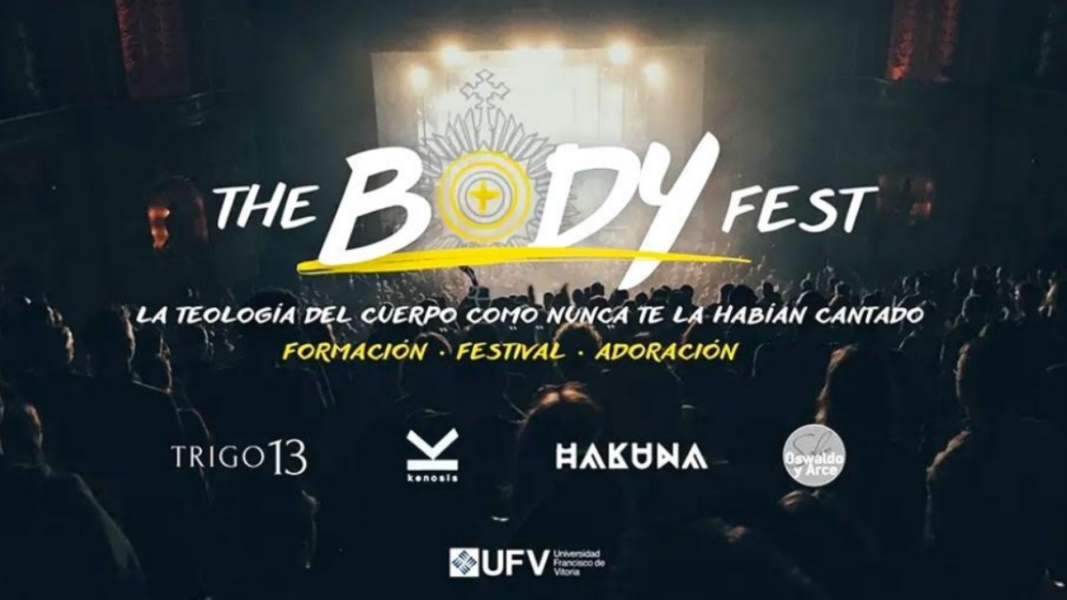
In fact, just as Bavaria has its Oktoberfest, influencer María Pombo has her SuaveFest, the Church has, courtesy of the Legionaries of Christ / Regnum Christi, the BodyFest, whose third edition was held in the afternoon/evening of October 31 to November 1. This “body festival” (I don’t know if it sounds worse in English or Spanish) is based on the theology of the body.
We have been citing names that are not heard in these conservative festivals, strangely: the von Hildebrand marriage, Kierkegaard, Cardinal Newman, St. Teresa of Jesus and St. Thérèse of Lisieux; is it because they are “outdated”, not modern enough? Does that mean unattractive to today’s Catholics? Where would the problem be if this is so: in the exposition of Catholic truth or in today’s Catholics if they are not capable of receiving the truths of always as they were always taught? Or, perhaps, in those who have been thinking for more than 60 years that people today can no longer receive a message that is eternal, not subject to fashions. On this, Martin Mosebach has explained very well, referring to the liturgy, how the change of form implies the change of content, which is what happens with these supposedly ‘innovative’ and/or ‘revolutionary’ ways of presenting the faith today.
I end with a brief piece of advice to Regnum Christi for future editions of BodyFest: that they look on the internet at other international nudist, pornographic, and satanic festivals celebrated with the exact same name and thus assess whether it is an appropriate name for a Catholic event.