


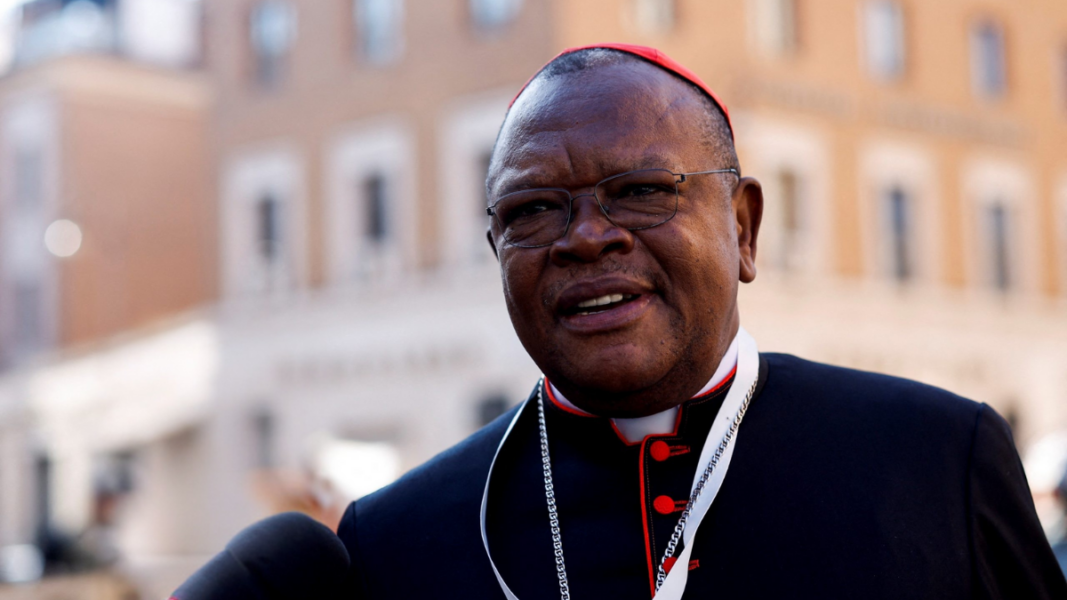
The cardinal Fridolin Ambongo, archbishop of Kinshasa, has warned about the limits of the peace agreement promoted by the United States for the Democratic Republic of Congo, following the rapid advance of the rebels in the east of the country just days after its ratification. According to The Pillar, the prelate denounced that this type of international pacts exclude the Congolese people and end up legitimizing the systematic plundering of the country’s resources.
Ambongo spoke in these terms during a homily delivered on December 14, in which he lamented the occupation of the city of Uvira by rebel forces less than a week after the presidents of Congo and Rwanda sealed in Washington the so-called Peace and Prosperity Agreement.
An international agreement that leaves out the Congolese people
In the cardinal’s opinion, the rapid collapse of the pact reveals its structural weaknesses and the lack of real involvement of the population directly affected by the conflict. For Ambongo, these international agreements, promoted from outside, do not address the root causes of the violence nor guarantee lasting peace.
The prelate questioned initiatives that are presented as solutions but, in practice, normalize the looting of the country’s natural resources and perpetuate a logic of interests foreign to the common good of Congo.
The Church’s proposal: a social pact for peace
Faced with this situation, Ambongo defended an alternative peace proposal promoted jointly by the Congolese Episcopal Conference and the Church of Christ in Congo, which groups 62 Protestant denominations. This initiative, called Social Pact for Peace and Good Living in the DRC and the Great Lakes Region, bets on an inclusive process that addresses the roots of the conflict.
In tune with the recent call by Pope Leo XIV for a “disarmed and disarming peace,” the archbishop held that only a path that rejects retaliation, exclusion, and ephemeral triumphalism can lead to authentic peace, based on the restoration of truth, justice, and the dignity of each person.
Ignored warnings and lives that could have been saved
The cardinal regretted that numerous lives could have been saved if the warnings issued by Catholic and Protestant leaders had been heeded earlier, especially after the capture of Bunagana in 2022 by the rebel group M23, one of the episodes that marked the escalation of the conflict.
Ambongo firmly condemned those who continue to consider war as a solution, underscoring the high human cost paid for years of armed confrontations.
A conflict entrenched for decades
The homily was delivered in the Cathedral of Our Lady of Congo, in Kinshasa, after the plenary assembly of the Association of Episcopal Conferences of Central Africa, which brings together bishops from Burundi, Rwanda, and the Democratic Republic of Congo.
The conflict in the east of the country, long-lasting and with a regional dimension since the 1994 Rwandan genocide, continues to strike a nation of more than 112 million inhabitants, approximately half of them Catholic.
The Church, a sign of hope amid violence
Despite the instability, ecclesial life is beginning to resume in some areas. In Uvira, recently occupied by rebel forces, the local bishop celebrated Gaudete Sunday a Mass with young people in St. Paul’s Cathedral, as a sign of hope and of the Church’s pastoral presence amid the violence.