


In the last few hours, rumors placing Monsignor Ronald A. Hicks, current bishop of Joliet (Illinois), as one of the names being considered to occupy the Archdiocese of New York have gained strength in the United States. The information was first reported yesterday by Religión Digital and has subsequently been corroborated by U.S. sources, giving greater consistency to a possibility that, for the moment, has not been officially confirmed by the Holy See.
The eventual appointment of Hicks has generated mixed reactions. On one hand, in certain ecclesial sectors it has awakened fears, as he is a bishop trained and promoted in the orbit of Cardinal Blase Cupich, a prominent figure in the more progressive wing of the U.S. episcopate. Hicks was vicar general of the Archdiocese of Chicago and later auxiliary bishop under Cupich’s governance, a circumstance that has led some to interpret him, automatically, as a possible continuer of that line.
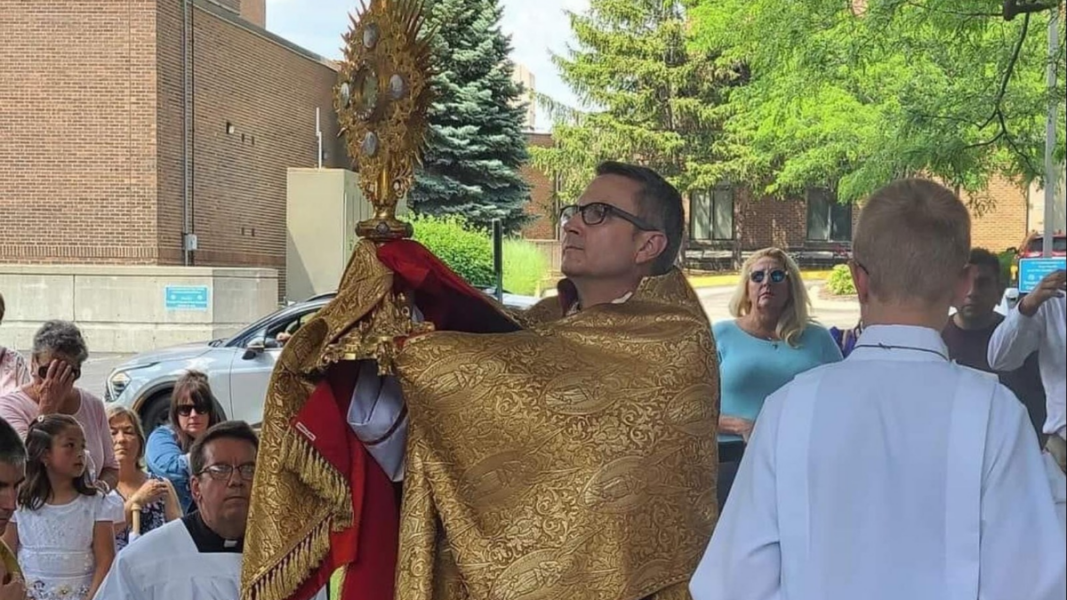
However, the direct testimonies of the faithful from his Diocese of Joliet, expressed on social media and U.S. Catholic spaces in the last few hours, paint a noticeably different profile from that of the Cardinal of Chicago. Those who know his pastoral governance closely emphasize an episcopate marked not by ideological activism, but by listening, youth, the centrality of the Eucharist, the promotion of adoration of the Most Blessed Sacrament, and considerable liturgical reverence.
Since his arrival in Joliet in 2020, Monsignor Hicks has promoted Eucharistic processions, solemn celebrations of Corpus Christi, and the opening of spaces for prolonged adoration, actively integrating into the National Eucharistic Revival promoted by the United States Conference of Catholic Bishops. His participation in the National Eucharistic Congress in Indianapolis in 2024 reinforced this image of a bishop centered on sacramental life as the axis of ecclesial renewal.
Also in the liturgical sphere, the faithful highlight his prudent and non-disruptive application of Traditionis custodes. In the Diocese of Joliet, communities linked to the Traditional Latin Mass have been able to continue their ordinary life without drastic measures, an attitude that contrasts with the line followed in other dioceses governed by prelates of a previous generation, more hostile to anything that sounds like Tradition.
This contrast between the external perception, based on his trajectory in Chicago, and the concrete experience of his episcopate in Joliet is one of the elements most repeated in the comments that have emerged following the publication of the rumors. For many faithful, Hicks does not fit into the category of an ideologically aligned bishop, but rather into that of a pastor who has chosen to strengthen Eucharistic life as a point of unity in a polarized ecclesial context.
What Would Be at Stake
If the appointment of Monsignor Ronald A. Hicks to the Archdiocese of New York were confirmed, we would be facing the most relevant episcopal decision of the pontificate of Leo XIV to date. Not only because of the symbolic and real weight of the New York see, but because it would allow greater clarity in ascertaining the archetype of episcopate that the Pope considers necessary for this stage: reverent profiles, with the Most Blessed Sacrament at the center, concerned with liturgy and capable of leading peaceful and unifying administrations, even if without immense doctrinal depth or the intellectual brilliance of other times.
They are, at times, profiles somewhat conniving with a politically correct message and with a soft tone toward worldly issues. But, unlike the generation of Cupich and the period of Francis, they do not share an unhealthy obsession with dismantling the liturgy. And this is no small matter: because the liturgy is not an accessory, nor a field for experimentation, but the place where the Church recognizes itself, adores, and receives what cannot be given: Christ in the Eucharist.
These profiles, without being perfect or meeting all expectations, could open a different generational handover, beginning to leave behind a Church that, for too long, abandoned to its fate the center that cohesions the faith. New York, due to its visibility and weight in the U.S. and universal Church, would thus become a decisive thermometer to measure whether Leo XIV is betting on a renewal that passes less through slogans and more through reverence, adoration, and unity around the altar.