


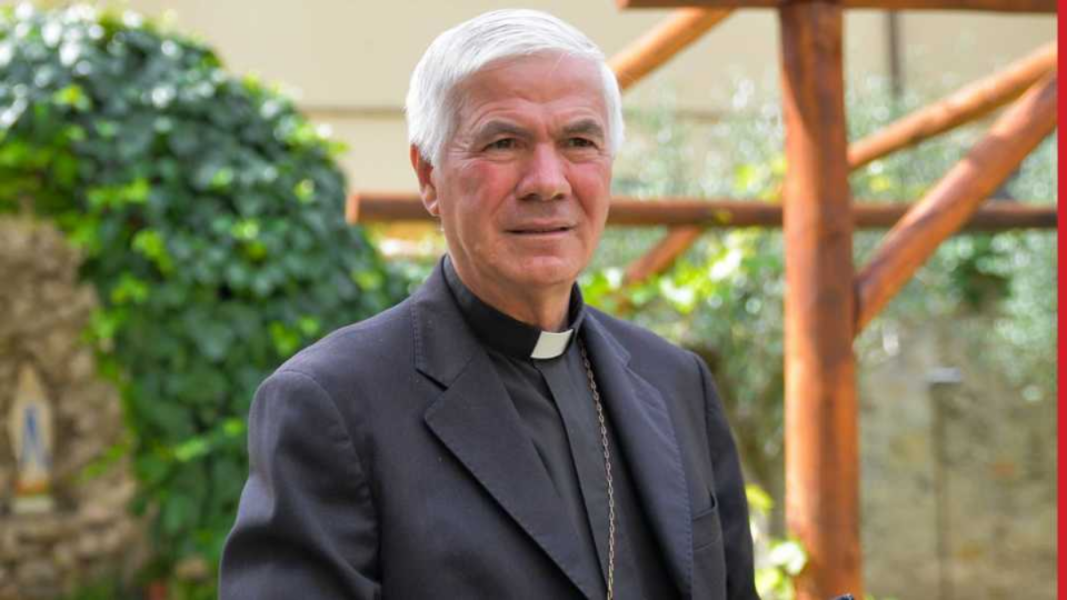
The Italian bishop, Mons. Giovanni D’Ercole, who resigned from his diocese in 2020 to retire to monastic life in Morocco, has reflected for years on martyrdom, the centrality of Christ, and Christian witness in societies increasingly hostile to the faith. In an interview granted to La Nuova Bussola Quotidiana, on the occasion of the publication of his book «The lion that is a lamb. In search of the Truth that saves», the prelate offers a profound reflection on the contemporary cultural crisis, the witness of the martyrs, and the role of the Church in a society that openly attacks life, the family, and the Christian faith.
«I have understood that the Truth, in order to truly save, cannot be a lion that attacks, but must become a lamb that immolates itself by becoming love.»
Starting from the fifth chapter of the Apocalypse, where the Lion of Judah reveals himself as the immolated Lamb, D’Ercole explains that Christian truth is not imposed by force or aggressive confrontation, but is fully manifested when it becomes sacrificial love. Without this dimension, he warns, truth is emptied of content and loses its capacity to transform man and society.
Martyrdom as a key to reading the present
The bishop emphasizes that his book was born in large part during the years he spent in Morocco, accompanying the last witness of the monks of Tibhirine, murdered in Algeria in 1996. For D’Ercole, their decision to remain among the Muslim people, even knowing the risk they faced, is one of the clearest expressions that truth is proclaimed above all with one’s own life.
«Where one is not willing to give one’s life for the Truth, it means that truth has not even entered the threshold of our thought.»
Martyrdom—whether the shedding of blood or persevering fidelity amid persecution—remains today a direct call to a humanity that speaks much of truth but rarely willing to assume its consequences.
A wounded society and an ineludible mission
Mons. D’Ercole does not shy away from the great contemporary challenges: abortion, euthanasia, gender ideology, family crisis, transhumanism, and artificial intelligence. In the face of them, he rejects both catastrophism and naivety. History, he recalls, is always in God’s hands, but that does not exempt Christians from their personal responsibility.
«God still holds the reins of this world and expects each of us to do our part, becoming builders—and not judges—of His Kingdom.»
Every baptized person—and especially pastors—is called to be a builder of God’s world, not a judge, bearing witness to the Truth about life and the family, even if it comes at a personal cost. For the bishop, these same crises are a sign that the Christian cannot delegate their mission or take refuge in passivity.
Pastoral fatigue and false innovation
In the ecclesial sphere, D’Ercole identifies two particularly harmful “viruses”: pastoral fatigue and an innovation disconnected from spiritual life, reduced to abstract formulas and soulless projects. Without entering into personal judgments, he recognizes the enormous difficulties that bishops face today, but insists that the true renewer of the Church is God, not pastoral plans.
«There is a real pastoral fatigue and an innovation disconnected from spiritual life, made of abstract formulas that do not reach people’s hearts.»
The key, he affirms, is prayer. Only from a deep spiritual life is it possible to read reality with God’s eyes, overcome inner fatigue, and recover a gaze of hope, even amid real and persistent problems.
Christ at the center and hope for the Church
Asked about the pontificate of León XIV, D’Ercole highlights three fundamental traits: the recovery of Christ’s centrality, the absence of personal protagonism, and the serenity with which the Pope exercises his mission. In his view, this style helps the Church return to the essentials and not be swept away by ideologies or empty activism.
The bishop concludes by pointing out that his personal search for truth led him back to the heart of the faith: the Eucharist. In the silence of the consecrated Host, he affirms, lies the secret of true victory and human happiness. In the face of an often banalized Eucharist, he sees emerging a silent movement of adoration and reverence that anticipates an authentic renewal.
For Mons. Giovanni D’Ercole, the ultimate response to the contemporary crisis is not a strategy or structural reform, but a sincere return to Christ present in the Eucharist, source of a new humanity that is already being rebuilt from within.
«In seeking the Truth, I encountered the Eucharist, and I understood that in the silence of an immaculate Host lies the secret of victory.»