


The origin of the Church and its culmination are found in the eternal love of the three Persons of the one Triune God. Therefore, in the Church is present the Will of the Father, the Word of the Son, and the Action of the Holy Spirit.
Will, Word, and Action that can be summarized in a purpose of God’s love for all His creation, especially man “the only creature that God has willed for Himself” (Gaudium et Spes, V.C.II). Man is a creature whom God has created, whom He has redeemed, and whom He awaits—united with all the elect—in the heavenly Church, in the sumptuous wedding feast of the Lamb at the end of time.
The note of Unity is so important in the militant Church that the Nicene-Constantinopolitan Creed itself indicates it as the first of its characteristics. The Church, therefore, is (must be) One, as an essential prerequisite for its other characteristics to be affirmed: Holy, Catholic, and Apostolic. Without unity, it is difficult to speak of holiness (there would be proud attitudes), of universality (there would be divisions), and apostolicity (there would be false apostles).
Christ did not found several churches, but only one. Christ died, John reminds us:
“to gather into one the children of God who were scattered abroad” (Jn. 11:52).
And He wanted to gather all His sheep into one fold:
“I have other sheep that do not belong to this fold. I must bring them also, and they will listen to my voice. So there will be one flock, one shepherd” (Jn. 10:16)
The theologian José Antonio Sayés points out:
“Well, that unity which Christ has made possible is none other than the unity of the Church. Therefore, Vatican Council II understands the Church as the instrument or sacrament of “intimate union with God and of the unity of the whole human race” (L.G. 1). There is a vocation to unity for all humanity, already from the beginning by God’s creative design in Christ, but now, that unity, broken by sin, finds in the Church the instrument of unity that humanity can never achieve by its own forces” (José Antonio Sayés. The Church of Christ).
The Church—general sacrament of salvation, where God binds Himself to the human race—must necessarily be united, for that was the great desire of Jesus—the last longing of Our Lord—before His departure from among us.
Indeed, it is especially significant (and moving) that Jesus’ last words to His disciples at the Last Supper, before facing the drama of His passion and death on the cross, were a powerful call to unity among them. We read in John that the Lord, in His magnificent Priestly Prayer, appeals insistently for His disciples (those of then, those of today, and those of always) to remain united around Him.
“I am not praying for them alone, but also for those who will believe in me through their word, that they may all be one. As you, Father, are in me and I am in you, may they also be in us, so that the world may believe that you have sent me. I made known to them your name, and I will make it known, so that the love with which you have loved me may be in them, and I in them” (Jn. 17:20).
And that unity would not only be of a purely spiritual nature, for the Lord left us a Visible Church, with a hierarchy established by divine will, and whose earthly governing head would be the Apostle Peter and his successors:
“You are Peter, and on this rock I will build my church” (Mt. 16:18).
Peter, therefore, is and will be for the future the rock on earth on which that unity that Christ wanted for His Church is built, with Christ Himself being “its cornerstone” (Acts 4:11). Peter will hold in the militant Church the power in general “the keys of the Kingdom of Heaven” (Mt. 16:19) (Is. 22:22); not only definitive authority in doctrinal matters (for to him the Lord entrusted the mission of “strengthening the faith of the brothers” (Lk. 22:32), but also of direction and government (of “feeding the flock” (Jn. 21:15-17).
As the Constitution on the Church of Vatican Council II, Lumen Gentium (18), states:
“But, in order that the episcopate itself might be one and undivided, He placed Saint Peter at the head of the other Apostles, and He instituted in him a permanent and visible source and foundation of the unity of faith and communion”.
And it adds that:
“the bishops, successors of the Apostles, together with the successor of Peter, the Vicar of Christ and head of the whole Church, govern the living house of God”.
But the call to unity, due to its importance, is also recalled by Saint Paul in his Letters. We read in Philippians, right before the wonderful Christological hymn of the second chapter where he will express the Kenosis and the glory of Jesus, a humble petition to that Christian community (and to all), centered on unity:
“complete my joy by being of the same mind, having the same love, being in full accord and of one mind” (Phil. 2:2).
A heartfelt unity in charity. But that spiritual unity demands fidelity to the doctrine received, and therefore the great desire of Saint Paul, as he expresses in the Epistle to the Ephesians, was that that community remain faithful to:
“one Lord, one faith, one baptism. One God and Father of all, who is above all and through all and in all” (Eph. 4:5-6).
In fact, by virtue of the one and same Baptism, the members of the People of God that is the Church are all equal in dignity; we all form part of the People of God (1 Pet. 2:10). And through the other sacraments—especially the Eucharist, a precious symbol of unity—the cohesion of the Body of Christ is strengthened.
Here we must mention the important reflection of the theologian Antonio María Calero, who points out that:
“From that unity on the ontological plane of faith, a unity strongly emphasized and demanded, one can and must speak of diversity in the Church. In fact, the Apostle himself does so: there are diverse vocations, diverse charisms, diverse graces, diverse functions, diverse ministries. But all that wide and rich diversity in the members springs from one and the same Spirit, and consequently must serve not for antagonistic struggle among them but for mutual enrichment and of the whole ecclesial body” (Antonio María Calero. The Church: Ministry, Communion, and Mission).
Unity, therefore, is not incompatible with diversity of members, and there we have the splendid Pauline image of the Mystical Body of Christ, with each of the members ordered, through their gifts, for the good of the whole Church, and with Christ as its head. The Letter to the Colossians tells us:
“He is the head of the body, the church; he is the beginning, the firstborn from the dead, so that he might come to have first place in everything” (Col. 3:19).
But returning to the Letter to the Ephesians, Saint Paul will denounce the great enemy of that unity, which he identifies above all with heresy. If in the Letter to the Philippians he had highlighted the unity of heart among Christians, here he will highlight the unity of doctrine:
“we must no longer be children, tossed to and fro and blown about by every wind of doctrine, by people’s trickery, by their craftiness in deceitful scheming” (Eph. 4:14).
II
We can reflect today, frankly, on whether that double unity, of doctrine and of heart that Christ demanded of us as the mortar of His Kingdom, has been fulfilled in the Church of Christ. And it seems clear—and all Christians should be ashamed of it—that it has not. And not only are Christians disunited because many do not recognize Peter as the head on earth of the Church of Christ, and that has led to a plurality of Christian doctrines outside the Catholic Church, which, by the mere principle of non-contradiction, are false. But perhaps the drama of our time is that also among the very Christians faithful to the Bishop of Rome, we find dramatic divisions that we must not brush aside. We all remember the last schism provoked in Catholicism by Monsignor Lefebvre, as well as the still unresolved divisions caused by the liturgical reform. Unity is not destroyed but rather enriched by the plurality and legitimate diversity of the members of the Body of Christ, and it is tragic that at this point the ecclesiastical hierarchy still has not realized the immense goods that it would bring to the Church (whose main mission is to save souls) to equally recognize the traditional rite and the novus ordo.
But let us leave that sad topic, and finally focus on the ecclesial ruptures that, from the beginning of the Church, have shown a triple mode of division: heresy, pertinacious denial of a truth that must be believed with divine and Catholic faith; apostasy, total rejection of the Christian faith; and schism, which is the refusal of submission to the Roman Pontiff or of communion with the members of the Church subject to him. These three phenomena have occurred in all eras, but today in particular episodes of apostasy, whether express or tacit, occur in a generalized and dramatic way.
For all this, the theologian José Antonio Sayés asks if we can continue to speak of the unity of the Church that Christ founded. Especially today when we see many bishops disagreeing on serious matters (for example, on moral doctrine or sacramental discipline), situations that produce sadness and bewilderment in the People of God. But Sayés responds with a resounding YES.
And it is “yes” because all infidelities and ruptures can never prove that the unity of the Church around Peter and his faith has been broken. But likewise we can affirm that that unity, present in the Church, is also an important challenge today in two aspects:
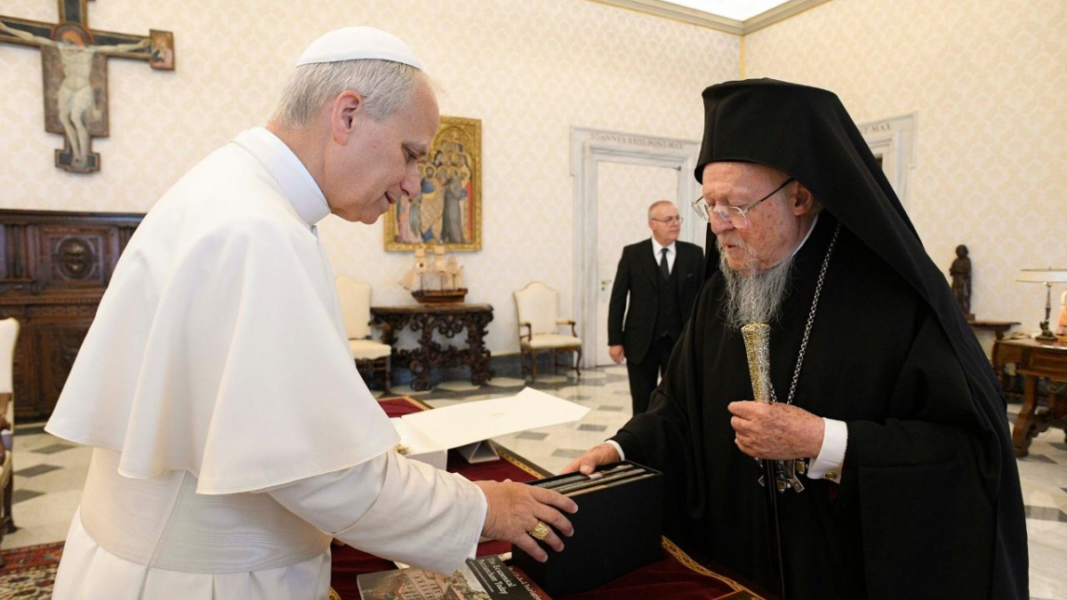
It is an internal task (for there are not a few tensions that exist within the Church itself), and it is equally an external task (because it remains a challenge that there are particular churches and Christian communities without unity with the Vicar of Christ). These Churches or communities preserve to a greater or lesser extent elements of truth and sanctification as Vatican Council II reminds us. In the case of the Orthodox, they have valid sacraments like baptism or the Eucharist, but—it is always good to remember—they all spring from the one Church that Christ founded on Peter, the rock, and his confession of faith. And therefore, as the Council also reminds us, they are proper goods of the Church and impel toward Catholic unity. And although it is no longer cited, we must not forget that Pius IX in 1864 condemned that «in the worship of any religion men can find the way to eternal salvation and achieve eternal salvation» (proposition XVI, Syllabus). And that Pius XI, in his Mortalium Animos, of 1928, considers that:
«the union of Christians cannot be fostered in any other way than by procuring the return of the dissidents to the one true Church of Christ, from which they unhappily separated one day; to that one true Church which all certainly know and which by the will of its Founder must always remain as He Himself founded it for the salvation of all».
Because as Unitatis Redintegratio of Vatican Council II points out, unity:
“which Christ granted from the beginning to His Church, we know subsists indefectibly in the Catholic Church, and we hope that it will grow day by day until the consummation of the ages” (U.R. 4).
And it subsists and will subsist because Jesus Himself, in Caesarea Philippi, made a promise to the one Church that He founded on Peter and his confession of faith:
“On this rock I will build my church, and the gates of Hades will not prevail against it” (Mt. 16:18).
For all this, to conclude, as a Catholic I make my own the resounding words of Saint Augustine, in his combat with the Manichaean heretics:
“Many things justly hold me in the bosom of the Catholic Church. The consent of peoples and nations holds me; its authority, begun with miracles, nourished with hope, strengthened with love, established for so long a time, holds me. The succession of bishops from the very seat of the Apostle Peter, to whom the Lord, after His resurrection, gave the charge to feed the sheep until the present episcopate, holds me. Finally, the very name of Catholic, which, not without reason, amid so many heresies, it has preserved, holds me. And although all heretics wish to be called Catholics, yet when a stranger asks where the Catholic Church is, no heretic dares point out his own assembly or house. These, then, in number and greatness, are the bonds that hold me as a Christian in the Church” (Saint Augustine. Contra epist. Manich. 4,5).
Note: The articles published as Tribuna express the opinion of their authors and do not necessarily represent the editorial line of Infovaticana, which offers this space as a forum for reflection and dialogue.