


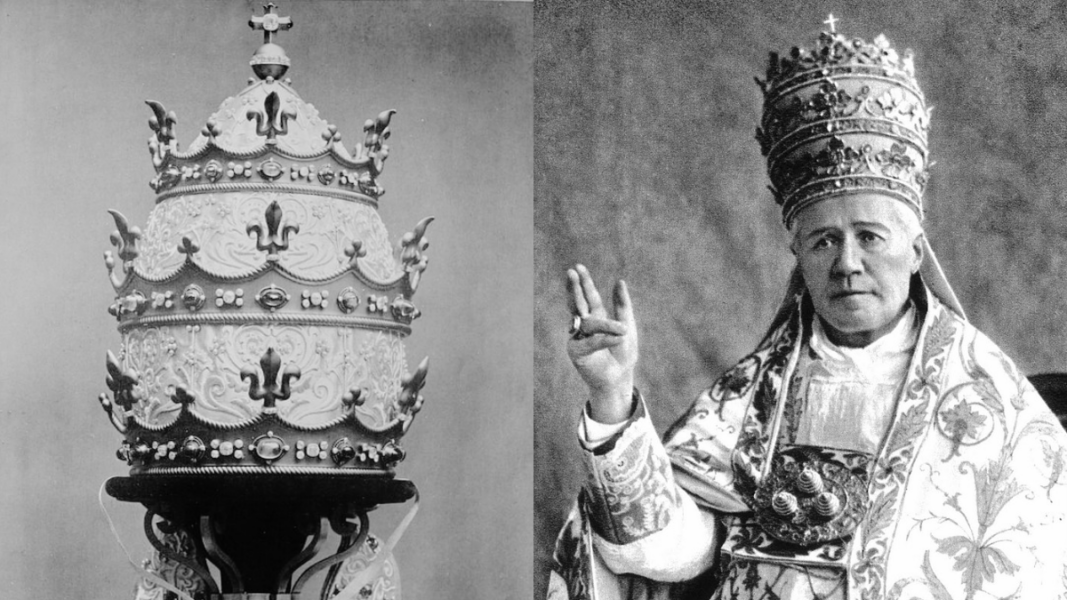
The supreme master and tutor of the Church in the visible plane is the Roman Pontiff, who follows the office entrusted by Christ Himself to the Apostle Saint Peter when he was constituted the first Pope. Oh, sublime chair of Saint Peter! So much blood and sacrifice have been poured out to defend its integrity. Before such greatness of the most sacral office that exists on the face of the earth, this inspires astonishment in the soul of the pious man. Everything that the Throne of Saint Peter inspires is material for broad meditation on the power and strength of the one Church founded by Christ Jesus.
The hidden forces, knowing everything encapsulated in the office of the Roman Pontiff, have plotted not for its destruction, but to take advantage of its influence in all spheres, temporal and supernatural. In the last sixty years, different factors have led the Pope to disregard—even contradict—his role as supreme shepherd of the souls entrusted to his care. Factors such as a new ecclesiology, a new conception of Petrine sacrality, the pressure of the world and fashions, new trends, doctrinal innovations and, of course, the strong influence of the forces mentioned at the beginning are the causes of the immoderate decline in the actions, works, and thoughts emanating from the Pope in office.
For more than a century, there existed a solemn oath, dedicated to the Most Holy Trinity, in which the Successor of Saint Peter, after being elected as successor of the Apostle Saint Peter, pronounced these exquisite words in fidelity to the Deposit of the Faith entrusted to him. One cannot underestimate or consider a trifle an oath; it is a matter of basic catechism to know the gravity of an oath, even more so if it is an oath made by the one who holds the position of being the Vicar of Christ. One after another, the Roman Pontiffs professed this oath in order to bind themselves spiritually to their duty, with clear words that describe their incessant labor, which they must exercise until death calls them to a most severe judgment for the rigor of the ministry exercised by their person.
This solemn declaration appears engraved in the Liber Diurnus Romanorum Pontificum, which collects the prayers, rites, ceremonies, and other solemnities reserved for the use of the Pope. The present profession of faith is so ancient that it is attributed to Pope Saint Agathon I, whose pontificate was from the year 678 to 681; the same was used uninterruptedly, with the exception of John Paul II onward. For the theological concepts contained, for its continuous use from time immemorial, for the delicate treatment applied to it, it can be easily determined to belong to the bimillennial tradition of the Holy Mother Church; ergo, it cannot be despised or suppressed as a mere historical piece of minimal value.
We read next the sublime protest of the Catholic faith, undoubtedly elaborated by the Holy Spirit and carried through the centuries:
Papal Oath Attributed to His Holiness Pope Saint Agathon
«I promise not to change anything of the Tradition received and, in nothing of it—as I have found it guarded before me by my predecessors pleasing to God—to meddle, nor alter it, nor allow any innovation in it.
I swear, on the contrary, with ardent affection, as its student and faithful successor in truth, to reverently safeguard the good transmitted, with all my strength and utmost effort. I swear to expurgate everything that is in contradiction with the canonical order, if such should appear; to guard the Sacred Canons and Decrees of our Popes as if they were the divine ordinance of Heaven, because I am conscious of You, whose place I take by the Grace of God, whose Vicarship I possess with Your support, subject to most severe rendering of accounts before Your Divine Tribunal concerning everything that I shall confess. I swear to God Almighty and to Jesus Christ Savior that I will maintain everything that has been revealed by Christ and His Successors, and everything that the first councils and my predecessors have defined and declared. I will maintain, without sacrifice of the same, the discipline and rite of the Church.
I will put out of the Church whoever dares to go against this oath, whether some other or I. If I should undertake to act in anything of contrary sense, or allow that it be executed thus, You will not be merciful to me on the terrible Day of Divine Justice. Consequently, without exclusion, we subject to most severe excommunication whoever—whether Us or another—dares to undertake any novelty in contradiction with the established Evangelical Tradition and the purity of the Orthodox Faith and Christian Religion, or seeks to change anything with opposing efforts, or agrees with those who undertake such a blasphemous venture».
General Analysis
The flavor of pure Catholicity saturates the palate of the devout reader upon reading this grandiose sanctified commitment that seeks to give his life for the holy faith. Its diaphanous clarity speaks for itself. This oath consists of an impregnable manifestation of the faith, united to the described acting of the fervent and zealous Catholic.
To begin to wield the divine pact, the first thing that jumps out after having read it entirely is the act of including or binding every person in its terms: «whether some other, or I», «whether Us, or another». This insertion of every person in the renowned promise means that we must guard, in an assimilated way, according to our duties of state and due hierarchy, the obligations that the new Roman Pontiff takes upon himself. There is no way to disconnect or go over the manifested exigencies, since the oath, as a whole and in detail, marks the unmovable course of the visible authority of the Church. If this has well-defined guidelines for the good of souls, these can be a perennial guide in all its acting, both out of love for the truth and out of fear of such contundent consequences; in other words, if the head is clear, the rest of the body must behave coherently.
In that same order of ideas, the other point to which we must fix our attention consists of a great truth of faith, today so hidden—even vilely violated—, founded on the limits of the Pope over the Deposit of the Faith: «The Holy Spirit was promised to the successors of Peter, not so that they might, by His revelation, make known some new doctrine, but so that, by His assistance, they might sanctify and faithfully expound the revelation transmitted by the Apostles, that is, the deposit of the faith». This quote from the most holy and infallible First Vatican Council, in the Dogmatic Constitution Pastor Aeternus, has been trampled in a flagrant manner in recent decades, in such a way that the average parishioner considers the Pope as the owner of the truths of the faith. Papolatry has gone viral due to several factors, a dangerous current because it is harmful to the sense of the nature of the Church concerning its hierarchy. The oath permeates with a spirit of intangibility of everything that the Vicar of Christ must receive as administrator; these are sacred, divine things of inestimable value, for which reason they are not within his arbitrary power, but become his principal custody.
To continue consolidating what was stated in the previous paragraph, we will outline this sharply below. No, the Pope cannot upset two thousand years of faith. No, the Pope cannot allow what was previously unthinkable —even using an apparent rhetoric sustained with arguments presumably rooted in tradition, but applied erroneously and improperly—. No, the Pope cannot censor, limit, or eliminate something medullary of the Lex Orandi of the Mystical Body of Christ Jesus; right at this point we can see the tearing effects of transgressing what has been faithfully transmitted from the Apostles to our times. No, the Pope cannot, under any circumstances, accommodate the faith to the demands of revolutionary modernity, to a new conception of man for a modern man, because it is of a liberal nature and in total contradiction with the bimillennial teachings (cf. Syllabus of Errors of the blessed Pope Pius IX, n. 80).
Fixing our gaze on other aspects of the oath, we specify another attribute of this formal testimony, where the Successor of Saint Peter submits without reservation to the safeguarding, vigilance, and warlike belligerence out of love for the King of Kings and Lord of Lords. Oh, how many splendid examples we have in the annals of the Church, demonstrating the pastoral courage of the Pope doing what is necessary to safeguard the faith and be faithful to his oath! The Servus servorum Dei (Servant of the servants of God) must be the most arduous defender of the orthodoxy and integrity of the apostolic teachings: the first to attack and defend; the proponent of just disciplinary measures against the infiltrators; the professorial rector who exhorts in season and out of season about the truth, united to the categorical denunciation of existing threats or dangers. He can never afford to hesitate or delay any matter where the salvation of souls is at stake. Because of the incalculable gravity of his labor as sentinel, his acting must be summary, but without being precipitate. We are in great need of this rigid conduct coming from the Petrine See against a quite substantial number of people and groups causing theological havoc in the ecclesial structure.
This testament of unwavering adhesion to God in His holy Gospel, with the precepts emanating from it, is a self-evident demonstration of the rigor of being Vicar of Christ on earth. This oath must be the war cry of every baptized person who bears the title of Catholic by the grace of God. The example must be given from the one who has the greatest responsibility in any institution or association; with greater reason it demands that it be so within the perfect society created by God Himself. An oath objectively ensures the due fulfillment of the pending labors to be exercised by the one who makes it with solemnity. Let us meditate on the energetic words of this profession of faith that seal the fate of its sworn: «If I should undertake to act in anything of contrary sense, or allow that it be executed thus, You will not be merciful to me on the terrible Day of Divine Justice».
Note: Articles published as Tribuna express the opinion of their authors and do not necessarily represent the editorial line of Infovaticana, which offers this space as a forum for reflection and dialogue.