


By the Rev. Peter M. J. Stravinskas
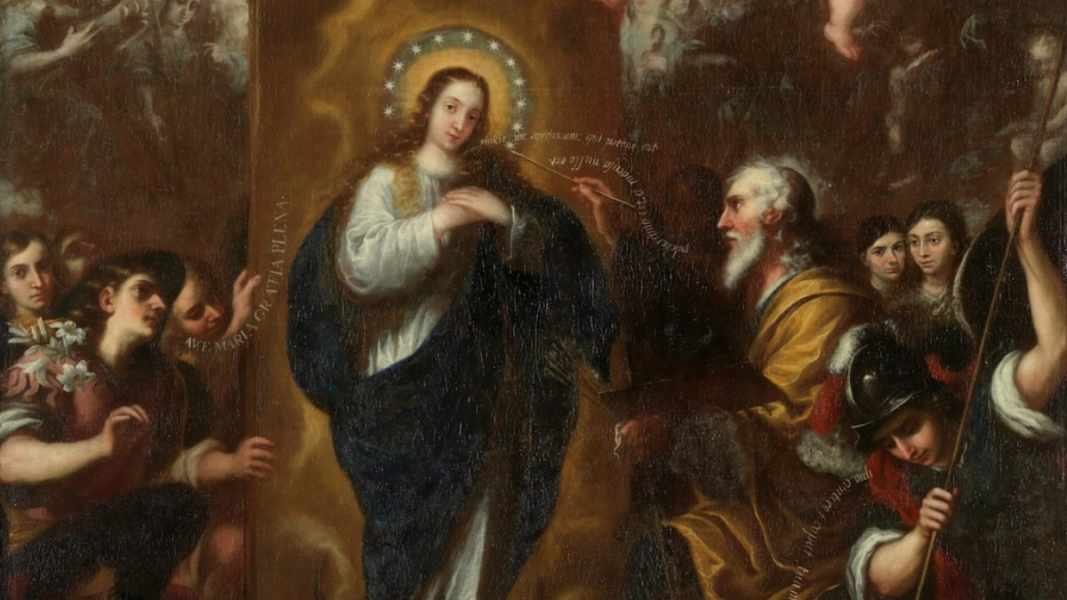
Many Catholics misunderstand today’s feast, which is also the patronal feast of our nation (the first country to embrace it under this title). They confuse the Immaculate Conception of Mary with the virginal conception of Jesus. But today we celebrate the fact that Mary was without sin from the first instant of her existence, which is extremely important because it demonstrates the care with which God guided the entire process of our salvation.
It is no coincidence that the Church celebrates this feast at the beginning of Advent. This privilege granted to Our Lady was part of the work of salvation initiated at the very moment when sin first entered the world. The experience of sin and its dominion over our world occurred because of human weakness and pride. Just as a woman made the first sin possible, so too a woman would make the work of our salvation possible. Mary was God’s response to Eve.
Christians of today and all times love Mary because she literally embodies everything we hope to become. That is why Wordsworth could extol her as “the one boast of our fallen nature.” By her faith and her willingness to cooperate with God, Mary showed herself to be a true daughter of Abraham. The humble maiden of Nazareth also demonstrated that true liberation does not consist so much in “doing one’s own thing” as in doing God’s thing. She confirmed that the angel was right, that the Lord was truly with her, by uttering that fearsome but firm “yes” that reversed all the previous “no’s” in history.
This solemnity gives us a golden opportunity to consider various theological dimensions of the Immaculate Conception.
First, original sin. Original sin is not something we can “grasp”: it is an absence of original holiness, of grace, and of union with the Creator. And it is a “heritage” from our first parents. Original sin is “programmed” into our nature. This led St. Paul to reflect on why we find it easier to do evil than to do good (cf. Romans 7:19).
Second, original sin constitutes us as “children of wrath” (Ephesians 2:3). It is common to look at a baby and say: “What an angel!” However, that is more a wish than a reality. A baby is totally absorbed in itself and demanding. G. K. Chesterton called original sin “the only part of Christian theology which can really be proved.” St. John Henry Newman identifies it as “some terrible primeval calamity.”
Third, baptism, which is necessary because it moves us from the Kingdom of Darkness to the Kingdom of Light. It returns us to the Garden of Eden before the fall. Georges Bernanos, in a charming phrase, referred to Our Lady in her Immaculate Conception as “younger than sin.” Baptism, we can say then, is the Christian’s “fountain of youth,” for it returns us to that state of original holiness, righteousness, and grace. Hence Our Lord’s statement to Nicodemus: “Amen, amen, I say to you, no one can enter the kingdom of God without being born of water and Spirit” (John 3:5).
Fourth, we must address a common Protestant objection to the Immaculate Conception: that this doctrine “deifies” Mary. But several of the leading Protestant Reformers believed in the doctrine of the Immaculate Conception, four centuries before its dogmatic definition! Similarly, Cardinal Newman, thirteen years before his conversion, preached:
Who can estimate the holiness and perfection of her who was chosen to be the Mother of Christ? If to him that hath shall be given, and holiness and divine favor go hand in hand (and this we are expressly told), what must have been the transcendent purity of her whom the Creator Spirit deigned to overshadow with His miraculous presence? What her gifts, who was the near earthly kinswoman of the Son of God, the only one whom He was bound by nature to revere and look up to; she who was intrusted to train Him and rear Him, educating Him day by day, as He grew in wisdom and stature?
Luther, Zwingli, and Newman never imagined that Mary became a goddess by her Immaculate Conception, just as Eve was not a goddess nor Adam a god for having been created without sin. Newman speaks of Mary as “the daughter of Eve who fell not.”
Which logically leads us to a fifth consideration: Was the definition of this dogma an “invention” of the Church in the nineteenth century? Clearly not, for if the Reformers of the sixteenth century and an Oxford scholar of the nineteenth century—not to mention countless Fathers of the Church—believed this to be a truth of faith, we are dealing with something deeply rooted in the Christian mind and heart.
Sixth, how was this privilege granted to the Most Holy Virgin? The simple answer: grace. It is fascinating to note that one of the primary principles of the Reformation was sola gratia (by grace alone). The clearest, finest, and most impressive application of that principle is precisely Mary’s Immaculate Conception.
Seventh, it is logical to ask how this could have occurred before the saving work of the world’s only Redeemer. Once again, the dogmatic definition explains that this saving action in favor of the Virgin Mary took place “in foresight of the merits of Jesus Christ, the Savior of the human race.” The theological term for this is “prevenient grace,” heard in today’s Prayer over the Offerings; in simpler language, we can call it “preventive medicine.” This means that a future event and its merits were applied in advance (for God exists in an eternal present), making the future Mother of the Redeemer a fitting dwelling place for Him.
With his inimitable style, St. John Henry connects the dots for us again:
There is mention of a war between a woman and the serpent in Genesis. Who is the serpent? Scripture does not say until the twelfth chapter of the Apocalypse. There at last, for the first time, the “Serpent” is interpreted as the Evil Spirit. Now, how is it introduced? Why, by the vision again of a Woman, its enemy—and as, in the first vision of Genesis, the Woman has a “seed,” so here a “Son.” Can we avoid saying, then, that the Woman is Mary in the third [chapter] of Genesis?
Today, then, we praise her who is “younger than sin,” “the daughter of Eve who fell not,” and “the one boast of our fallen nature,” proud to fulfill the prophecy inspired by the Spirit in her Magnificat: “Henceforth all generations shall call me blessed” (Luke 1:48).
About the author
Father Peter Stravinskas holds doctorates in school administration and theology. He is the founding editor of The Catholic Response and editor of Newman House Press. Most recently, he launched a graduate program in Catholic school administration through Pontifex University.