


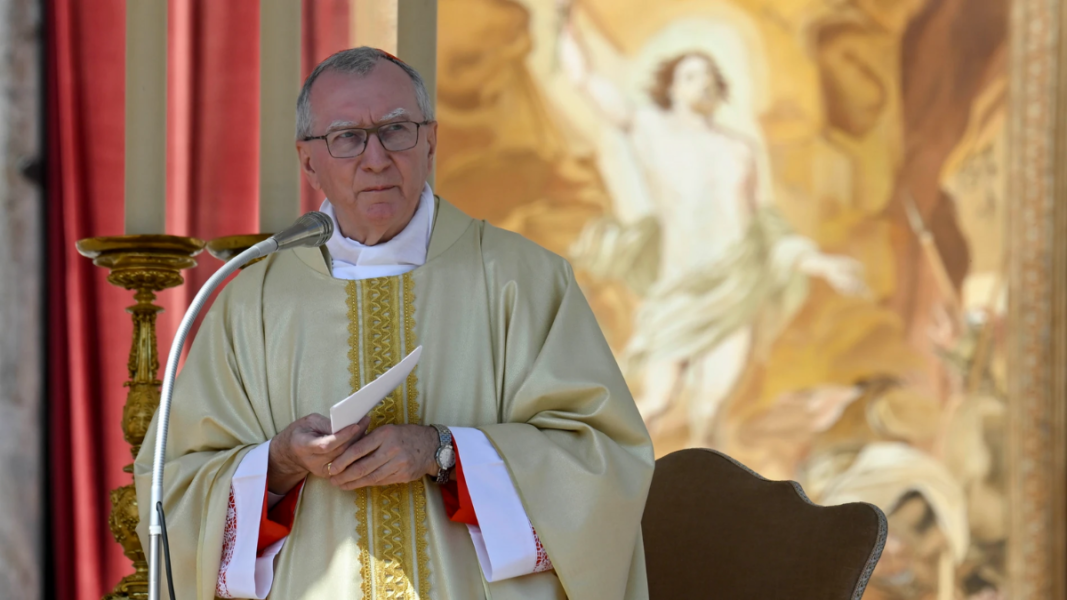
The Secretary of State of the Holy See, Pietro Parolin, celebrated a Mass on this December 13 in the Paul VI Hall on the occasion of the Jubilee of Italian Diplomacy. During the homily, he traced a broad journey through some of the main international hotspots of tension, emphasizing what he defined as the “geopolitical complexity” of the current moment and appealing to the role of diplomacy as an instrument to keep open the possibility of peace.
Read also: The Pope at the Jubilee of Italian Diplomacy: «The Christian is always a man of the Word»
Parolin resorted to the biblical image of fire —a transformative element in Scripture— to describe the diplomatic mission: not limiting oneself to technical negotiation, but “generating possibilities” oriented toward a higher and common good, in which, according to his words, “each people can be more fully itself”.
Holy Land and Ukraine: conflicts without visible way out
In his reflection, he dwelt especially on two war scenarios that occupy the center of international attention. First, the Holy Land, where “the pain of entire populations” intertwines with a conflict that seems to find no truce. In the face of this situation, he stated that the international community is called to combine compassion for the victims with the lucidity necessary to point out paths of reconciliation, even when these seem distant.
He also alluded to the war in Ukraine, emphasizing how the prolongation of the conflict is generating destruction, distrust, and a growing moral weariness. The silence of weapons, he acknowledged, seems to be receding, precisely when the need for peace is perceived as most urgent.
Africa: «a violence with a fundamentally religious root«
Beyond the usual media hotspots, Parolin broadened his gaze to other regions of the world affected by persistent conflicts and chronic humanitarian crises that receive scant international attention. In this context, he explicitly mentioned the situation in Cabo Delgado province, in Mozambique, which he recently visited on the occasion of the 30th anniversary of diplomatic relations between that country and the Holy See.
Read also: Parolin visits Cabo Delgado, one of the most dangerous places in the world for Christians
There, he explained, a “tragic reality” is lived marked by brutal murders —in many cases by decapitation—, widespread destruction, and massive population displacements. As he indicated, it is a violence with a fundamentally religious root, almost ignored by the international community. To this situation he added other African scenarios gravely affected by instability, such as the Democratic Republic of the Congo, Sudan, and the Sahel countries.
Parolin pointed out the violence in places like Cabo Delgado province (Mozambique), where clashes with insurgent groups have left thousands dead, displaced, and entire communities under constant threat. He described these realities as painful and complex, emphasizing that they cannot be ignored, and highlighted the need for “compassion and lucidity” to seek paths of reconciliation and peace.
Although he did not deny the complexity of the causes —including political, social, and economic factors—, the attention devoted to Mozambican Christians, and his description of their suffering as part of a crisis that “must not be forgotten,” suggest a shift in his treatment of the African theme.
This approach contrasts markedly with his statements from October 2025, when in the presentation of the ACN Report on Religious Freedom he downplayed the violence against Christians in Nigeria by describing it, to the Vatican press, as a “social conflict” between herders and farmers, and not as explicit religious persecution.
Read also: Parolin downplays the blood of Nigerian martyrs
That stance was interpreted by many —including Nigerian Catholic leaders and human rights defenders— as a minimization of the martyrdom of Christians who have been attacked by Islamist groups with the explicit aim of imposing sharia and eradicating Christianity from the north of the country.
“Do not yield to fear or fatalism”
In the concluding part of the homily, the cardinal resorted to the figure of the prophet Elijah, described in the book of Sirach as “fire,” to exhort against being paralyzed by fear or falling into fatalism. In that framework, he defended the need to continue believing in the possibility of peace, even in apparently closed contexts.
Parolin also insisted on the importance of speaking the truth “without aggressiveness,” respecting the dignity of peoples and keeping channels of dialogue open, even when the international climate is dominated by confrontation and the language of force.