


By Fr. Brian A. Graebe
Isaiah stands as the great prophet of Advent: he so powerfully announces the coming of Christ (as well as his Passion and Death) that this book has been called the “fifth Gospel.” Later in Advent, we will hear his most direct prophecy: “the virgin shall conceive, and bear a son, and shall call his name Emmanuel.” In this Second Sunday of Advent, however, Isaiah offers us a vivid description of the messianic era, which seems like a pastoral ode: “the wolf shall be guest of the lamb, and the panther shall lie down with the kid.”
Here, all of nature rests in harmony and peace. Our minds turn back to Eden, free from violence and death. We glimpse the restoration of that fallen world in this vision of hope, from the prophet of hope.
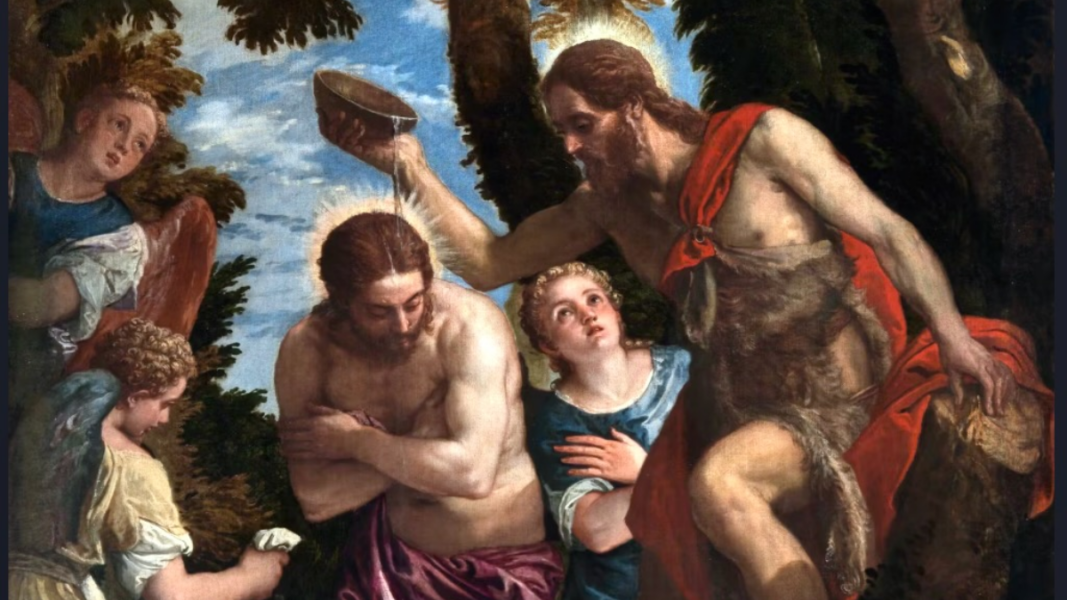
But Isaiah is not the only prophet we encounter today. We also meet St. John the Baptist, the last and greatest in the long line of prophets. It is he whom Isaiah had foreseen as “a voice crying in the wilderness.” John’s message, however, seems very different: “Repent!”
John knew that humanity had abandoned Eden long ago. That original harmony was broken when our first parents sinned against God, and we have all followed the same path through the centuries. That is why John baptized in the Jordan River. His baptism was not a sacrament; it could not erase sins. But it was a way to express sorrow for sin, while the washing prefigured the rebirth that baptism would bring. Every newly baptized person, no matter how old, emerged from the waters as a newborn, recovering the lost innocence.
That is undoubtedly one reason why God almighty, creator of the universe, appeared on earth as a baby: to remind us of our need to be like children, reflecting the humility and trust proper to little ones. As Isaiah tells us, there will be “a little child who shall lead them.” Jesus wants to lead us toward that innocence and that joy, but we know that not everyone is willing to follow him.
Certainly not everyone was willing to follow John. We see the Pharisees and Sadducees, so proud, so arrogant, so consumed by their own self-sufficiency. John rebukes them bluntly: “Brood of vipers!” Jesus himself will use that language later, both warning of what awaits those who persist in their sins.
They had to use such strong words: the Pharisees and Sadducees, blinded by their arrogance, thought they did not need John’s call to repentance. As sons of Abraham, they believed they had it all assured. We see that same mentality today in some believers: because I am baptized, or because I am a person who considers myself “good,” or because I have accepted Jesus Christ as my Lord and Savior, of course, I am going to Heaven.
John raises his hand and lifts his voice to say: Not so fast. It is the one who recognizes his sin, his constant need for mercy, his own smallness, who obtains God’s favor. What is lower than stones? Yet John tells us that God can from them raise up children of Abraham.
Isaiah speaks of that smallness in his image of the root: buried in the earth, the humble stump of Jesse. Through the son of Jesse, David, the promised Savior would come, when that root would sprout to become the wood of the Cross. It is the blood sprinkled from that Cross that makes us true children of Abraham, adopted into the bloodline of salvation.
And as newly adopted sons and daughters, we have a mother to whom we must turn. Mary offers the perfect model of trust and humility. In celebrating her Immaculate Conception tomorrow, we remember how Mary remained completely free from stain of sin throughout her life. That purity of mind and body allowed her to be the vessel honored by God, magnifying him in her immaculate soul.
It is no coincidence that, in so many of her apparitions, Mary manifests herself to children. Their docility, openness, and lack of ego allow Mary’s message—which is always Christ’s message—to be received and proclaimed without obstacles.
God himself came to Mary as a little child, and through Mary he comes to us, at Christmas and always. The question is: will we receive him with the same humility as Mary?
Isaiah and John present a stark contrast of the choice we face. We can accept him and receive the joy of his peace, the beautiful harmony that Isaiah describes. For the one who rejects him, refusing to humble himself, John does not mince words: “he will burn it with unquenchable fire.”
Two paths, leading to two very different destinations. But we do not walk alone. God knows that we, his sheep, can easily go astray, so he has sent a little child to guide us. If we follow him, he will lead us not back to the ruined garden of Eden, but forward, to the eternal garden of Paradise.
About the author
Fr. Brian A. Graebe, S.T.D., is a priest of the Archdiocese of New York. He is the author of Vessel of Honor: The Virgin Birth and the Ecclesiology of Vatican II (Emmaus Academic).