


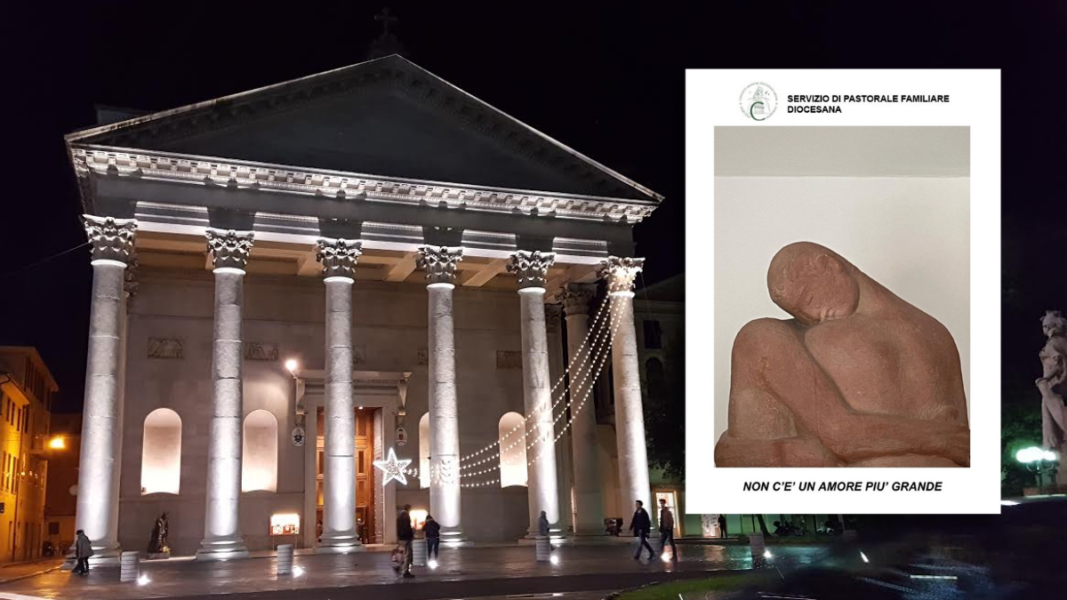
The Italian diocese of Chiavari has published a brochure in which homosexual couples and civil unions of divorced people are presented as legitimate expressions of “Christian family.” The initiative, promoted by the diocesan family pastoral, represents an open break with the Church’s teaching on marriage and family.
The booklet is titled Non c’è amore più grande (There is no greater love) and has been prepared by the Diocesan Family Pastoral Service, directed by Don Marco Torre. According to La Nuova Bussola Quotidiana, the introduction explains that the objective is “to collect love stories from our diocese.” However, the criterion that guides the selection of testimonies is not fidelity to the Gospel or the living of the sacrament of marriage, but a subjective and sentimental notion of love, detached from Christian morality.
“Love” as the absolute criterion
Far from proposing models of conjugal life oriented toward holiness—such as marital fidelity, openness to life, or perseverance in trial—the brochure prioritizes situations that the Church has always considered objectively disordered. “Imperfectness,” presented as a pastoral value, is not understood here as human weakness on the path of conversion, but as an assumed and justified contradiction in the face of doctrine.
Thus, stable sacramental marriages are equated without distinction with homosexual couples, believers or not, and with divorced people remarried civilly. Everything is subsumed under a generic idea of “love,” repeated insistently but never defined in the light of revealed truth.
Homosexual couples as a pastoral example
Among the highlighted testimonies is that of Marco and Michele, a homosexual couple who live together and actively participate in parish life. Both recount how positive it is for them to “live more freely” their relationship within the ecclesial community and emphasize their involvement in choirs and parish groups.
The space given to their story is not anecdotal. The text itself explicates the objective of “tearing down the walls of division” that—according to its authors—have prevented the full participation in the Church of people belonging to the sphere of “homoaffectivity.” An approach that contradicts not only the Catechism of the Catholic Church, but also the warnings issued in 1986 by then-Cardinal Joseph Ratzinger about the ideological pressure from LGBT groups to change the Church’s moral doctrine.
Normalization of relationships contrary to doctrine
The brochure also includes the testimony of Gianluca, a homosexual man whose partner is not a believer and maintains a critical attitude toward the Church. This circumstance, far from being presented as an obstacle, is shown as an enriching experience compatible with a full living of the faith and ecclesial communion.
In the same vein, the story of Alessandra and Luca is included, a couple of divorced people united civilly who resort to a broad interpretation of Amoris Laetitia (n. 297) to justify their situation. Both acknowledge having “violated God’s rules,” but claim to do so to better understand His face, without renouncing the new union they maintain.
Episcopal silence and worrying precedents
To date, the Bishop of Chiavari, Monsignor Giampio Devasini, has not publicly commented on the publication. However, the diocese has precedents that invite concern. Don Marco Torre himself organized two years ago, in the diocesan seminary, LGBT-themed initiatives in collaboration with the Tenda di Gionata association.
Additionally, in the locality of Rapallo—belonging to the same diocese—activities linked to associations that organize events on “sexual health” from parish facilities have been promoted, as denounced by Italian media.
A pastoral drift that does not seem accidental
The publication of Non c’è amore più grande cannot be interpreted as an isolated error or a mere pastoral excess. It is an operation consistent with a line that progressively dilutes the Christian notion of family and presents as fully integrated into ecclesial life situations objectively contrary to Catholic morality.
After the vigils against so-called “homophobia” and the normalization of ideological language, the next step seems to be the practical acceptance of homosexual relationships and irregular unions as a constitutive part of the Christian family, all with the silence—or consent—of episcopal authority.