


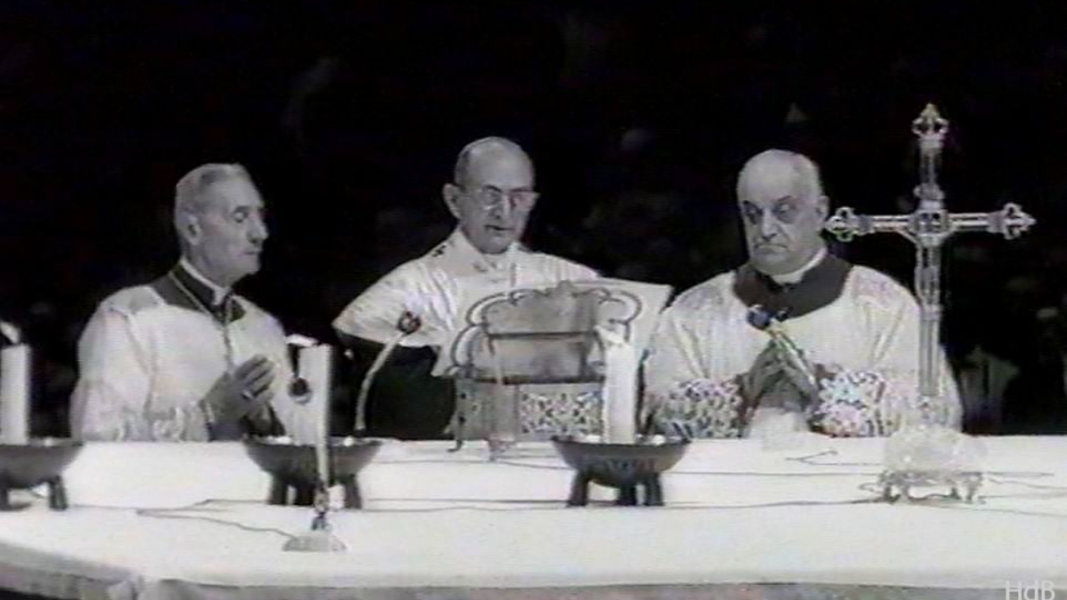
Sixty years ago, in December 1965, Pope Paul VI celebrated in St. Peter’s Square the Mass that solemnly closed the Second Vatican Council. That liturgy, remembered by witnesses as simple and participatory, was presented at the time as a visible application of the Sacrosanctum Concilium, the conciliar constitution on the sacred liturgy.
However, as The Catholic Herald recalls, that Mass bore no resemblance to what is today commonly identified as the “Vatican II Mass.” It was an essentially traditional celebration, in Latin, with Gregorian chant and some prudent simplifications, explicitly approved by the conciliar Fathers, who never imagined a break with the Ordo Missae inherited from centuries, or did they?
The 1965 reform: continuity, not rupture
During 1965, a new Ordinary of the Mass was introduced, officially published by the Holy See in January of that year. It was received at the time as the reform requested by the Council. Its changes—simplification of gestures, expansion of the number of prefaces, some prayers aloud, verbal participation of the faithful—had been debated and approved by the bishops, under a clear premise: the traditional Ordo Missae must be preserved.
Neither the versus populum celebration, nor communion in the hand, nor the complete substitution of Latin by vernacular languages were proposed or voted on in the conciliar hall. Latin was to be maintained, with limited use of the local language permitted in certain parts.
Paul VI and the “new form of liturgy”
On March 7, 1965, Paul VI publicly celebrated this reformed Mass in a Roman parish and stated: “Today we inaugurate the new form of the liturgy in all the parishes and churches of the world.” For the Pope, it was not a provisional stage nor a transition to something radically different.
The truly revolutionary element of that celebration was the extensive use of Italian, authorized quickly and expansively by the bodies responsible for implementing the reform, especially the Consilium, directed by Monsignor Annibale Bugnini, who later boasted of having given a “broad” interpretation to the conciliar principle of the use of the vernacular.
From organic development to “fabricated liturgy”
While the bishops returned to their dioceses after the Council, the Consilium was already advancing toward a very different project: the so-called “normative Mass,” which would eventually give rise to the Novus Ordo promulgated in 1969. Those drafts no longer sought to preserve the inherited rite, but to construct a new one, using the ancient as mere reference material.
The initial Confiteor, the Orate fratres, the sacrificial gestures disappeared; even the Roman Canon was questioned and new Eucharistic Prayers were prepared. The then-Cardinal Joseph Ratzinger would later describe this process as the shift from a liturgy born of organic growth to a “fabricated liturgy,” a laboratory product.
A reform beyond what the Council intended
When the new Missal was promulgated in 1969, the changes far exceeded what had been approved by the Council: new Eucharistic Prayers, a theologically impoverished offertory, a drastic reduction of signs, and a complete reconfiguration of the liturgical calendar. Even Paul VI had to intervene personally to preserve some traditional elements, although many were left as mere “options” quickly abandoned.
Various conciliar Fathers would later express their bewilderment. Cardinal John Heenan wrote that the changes had been “more radical than Pope John XXIII and the bishops intended.” Others, like Bishop Ignatius Doggett, spoke bluntly of a reform “hijacked” and transformed into something that was never debated or approved.
Questioning the modern rite is not betraying the Council
In light of these facts, the article underscores an uncomfortable conclusion: the 1970 Missal is not the Mass requested by Vatican II. It is a later product, sacramentally valid and authorized by the Pope, but born of an ideological and expansive interpretation of the conciliar constitution.
Therefore, questioning the modern rite or calling for a “reform of the reform”—as Ratzinger and Benedict XVI did—does not imply disloyalty to the Council, but rather, in many cases, fidelity to what its Fathers actually approved.
The persistent appeal of the traditional rite
Paradoxically, The Catholic Herald maintains, it is in the celebration of traditional rites where today one finds most clearly what the Council desired: full, conscious, and fruitful participation in a received liturgy, not a fabricated one. Especially among the young, interest grows in a form of the Mass that preserves doctrinal continuity, symbolic richness, and a sense of sacrifice.
Sixty years later, the question remains open: is it possible to recover the authentic “Vatican II Mass”? Everything indicates that, without a profound review of the subsequent reform, that aspiration will remain an unfinished task.