


Holiness,
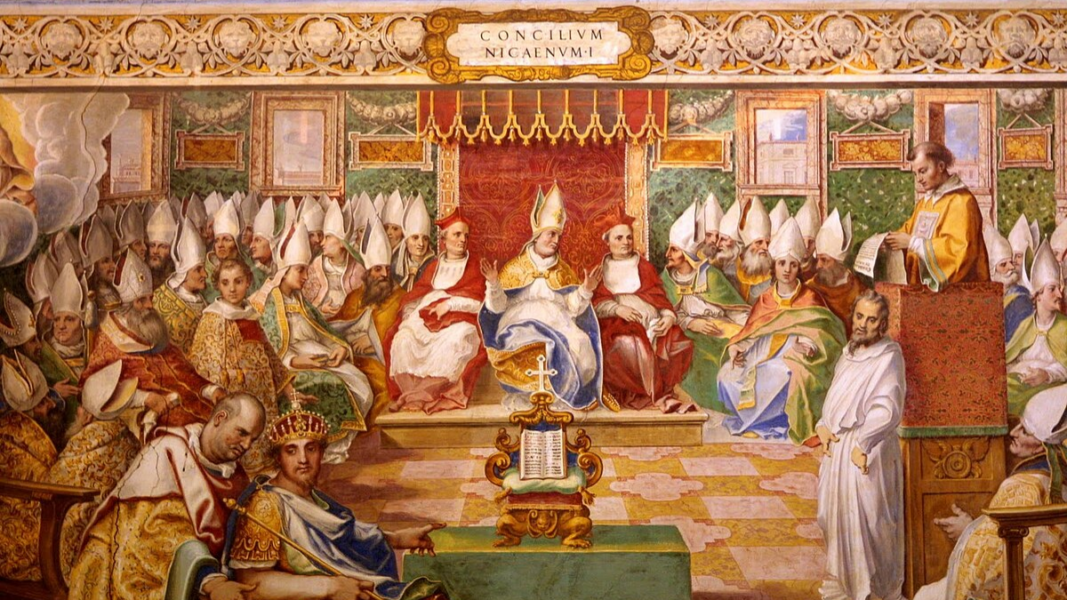
I present this new letter with the critical consideration of the document indicated in the title, and whose most relevant text will appear in italics; but before that, I would like to warn that, although it may seem unbelievable, the greatest danger to the orthodoxy of Nicaea was not radical or anhomean Arianism, which, by denying any similarity between the nature of the Father and that of the Son, also radically denied the divinity of the latter, but the multitude of intermediate movements, known as semi-Arians: those of the homeos and the homeousians; for, as the distance between the divine and the created is infinite, in the end there are no half-measures, and moreover it is already said that the most dangerous thing is a half-truth, as it is the most effective way to subtly corrupt the truth.
5- To express the truth of the faith, the Council used two words, “substance” (ousia) and “of the same substance” (homooúsios), which are not found in Scripture. In doing so, it did not intend to replace biblical statements with Greek philosophy. On the contrary, the Council employed these terms to affirm the biblical faith clearly, distinguishing it from Arius’s Hellenizing error. The accusation of Hellenization does not apply, therefore, to the Fathers of Nicaea, but to the false doctrine of Arius and his followers.
It cannot be denied what is evident: that “ousía” is a Greek philosophical notion, and that “homooúsios”, therefore, is a notion derived from Greek philosophy, so the Council certainly replaced biblical statements with others that are philosophical and, hence, much more precise; that, obviously, did not mean a canonization of Greek philosophy, but it did justify resorting to the achievements of human reason to safeguard the fundamental rationality of the faith.
There lies the great difference with Islam, which had a brilliant rationalist outburst but ended up suffocating it in favor of a strictly literalist interpretation of the Quran, which in Christianity occurred, in a similar way, with the Protestant Reformation; while the greatness of the Fathers of the Church was to have achieved the admirable synthesis of faith and reason that Catholic theology entails.
The Fathers of the Church were as Hellenized then as Arius, only that the former took advantage of the Greek conceptual apparatus to create a technical and precise doctrinal system that prevailed due to the magisterial approval it obtained, but which in itself not only differs greatly from the biblical mentality, but would not even be the only hermeneutical possibility to translate the succinct biblical data, which summarily indicate the total divinity of Christ, his incarnation and some type of difference with the Father and the Holy Spirit; but what type of difference: real or notional? It does not appear explicitly in the literalness of the biblical text, to which one cannot demand a philosophical precision that is alien to the mentality with which it was written.
It could be argued that the biblical mentality was usually realist, so it would be unlikely that it was thinking of a merely notional difference, which assumes a greater philosophical elaboration; however, if the same is applied strictly to the Old Testament, it would result that wisdom and the spirit of God, for example, should already be understood as really distinct from the Father, which would place the explicit teaching of the Trinity in that Testament, which is impossible, since there the divine unity prevails above all, and therefore Christ could not use as an argument his identification with a divine person distinct from the Father, since such an idea was not recognized in his time; therefore, if, when Christ expresses an identification with the Father, we know that he is proclaiming his own divinity, because that accusation founded his final condemnation, and He did not bother to dilute it to avoid the danger, we cannot, from the Bible alone however, delimiting strictly the literary intention of the realist, know exactly, when he expresses some difference with the Father and the Spirit, what type of difference he refers to.
Positively, the Fathers of Nicaea wanted to remain firmly faithful to biblical monotheism and to the realism of the Incarnation. They wanted to reaffirm that the one and true God is not unattainably distant from us, but on the contrary, has drawn near and come to meet us in Jesus Christ.
This wording is not at all happy, as it perfectly accommodates the idea that either there is only one person in God who has become incarnate in Christ, or Christ is a human person with some special relationship with God, which is neither true in the intention of the conciliar Fathers nor in the text of the resulting creed.
6- To express its message in the simple language of the Bible and of the liturgy familiar to all the People of God, the Council takes up some formulations from the baptismal profession: “God from God, light from light, true God from true God”.
Those expressions generated no problem, nor do they serve to express the essence of Nicaea, which resides entirely in a single term: the “homoousios”, which is not biblical but strictly philosophical in its origin; therefore, it is not valid to say that the concern of the conciliar Fathers was to express their message in the simple language of the Bible and of the liturgy familiar to all the People of God.
7. The Creed of Nicaea does not formulate a philosophical theory. It professes faith in the God who has redeemed us through Jesus Christ.
The Creed of Nicaea uses a philosophical theory to explain the faith, giving official origin to strict theology, which consists in the application of reason, with all its methodology, to the data of faith, in order to achieve a precise rational explanation of it.
It is the living God: He wants us to have life and to have it in abundance (cf. Jn 10,10). That is why the Creed continues with the words of the baptismal profession. (…) This makes it clear that the Council’s christological statements of faith are inserted into the history of salvation between God and his creatures.
The fundamental affirmation of the Council: the “homoousios”, abstracts from all historico-salvific consideration.
Saint Athanasius (…) repeatedly and effectively underlined the soteriological dimension that the Nicene Creed expresses. He writes in fact that the Son, who descended from heaven, “made us sons for the Father and, having become man himself, divinized men. It is not that being man he later became God, but that being God he became man in order to divinize us”.
If we can become divinized, why could not Christ also have been divinized? How can one speak of human divinization without incurring flagrant pantheism? Obviously I am not denying supernatural human divinization, but indicating that even from supernaturality it is an extremely difficult matter, and I think it is not yet well resolved in official theology.
Only if the Son is truly God is this possible: no mortal being, in fact, can overcome death and save us; only God can do it.
If we, who are by nature mortal, can be divinized, it is evident that we could then also overcome death in our own divinization, and it would no longer be true that only God could overcome it.
It will be said that we can overcome it as a gift from God, which is fine; but has it not also been said that we overcome it by being divinized? And then we should be able to consequently attain everything that God is, including his omnipotence, eternity, necessity, etc. Or what divinization are we talking about? Evidently, that word remains very beautiful and expressive, but I reiterate that it generates immense and very thorny problems as soon as one seeks minimal precision.
The Nicene Creed does not speak to us, therefore, of a distant, unattainable, immobile God who rests in himself, but of a God who is near us, who accompanies us on our way through the paths of the world and in the darkest places of the earth.
How is it that God is not distant, nor unattainable, nor immobile? Where does Nicaea deny divine transcendence and immutability? Precisely what it does is apply them to the Son in the same sense as they are applied to the Father.
The Incarnation is another question, which obviously does not strictly affect divinity in itself.
This revolutionizes pagan and philosophical conceptions of God.
There is no revolution of the pagan philosophical conception of God, for, in the case, for example, of the Aristotelian system, Catholic theology has continued to apply, in general terms, its ideas to the divine nature; the revolution is in the very notion of the Trinity, which theology has strived to explain from rational parameters, because that is precisely its mission.
Another word from the Nicene Creed is particularly revealing for us today. The biblical affirmation “he became flesh”, specified by adding the word “man” after the word “incarnate”. Nicaea thus distances itself from the false doctrine according to which the Logos would have assumed only a body as an outer garment, but not the human soul, endowed with understanding and free will.
Here one must be very careful, because the human nature of Christ was not free apart from the divine, but obviously, and without giving reason to the monotelite heresy, there is a necessary moral unity, not of nature, between the divine will and the human will of the one person of the Word.
On the contrary, it wants to affirm what the Council of Chalcedon (451) would declare explicitly: in Christ, God has assumed and redeemed the whole human being, with body and soul.
Indeed, there was a complete assumption of the human nature of Christ, but in the one person of the Word, which imposes a radical coherence of the human nature with the divine both at the intellectual level—and hence the magisterium speaks of the beatific vision—as at the volitional level, from which results the aforementioned moral unity.
The Son of God became man—so explains Saint Athanasius—so that we men could become divinized.
This, as has been said, is as beautiful as it is difficult to explain rationally, and not out of mere rational curiosity, but out of the theological need to achieve a coherent explanation that excludes every aberrant deviation.
Divinization has nothing to do with man’s self-deification. On the contrary, divinization protects us from the primordial temptation of wanting to be like God (cf. Gn 3,5). What Christ is by nature, we come to be by grace.
True, but a pantheism by grace would still be pantheism; therefore, one must explain how a non-pantheistic divinization is possible.
Through the work of redemption, God has not only restored our human dignity as image of God, but He who created us wonderfully has made us, in a more admirable way still, partakers of his divine nature (cf. 2 P 1, 4).
The divine nature, given its absolute simplicity, is imparticipable, and moreover that biblical quotation does not speak literally of participation, but of consortium, which is something much broader.
Divinization is, therefore, true humanization.
This is simply a contradiction, for the divine nature and the human nature are incommensurable with each other and, hence, the divine cannot be considered as the goal or perfection of the human; do you see now why I have been warning of the dangers of the notion of divinization?
Here, having exceeded the most elementary precaution, there is, in short, an evident literal heresy that goes in the line of Dignitas infinita, but even surpasses it, by not limiting itself to introducing divine rights into human nature, but by placing the culmination of the latter in attaining the divine, which would then no longer be properly transcendent; these dogmatic texts are contradicted: Dz 432: When the Truth itself (…) says: «Be perfect, as your heavenly Father is perfect», it is as if it said more clearly: «Be perfect by the perfection of grace, as your heavenly Father is perfect by the perfection of nature», that is: each in his own way, because such similarity cannot be affirmed between the creator and the creature, without affirming greater dissimilarity. If anyone, therefore, dares to defend or approve in this point the doctrine of the aforesaid Joachim (of Fiore), let him be rejected by all as a heretic; Dz 1701: Errors of our age (…): God is becoming in man and in the world; Dz 1782: There is one true and living God (…), infinite (…) in every perfection, who (…) must be preached as distinct from the world really and essentially (…), and ineffably exalted above all; Dz 1804: If anyone says that finite things, whether corporeal or spiritual, or at least the spiritual, have emanated from the divine substance, or that the divine essence by manifestation or evolution of itself becomes all things, (…) let him be anathema; and Dz 2108: The other doctrine on divine immanence leads to pure and shameless pantheism, because we ask: does this immanence distinguish God from man, or does it not distinguish him? (…) If it does not distinguish him, we have pantheism; (…) God is one and the same thing as man; hence pantheism.
Although the original temptation to become like God has been criticized before: “self-deification”, now reason is being given to it, for, as every nature has the right to attain by itself its own perfection, it results that, if the perfection of the human is in attaining divinity, this achievement no longer requires any grace, which is always supernatural and undeserved, but rather, it is strictly due to human nature, and man would only be honoring his own right by demanding it from God.
This is so grave that it only finds a parallel in the central thesis of the North American Masonic sect of the Mormons, which says that God was man, but not by Incarnation, but because he arose as man and became God, which is what we too could become from Mormonism.
It repeats then, but at an even more radical level, the phenomenon that already occurred in Francis’s magisterium: the appearance of formal heresies, from which it is supposed that the pontifical magisterium, even the ordinary one, should be exempt by the assistance of the Holy Spirit, as explained in point 892 of the official Catechism of the Catholic Church; however, the patent fact is there, and I simply fulfill my ministerial obligation to denounce it, as point 2088 of the same Catechism says: “The first commandment requires us to nourish and guard our faith with prudence and vigilance, and to reject everything that opposes it”, and the Code of Canon Law recalls in canon 750: “All are obliged to avoid any contrary doctrine”, and even Dz 1105 condemns this thesis: “Even if it is evident to you that Peter is a heretic, you are not obliged to denounce him, if you cannot prove it”; therefore, it is clear that not even he who passes as Peter can be exempt from reproof in matters of faith.
This is why man’s existence points beyond itself, seeks beyond itself, desires beyond itself and is restless until it rests in God: Deus enim solus satiat, only God satisfies man! Only God, in his infinity, can quench the infinite desire of the human heart, and that is why the Son of God wanted to become our brother and redeemer.
It is true that man’s desire, due to its rational character, tends to infinity, but in an imprecise way, for one cannot desire what one does not know, and humanly one cannot know in itself the real infinity of God; therefore such desire lacks a strict formal object and gives no right, but only evidences the human intentional openness to the divine mystery.
It may seem that a human obediential potency should be derived from existence in the same nature; but, as every potency must, by definition, have an act that fulfills it and to which it is ordered, which does not occur here, since divinization—and that is a capital key—cannot be fulfilled at the level of nature, it follows the utter impropriety of speaking of human obediential potency, but rather one should limit oneself to pointing out an imprecise tendency; the consideration is added of the counterproductive character of that same desire for human nature, which, by desiring what is in itself mysterious, recognizes not only its inability to attain it, but also obliged to deny itself for it, by having to desist from the natural demand to understand everything.
11- Love of God without love of neighbor is hypocrisy; radical love of neighbor, especially love of enemies without love of God, is a heroism that surpasses and oppresses us.
Radical love of neighbor is completely impossible for human nature, which, always desiring what presents a reason of good for it, shows its medullarly selfish character; therefore there is no true natural love other than the divine, in which the Father does not love the Son for himself, which would indeed be selfish, but for the Holy Spirit, who thus is the person resulting from that act of love, as the Son is from the act of self-knowledge of the Father; consequently, it makes no sense to speak of any heroism, when this simply refers to what is very difficult or impossible in an ordinary way, but not in an extraordinary way, as would also be the case.
12- Although full visible unity with the Orthodox Churches and Oriental Orthodox Churches and with the Ecclesial Communities born of the Reformation has not yet been given to us, ecumenical dialogue has led us, on the basis of the one baptism and the Nicene–Constantinopolitan Creed, to recognize our brothers and sisters in Jesus Christ in the brothers and sisters of the other Churches and Ecclesial Communities and to rediscover the one and universal Community of Christ’s disciples throughout the world.
What sense does it make to speak of a single and universal community of Christ’s disciples? Is that community the one that realizes the constitutive notes of the Catholic Church: unity, holiness, catholicity and apostolicity? Is not the dogma that the Catholic Church is the one visible Church of Christ being denied then, while all the others are not, by the very fact of separation, and thus only have the saving means they have preserved from the Catholic Church, and which are fruitful only in those who remain there out of invincible ignorance and, hence, blameless?
Who is no one to downgrade the importance of the Catholic Church, equating it with other churches, when only the first is the one spouse of Christ, instrument of the Spirit, and effective sacrament of salvation? Thus, the sacraments that other churches have function because, in reality, they are not of these but of that one, and, at most, these separated churches could be compared, for what they maintain of the Catholic one, to sacramentals, whose fruition is limited to the subject’s availability; that is: depending on the already mentioned blamelessness that he has in his personal situation of separation.
We in fact share the faith in the one and only God, Father of all men, we confess together the one Lord and true Son of God Jesus Christ and the one Holy Spirit, who inspires us and impels us to full unity and common witness to the Gospel. What really unites us is much more than what divides us!
As denying a single dogma is enough to lose the Catholic faith entirely, it is ridiculous to speak of how much unites us, for, until communion in all Catholic doctrine has been achieved, nothing effective has been done for real union.
In order to exercise this ministry in a credible way, we must walk together to achieve unity and reconciliation among all Christians.
That unity can only be achieved from communion in the integrity of Catholic doctrine.
The Creed of Nicaea can be the basis and reference criterion of this path. It proposes to us, in fact, a model of true unity in legitimate diversity.
In matters of faith there is no legitimate diversity, since every dogmatic divergence supposes total rupture.
Unity in the Trinity, Trinity in Unity, because unity without multiplicity is tyranny, multiplicity without unity is disintegration.
It is pure rhetoric without the slightest sense, for what do the unity of nature and the trinitarian personal multiplicity have to do with the unity of faith of the Church, which admits no minimal dogmatic discrepancy?
The trinitarian dynamic is not dualistic, like an excluding aut-aut, but a bond that implies, an et-et.
That scheme has no application in the trinitarian case, founded on absolute unity and relative multiplicity.
We must leave behind theological controversies that have lost their raison d’être in order to acquire a common thought and, even more, a common prayer to the Holy Spirit, so that he may gather us all into one faith and one love.
It is incomprehensible to speak of “theological controversies that have lost their raison d’être”, when historically all ruptures have been due to such considerable dogmatic differences that they have justified the declaration of excommunication on the part of contemporary popes.
This does not mean an ecumenism of return to the pre-division state, nor a reciprocal recognition of the current statu quo of the diversity of Churches and Ecclesial Communities, but rather an ecumenism oriented to the future, of reconciliation on the path of dialogue, of exchange of our gifts and spiritual patrimonies.
Pretending a return to the previous state would be to deny all the dogmatic development carried out by the Catholic Church, and, in turn, to validate the current situation would be to relativize the doctrine of this same Church; but speaking of looking to the future is something as hackneyed as gratuitous, for in the future there is nothing yet, and no matter how much one looks, nothing will appear until it becomes present.
It is a theological challenge and, even more, a spiritual challenge, which requires repentance and conversion on the part of all.
That is true: conversion is always necessary, since historically there are usually errors and sins on the part of all; but conversion must be, above all, toward the truth, and the only full truth is that of Catholic doctrine, although clarifications and deepenings are always possible; therefore Catholics must convert morally, but not doctrinally, and the Catholic Church may recognize many historical errors, but none strictly in its doctrine, but rather in this the non-Catholics are the only ones who have to correct the errors.
Come, Love of the Father and the Son, to gather us into the one flock of Christ.
The one flock of Christ is the Catholic Church, governed and pastured by the only legitimate shepherds, who truly represent Christ.
It is not understood that first, in the joint act with the schismatic patriarch of Constantinople, the “Filioque” was omitted, to profess the Nicene-Constantinopolitan creed as such, which is already wrong, because that addition is fundamental to establish the divinity of Christ and the personality of the Holy Spirit, and to distinguish their respective processions, and that then in this text it goes beyond the same addition, assuming the psychological trinitarian theory of Richard of Saint Victor, which reduced the whole psychological process to a single act: love; and thus distinguished the procession of the Son as an act of love of the Father to the previous one, and that of the Holy Spirit as a mutual act of love between the Father and the Son, who thus would have to appear as a single principle of two distinct acts: that of each one’s love for the other. Saint Thomas also tried, in some way, to assume and integrate this theory (Summa Theologica I, q. 36, a. 4, and q. 37, a. 2); but there is an insoluble stumbling block, since acts, even springing directly from nature, have as their fundamental principle the subject or person, who thus is the one who constitutes them numerically; which means that, although a single subject can perform many acts, however, a single act can only be performed by a single subject, for the act of another subject is necessarily a distinct act, having to be reduced to a single fundamental principle; by which the intransferable character of the subject is seen, who can, obviously, communicate an act, but not what the subject exclusively puts in his own act: the communication itself, which can only have a sending subject, while any other subject can only be a receiver.
There is no choice but to recognize that there the Angelic Doctor erred, making the distinction—impossible in an exclusive way—between the essential and notional senses of the same act: that of loving, and between “spirator” and “spirant”, when, on the one hand, every act, springing immediately from nature, must necessarily have an essential sense, and, on the other hand, it cannot be said that, being two spirants, the Father and the Son are not also two spirators, for it is evident that in both cases they are designated as agents of spiration; now, as every act must have its fundamental principle or producing subject, which can only be one, by being the one who principally individualizes the act itself, then the spiration act, having to be only one so that a single receiving person springs—the Spirit—, can correspondingly have only one sending person, regardless of the name given to it. This acquires even greater force in the divine case, insofar as the divine acts, having to be completely perfect, can only be distinguished by the terms and not by any imperfection, which is what makes, for example, a single human subject have to apply many acts to the knowledge of the identical object; therefore, as in divinity only two psychological acts fit: the intellective and the volitive, only one sender and one receiver fit for each, and hence a single act is incapable of distinguishing three subjects.
It will then be asked if, if the Father must be the only sender of the two acts, while the receiver of the first will be the Son, and of the second the Spirit, how is it possible to affirm that the latter also proceeds from the former; and it is answered from the psychological consideration of said acts, since, on the one hand, as one can only love what one knows, the volitive act necessarily depends on the intellective, and, on the other, the sense of the act from which the Spirit proceeds consists, as was anticipated, in that the Father, having known himself in the Son, loves him, not for himself, which would suppose egoism, but for the Son. Thus it can be seen how the procession of the Spirit depends on that of the Son and also on the person himself of the Son, and in that sense it is said that the Spirit proceeds also from the Son, and not only from the Father.
It follows, first, that, although the expression “Filioque” is, obviously, correct—since the Spirit also proceeds from the Son—, the expression “Per Filium” is however more accurate by being precise, since the Spirit does not proceed from the Son as from the proper sender, who is only the Father, but the Son only intervenes passively in that procession; the second derivation is that, if it is clear that the Son then remains in total passivity within the Trinity, the same must be said, and with more reason, of the Spirit, who moreover does not intervene in the production of any act. Therefore, the distinction between the notional and essential sense of the acts is trivial within the Trinity, since there every act is, in reality, essential, by springing directly from the essence, and notional, by having as ultimate subjects those whom each act constitutes, while the exclusively essential sense only occurs in “ad extra” acts, in which the trinitarian persons—who appear exclusively, given their strictly relative character, in the relations established by the “ad intra” acts—act as a single principle. It can be seen, in short, how applying that same “ad extra” argument to an “ad intra” act, so that it can also be affirmed that several sending persons act as a single principle, is a great error that confuses two such disparate planes; but rather then, in the procession of the Spirit, only one person—the Father—can act actively as sender, while the Son can only act passively, although he is not the receiver of the procession—which is the Spirit—, but of the act of love of the Father, which comes to indicate that the psychological act founds the procession, but is not the procession itself, but that, in the case of the second, the act, with the Father as sender and the Son as receiver, has a different scheme from that of the procession, in which the receiver is the Spirit, and the sender the Father through the Son. That difference lies in that the procession is the communication itself that founds every relation, while the psychological act expresses the relations that each procession establishes, and that, in the case of the first procession, is a single one: the one given between the Father and the Son, since the Father does not know himself in himself, which is impossible, but in the Son; and, in the case of the second procession, they are two: the one given first between the Father as lover and the Son as beloved, and the one also given between the Son as beloved and the Spirit as beneficiary of that love, since the Father, as was said, does not love the Son for himself but for the Spirit.
A transcendental corollary due to its scope is that, as the solipsistic conception of divinity, proper to Aristotle, for whom God is self-thinking thought, is impossible—for without real distinction of terms there is no real relation, and without this there is no real act either—, every unitary monotheistic conception, such as, for example, the Islamic one, converges in a completely inactive God, incapable of performing any real act, for lacking a also real term on which to act, to relate really; in sum, the Trinity is the only logical possibility to conceive an active divinity, from which it does not follow, however, that the Trinity is accessible to human reason alone, which, in fact, has only been able, in its indigence, to realize this after the knowledge of the trinitarian mystery through Christian revelation.
Indicate to us the paths to be followed, so that with your wisdom we may become again what we are in Christ: one thing, so that the world may believe.
It is false that all Christians are already one thing in Christ, for the Catholic Church is a necessary means to unite with Christ, and only those who, being visibly outside, are affected by invincible and blameless ignorance, can be really united to Christ, being implicitly united to the Catholic Church.
Note: The articles published as Tribuna express the opinion of their authors and do not necessarily represent the editorial line of Infovaticana, which offers this space as a forum for reflection and dialogue.