


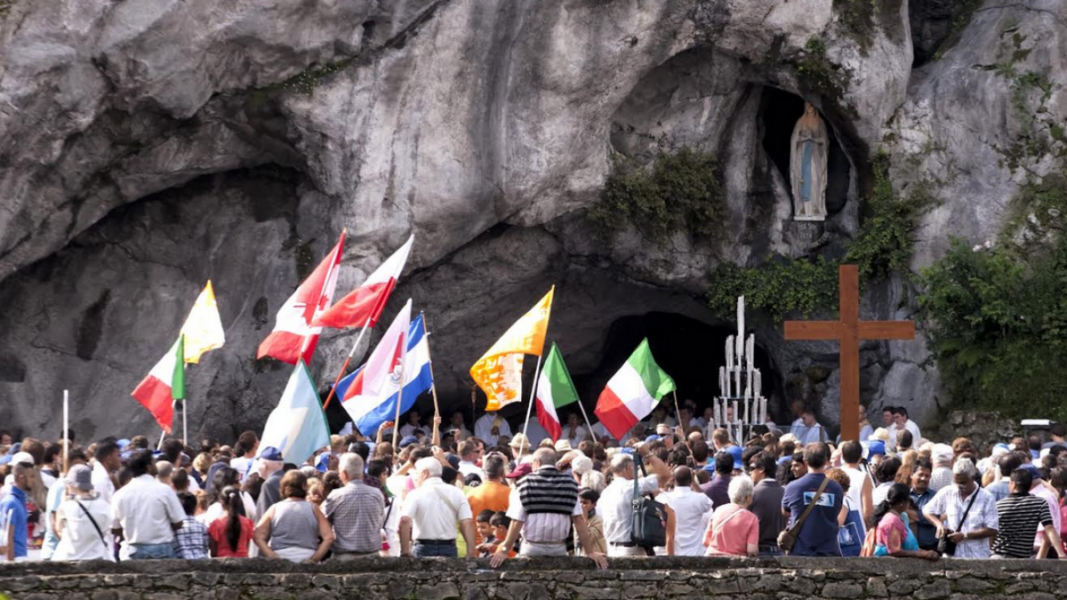
A few years ago, two friends and I began a tradition, interrupted only during the pandemic years, of pilgrimage to Lourdes for the Solemnity of the Immaculate Conception of the Virgin Mary, as that was the message Mary gave to Saint Bernadette: “I am (was) the Immaculate Conception,” in 1858.
It is a journey that we take very seriously. We spend three nights in Lourdes in total silence and fasting, which we break only on the day of the Solemnity. During those three days, we arrive early at the sanctuary, attend Mass, and then each one organizes her day personally, with adoration of the Blessed Sacrament, Way of the Cross, confession, nighttime torch-lit rosary, etc., and praying in various places in the sanctuary throughout the day.
A few years ago, however, I began to find in Lourdes that the existence of different languages everywhere is actually an inconvenience and a discomfort, starting with the Mass. In the Lourdes sanctuary, various Masses are celebrated each day, each in a different language. We usually went to the one celebrated at 11 a.m. in the Chapel of Saint Joseph, an ugly temple, underground, with pews like bleachers and the altar in the lowest part of the temple. The world upside down of modern churches.
The second discomfort came from the beautiful nighttime torch-lit rosary: each mystery announced in a different language, and the faithful responding in their own languages. Despite the beauty of the rosary’s development, its recitation over the loudspeaker in different languages is annoying, chaotic, and confusing; like a cacophony.
Wouldn’t it be more logical that in an international sanctuary the rosary be prayed in Latin and that there be at least one Mass in Latin, in which faithful from different nationalities could participate together without barriers? The use of Latin is something, moreover, contemplated by the Missal of Paul VI. Isn’t that the catholicity, the universality of the Church, to which the common language so much contributes? And isn’t it, therefore, not only an obstacle, but a punishment, the balkanization of the Church in vernacular languages?
After the Covid19 pandemic, when I began attending the traditional Mass, I discovered that a traditional institute (ex Ecclesia Dei) has a house in Lourdes and a priest celebrates the traditional daily Mass at 6 p.m., outside the sanctuary grounds, but relatively close. There one can experience that catholicity of the Church that the sanctuary lacks, in a Mass attended by people – I imagine – from different backgrounds, locals and pilgrims, and that all can follow in the universal language of the Church helped by their respective missals. As it was always done and as it should be done again; because to the inferiority of the novus ordo for rendering worship to God compared to the beauty of the vetus ordo is added the fragmentation of language.
These discomforts due to the division by national languages that I have experienced in this pilgrimage which I believe otherwise helps me so much in faith and love for the Most Holy Mary and to “touch” the universality of the Church, have made me keep very present in the trips to Lourdes, and very vividly in this past week, the similarity that this Church fractionated in vernacular languages that prevents faithful from different backgrounds from praying together has with the biblical passage of the Tower of Babel.
In addressing the question of Latin in his 2014 work “Resurgent in the Midst of Crisis: Sacred Liturgy, Traditional Mass, and Renewal in the Church,” which was for me a violent awakening, Professor Peter Kwasniewski argues how “Latin is the language appropriate to the Roman rite; it is the “Catholic” language of Christendom, which rises above all nations, peoples, cultures, and ages. For a number of historical reasons, Latin became the vehicle of formal, public worship in all the particular churches gathered around the Throne of Peter in the western part of the ancient Roman Empire, and so it was always preserved. Its antiquity and extent of use, its clarity and stability of meanings, its subtle beauty of expression, endow Latin with all the qualities required for a cultus public, which is always ancient, always new, noble and solemn, absolutely free from the whim of worldly fashions”.
Beyond the case of Lourdes, paradigmatic because it is an international sanctuary, regarding the translation of the Mass into vernacular languages, Kwasniewski states that “far from strengthening the power and influence of the liturgy in the life of Catholics, the sudden vernacularization of the liturgy, by giving rise to the illusion of easy understanding and passivity, has made it much more difficult for people to achieve a constant interior awareness of the depth, magnitude, gravity, and urgency of the action in which they participate. The priest facing the people, even at the moment of the divine sacrifice, along with the use of the vernacular, has strengthened the impression that what is taking place is something direct and simple, and not something tremendous, a mystery whispered in the presence of God.” In comparison with the mystery of the traditional Mass, the form called by Benedict XVI “ordinary,” the novus ordo Missae, remains, as Kwasniewski states, “overwhelmingly verbal, didactic, and linear, in a way that is strangely alien to the entire liturgical Tradition, both Eastern and Western.” And it is no less true that the use of the vernacular has greatly contributed to the evident loss of sacrality.
It is in the context of catholicity that Lourdes, Fatima, or a pilgrimage to Rome can make it very easy to become aware of this division caused by vernacularization; while it is more difficult to realize it in a comfortable parish bubble where the parishioners share a language. However, the problem of the abandonment of Latin, again, beyond Lourdes, is that the translation of the Mass into different vernacular languages not only divides the faithful, but adulterates the Mass, since there are passages translated, it seems, deliberately erroneously.
We said a few paragraphs above that the situation of the Lourdes sanctuary recalls the punishment of fragmentation and division in languages that the Lord sent to those who were building the Tower of Babel. Let us review that biblical episode to delve deeper into the question of the vernacularization of the Church. Why did the Lord create different languages?
In the book of Genesis we read that “the whole earth had one language and the same words. But when men, migrating from the East, found a plain in the land of Shinar where they settled, they said to one another: ‘Come, let us make bricks and bake them well.’ And the brick served them in place of stone, and the bitumen served them as mortar. And they said: ‘Come, let us build ourselves a city and a tower whose top may reach to heaven; and let us make a monument so that we may not be scattered over the surface of the whole earth.’ But the Lord came down to see the city and the tower that the sons of men were building. And the Lord said: ‘Behold, they are one people and all have one language. And this is only the beginning of their works! Now nothing will prevent them from realizing their purposes. Come, then, let us go down and there confuse their language, so that one does not understand the speech of the other.’ Thus the Lord scattered them from there over the surface of the whole earth; and they ceased building the city. Therefore, it was called Babel; because there the Lord confused the language of the whole earth; and from there the Lord scattered them over the whole face of the earth” (Gen 11:1–9). Commenting on the name of Babel, Msgr. Straubinger states that “it would be a counterposition to Balbel, which means in Hebrew something like ‘confusion,’ and it is a popular etymology that expresses contempt for Babylon.” Basically, God made the Babel project fail by confusing the languages, because men had rebelled against Him again; rebellion motivated by pride to achieve glory and perpetuate their own memory forever (Gn 11:4), a prerogative that belongs only to God.
The vernacularization of the Church can therefore be seen as human rebellion and as divine punishment. For it has brought nothing good. It has not brought harmony, but confusion and division. And we already know that division is at the etymological origin of the name of the Evil One, who is also the father of lies. Because it is a lie that “before, people did not understand the Mass,” since for that there were the missals with which most people attended the celebration of the Holy Sacrifice of the altar.
The vernacularization is rebellion and disobedience because it is not even due to what is indicated in the liturgical constitution Sacrosanctum Concilium that emanated from the Second Vatican Council, in whose canon #36 it is established as a principle that “the use of the Latin language in the Latin rites shall be preserved, except for particular law (#1). The SC also admits the possibility of using national languages: ‘However, since the use of the vernacular language is very useful for the people on not a few occasions, both in Mass and in the administration of the Sacraments and in other parts of the Liturgy, greater place may be given, especially in the readings and monitions, in some prayers and chants, according to the norms established for each case in the following chapters’ (#2).
That is to say, the main language of the Mass according to the Second Vatican Council continues to be Latin, and only on occasions is the national language permitted, which is admitted, moreover, as a vulgar language. Sixty-three years after the promulgation of Sacrosanctum Concilium, through the Concilium commission and various excesses, we find ourselves faced with a totally vernacularized Church, using in the entirety of the Mass celebration a vulgar language that is different in each country. It is important to note that these abuses were facilitated by the ambiguities of most conciliar texts, including the SC.
We are therefore faced with the total vernacularization of the Church before a new case of abuse, of the application of the (bad) spirit of the Council, of the triumph of disobedience (as subtitled the documentary on Communion in the hand), which leads to desacralization, the loss of mystery, the worldliness of the liturgy and, eventually, the massive loss of faith.
Note: Articles published as Tribune express the opinion of their authors and do not necessarily represent the editorial line of Infovaticana, which offers this space as a forum for reflection and dialogue.