


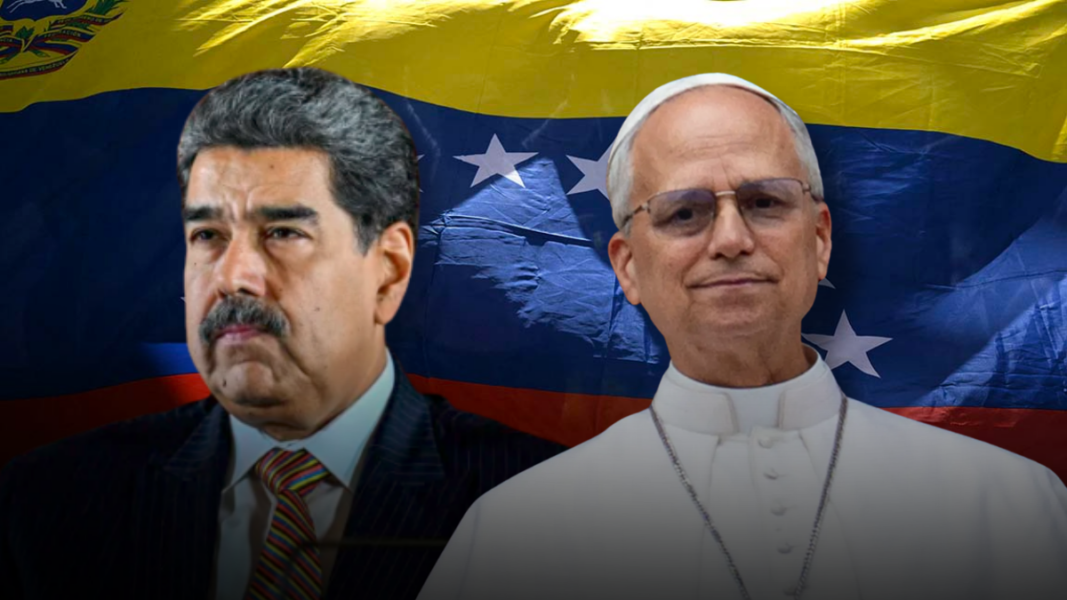
The recent detention of Cardinal Baltazar Porras by Venezuelan authorities has reopened a fundamental debate about the Holy See’s diplomatic policy toward the Nicolás Maduro regime. The incident, which occurred just a few days after Pope Leo XIV spoke out against a potential U.S. military intervention in Venezuela, has exposed with particular clarity the ongoing tension between two Vatican objectives: defending human dignity and fundamental rights without jeopardizing the presence and pastoral action of the Church in the country.
Read also: Venezuela prohibits the exit of Cardinal Porras and retains his passport
An analysis published by The Pillar places the episode as a concrete test of the delicate balance that the Vatican has sought to maintain for years in Venezuela, betting on prudence, mediation, and discreet diplomacy, even at the cost of avoiding strong public pronouncements against a regime accused of serious abuses.
A diplomatically significant incident
On December 10, Cardinal Porras, emeritus archbishop of Caracas and holder of a Vatican passport, was prevented from leaving the country at Simón Bolívar International Airport. For more than two hours, the cardinal was detained, subjected to security checks, and threatened with arrest. Finally, the authorities annulled his Venezuelan passport, leaving him in a de facto situation that violates the usual norms of diplomatic treatment. The fact is particularly relevant because it involves a prelate with Holy See documentation, which under normal conditions would have prompted an immediate formal protest. So far, however, no public reaction from the Vatican has been forthcoming.
The Pope’s words and their context
The incident occurred just eight days after Pope Leo XIV, in a press conference on December 2 upon returning from Turkey and Lebanon, was asked about a possible U.S. military action against Venezuela. The Pontiff then stated that it was preferable to seek paths of dialogue and, in any case, to exert non-military pressures, including economic ones, to favor a change in the situation.
In other recent interventions, the Pope has insisted that violence does not resolve conflicts and that, in contexts of political tension, it is the people who suffer the most, not the rulers. These statements, consistent with the Vatican diplomatic tradition, have been interpreted by some observers—especially in Latin America—as insufficient to reflect the gravity of the humanitarian crisis and the abuses attributed to the Venezuelan regime.
Continuity with the line of the previous pontificate
Leo XIV’s prudent approach recalls, to a great extent, the policy followed by his predecessor regarding the dictatorships in Venezuela, Cuba, and Nicaragua. During Francis’s pontificate, the Holy See systematically chose to avoid direct public confrontations, prioritizing the protection of the local clergy and the possibility of acting as a mediator.
That strategy allowed the Church to maintain a margin of pastoral and social action in highly restrictive contexts, but it also generated frustration among many faithful, who expected a clearer denunciation of human rights violations. In the Venezuelan case, the reception of Nicolás Maduro at the Vatican in 2016 and the refusal to receive representatives of the opposition reinforced that perception of ambiguity.
Gestures that pointed to a possible change
The beginning of Leo XIV’s pontificate had raised expectations of an adjustment in this approach, given his extensive pastoral experience in Latin America. Some recent gestures seemed to confirm that possibility, such as the audiences granted to exiled Nicaraguan bishops and to Bishop Rolando Álvarez, imprisoned by the Managua regime, as well as the homily by Cardinal Pietro Parolin in October, in which he launched an unusually harsh criticism of the Venezuelan regime during a liturgical celebration.
However, the silence following the Cardinal Porras incident and the Pope’s recent prudent statements have once again raised doubts about whether a substantial change will occur or if a continuist line will prevail.
A balance that is increasingly difficult
The challenge for the Holy See is particularly complex in Venezuela. A frontal condemnation could trigger direct reprisals against the clergy and ecclesiastical institutions, while an excessively cautious attitude risks being perceived as moral equidistance, diluting the regime’s responsibility.
The difficulty is aggravated because the Church remains one of the few institutions with cross-cutting social legitimacy in Venezuela, making it a potentially key actor in any future negotiation process. Recent reports even point to the possibility of a negotiated exit for Nicolás Maduro under amnesty guarantees, a scenario in which ecclesiastical mediation could prove decisive.