


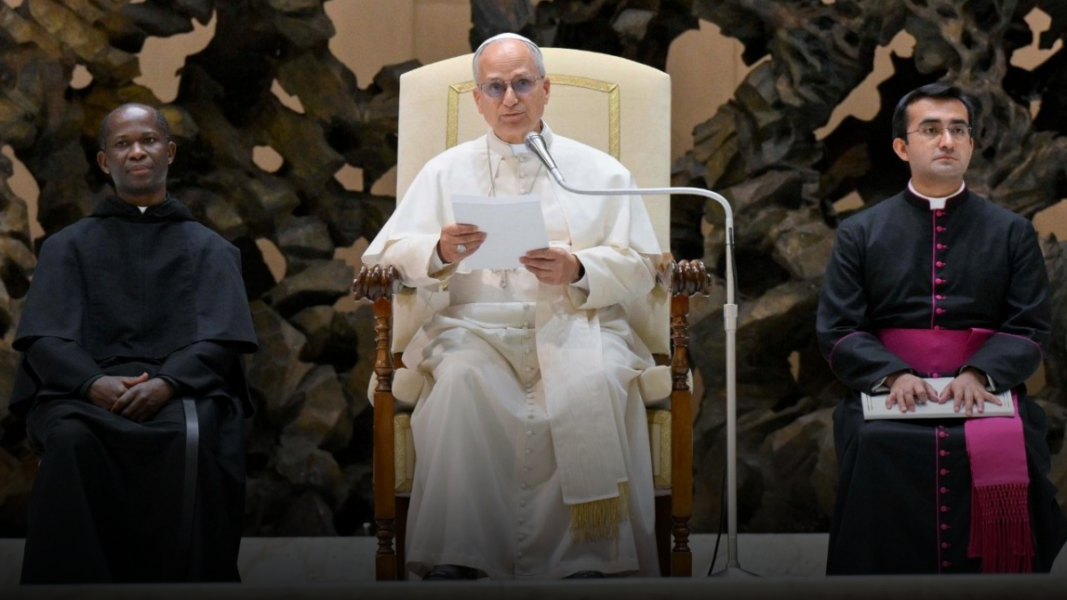
In the framework of the Jubilee of Italian Diplomacy, Pope Leo XIV received the participants this Saturday, December 13, in an audience held in the Paul VI Hall of the Vatican. In his speech, the Pontiff offered a profound reflection on the Christian meaning of diplomacy, emphasizing the value of hope, dialogue, and the honest use of the word as indispensable foundations for building peace in an international context marked by tensions and conflicts.
Below we leave the words of Leo XIV:
Mr. Minister,
Most Reverend Eminence,
Excellencies,
Ladies and Gentlemen:
I am particularly pleased to greet and welcome you today, on the occasion of this Jubilee of Italian Diplomacy. Your pilgrimage through the Holy Door gives a special character to this meeting of ours and allows us to share the hope that we carry in our hearts and that we wish to bear witness to our neighbor. This virtue, in fact, does not refer to a vague desire for uncertain things, but is the name that the will takes when it is firmly oriented toward the good and justice that it perceives as absent.
Hope thus acquires a precious meaning for the service that you perform: in diplomacy, only those who truly hope seek and always sustain dialogue between the parties, trusting in mutual understanding even in the face of difficulties and tensions. Since we hope to understand each other, we commit to doing so by seeking the best ways and words to achieve understanding. In this regard, it is significant that pacts and treaties are sealed by an agreement: this closeness of the heart —ad cor— expresses the sincerity of gestures such as a signature or a handshake, which otherwise would be reduced to mere procedural formalities. Thus appears a characteristic trait that distinguishes the authentic diplomatic mission from the interested calculation of partial benefits or the balance between rivals who hide their respective distances.
Dearest ones, to resist such drifts, let us look to the example of Jesus, whose witness of reconciliation and peace shines as hope for all peoples. In the name of the Father, the Son speaks with the power of the Holy Spirit, carrying out God’s dialogue with men. For this reason, all of us, made in the image of God, experience in dialogue, in listening and speaking, the fundamental relationships of our existence.
It is no coincidence that we call our native language mother, that which expresses the culture of our homeland, uniting the people like a family. In one’s own language, each Nation bears witness to a specific understanding of the world, both of the highest values and of the most everyday customs. Words are that common heritage through which the roots of the society we inhabit flourish. In a multiethnic climate, it then becomes indispensable to care for dialogue, promoting mutual and intercultural understanding as a sign of welcome, integration, and fraternity. At the international level, this same style can bear fruits of cooperation and peace, provided that we persevere in educating our way of speaking.
Only when a person is honest, in fact, do we say that they are “a person of their word,” because they keep it as a sign of constancy and fidelity, without changes of course. In the same way, a person is coherent when they do what they say: their word is the good pledge they offer to those who listen, and the value of the given word shows how much the person who pronounces it is worth.
In particular, the Christian is always a man of the Word: of that which he listens to from God, first of all, responding in prayer to his fatherly call. When we were baptized, the sign of the Cross was traced on our ears, saying: “Effatá,” that is, “Be opened.” In that gesture, which recalls the healing performed by Jesus, the sense by which we receive the first words of affection and the indispensable cultural elements that sustain our life, in the family and in society, is blessed.
Just as the senses and the body, language too must be educated, precisely in the school of listening and dialogue. Being authentic Christians and honest citizens means sharing a vocabulary capable of saying things as they are, without duplicity, cultivating concord among people. For this reason, it is our commitment and yours, especially as Ambassadors, to always favor dialogue and to reweave it when it is interrupted.
In an international context wounded by abuses and conflicts, let us remember that the opposite of dialogue is not silence, but offense. Where, in fact, silence opens to listening and welcomes the voice of the one before us, offense is a verbal aggression, a war of words armed with lies, propaganda, and hypocrisy.
Let us commit with hope to disarm proclamations and speeches, caring not only for their beauty and precision, but above all for their honesty and prudence. Those who know what to say do not need many words, but only the right ones: let us therefore exercise ourselves in sharing words that do good, in choosing words that build understanding, in bearing witness to words that repair wrongs and forgive offenses. Those who tire of dialoguing tire of hoping for peace.
In this regard, ladies and gentlemen, I evoke with you the urgent appeal that Saint Paul VI addressed to the Assembly of the United Nations exactly sixty years ago. What unites men, my venerable Predecessor observed, is a pact sealed «with an oath that must change the future history of the world: no more war, never again war! Peace, peace must guide the destinies of Peoples and of all humanity!» (Address to the United Nations, 5). Yes, peace is the duty that unites humanity in a common search for justice. Peace is the purpose that, from the night of Christmas, accompanies the entire life of Christ, up to his Easter of death and resurrection. Peace is the definitive and eternal good that we hope for all.
In order to safeguard and promote true peace, be, therefore, men and women of dialogue, wise in reading the signs of the times according to that code of Christian humanism that is at the basis of Italian and European culture. Wishing you the best for the service you are called to perform, I impart upon you and your families the Apostolic Blessing.