


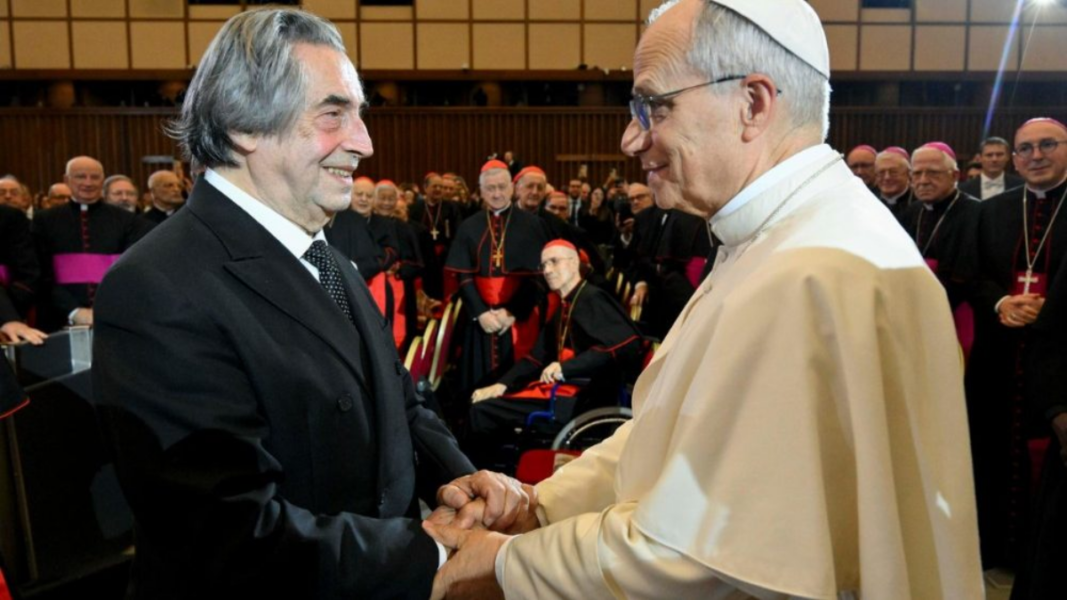
On the afternoon of Friday, December 12, in the Paul VI Hall of the Vatican, the traditional Christmas Concert was held in the presence of Pope Leo XIV, directed by Maestro Riccardo Muti, who on this occasion received the Ratzinger Prize. At the end of the concert, the Pontiff addressed a speech to the participants in which he emphasized the spiritual, anthropological, and educational value of music, presenting it as a privileged way to elevate the human heart toward God and to promote harmony in the face of division.
«Maestro Muti, your way of interpreting conducting, as an art of listening and responsibility, also finds confirmation in your natural inclination toward formation,» said the Pontiff.
In his speech, Leo XIV evoked the figure of Benedict XVI, recalling his conviction that “true beauty wounds, opens the heart and dilates it,” and his way of hearing in music a trace of the voice of God in the universe. The Pope emphasized the personal and artistic relationship that united the then Cardinal Joseph Ratzinger with Riccardo Muti over the years, from Salzburg and Munich to Rome, noting that the award granted is a continuation of that dialogue oriented toward the common good and harmony.
We leave below the complete words of Leo XIV:
Dear brothers and sisters:
I am very grateful for this Concert, on the occasion of the Lord’s Christmas. Saint Augustine, in his treatise on music, calls it scientia bene modulandi, linking it to the art of guiding the heart toward God. Music is a privileged path to understanding the highest dignity of the human being and to confirming it in its most authentic vocation.
I thank the institutions that have promoted this initiative—the Dicastery for Culture and Education and the Pontifical Foundation Gravissimum Educationis—and all those who, in various ways, have made its realization possible.
I address my greeting to Maestro Riccardo Muti, to whom the Ratzinger Prize is awarded today, a sign of recognition for a life entirely consecrated to music, a place of discipline and revelation. Pope Benedict XVI used to recall that “true beauty wounds, opens the heart and dilates it,” and in music he sought the voice of God in the universe. In this journey of seeking beauty, you, dear Maestro, have had the opportunity to meet Cardinal Ratzinger on several occasions, beginning when he attended concerts in Salzburg, in Munich, and later in Rome. In the following years, Pope Benedict participated in your performances in the Paul VI Hall, where he presented you with the Grand Cross of Saint Gregory the Great. The Prize you receive today is the continuation of that relationship, of an open dialogue oriented toward the mystery and the common good, toward harmony.
This ethical responsibility of musical art was well illustrated by my venerable predecessor, Pope Francis, who loved music and listened to it with spiritual pleasure. Music, he said, “grants to those who cultivate it a wise and serene gaze, with which divisions and antagonisms are more easily overcome, to be—like the instruments of an orchestra or the voices of a choir—in tune, watching for dissonances and correcting disharmonies, which are also useful for the dynamics of compositions, as long as they are integrated into a wise harmonic fabric.” [1] To harmonize means to keep differences that could clash united, allowing them to generate a higher unity. Silence also contributes to this purpose: it is not absence, it is preparation, because in it the possibility of the word is formed, and in the pause the truth emerges.
Maestro Muti, your way of interpreting conducting, as an art of listening and responsibility, also finds confirmation in your natural inclination toward formation. This is demonstrated by your bond with Italian conservatories and the practice of “open rehearsals,” offered as a form of sharing, where every gesture is an act of trust, an invitation more than an order.
It is thus particularly coherent to award the Ratzinger Prize to one who has known how to safeguard what Benedict XVI always considered the heart of art: the possibility of making a spark of the presence of God resound, through beauty.
I thank the Youth Orchestra “Luigi Cherubini,” whose participation has allowed the talent and creativity of youth to be given voice, and the Choir “Guido Chigi Saracini” of the Siena Cathedral.
This afternoon’s Concert is an occasion for awareness and commitment in the educational field: in the world, in fact, millions of children and girls are excluded from any schooling itinerary. For this reason, I greet with hope the birth of the Observatory on inequality and universal access to education, announced on the occasion of the recent Educational World Jubilee. The Dicastery for Culture and Education is gathering around this project all those who have the education of young people at heart, beginning with the Galileo Foundation, which has expressed its adhesion through support for this evening and for the educational projects of the Foundation Gravissimum Educationis.
Brothers and sisters, on the eve of Holy Christmas, I renew the invitation to persevere in prayer so that God may grant us the gift of peace. Upon all of you, and upon all those who have followed the event thanks to the television connection, I invoke from the heart the Lord’s blessing.