


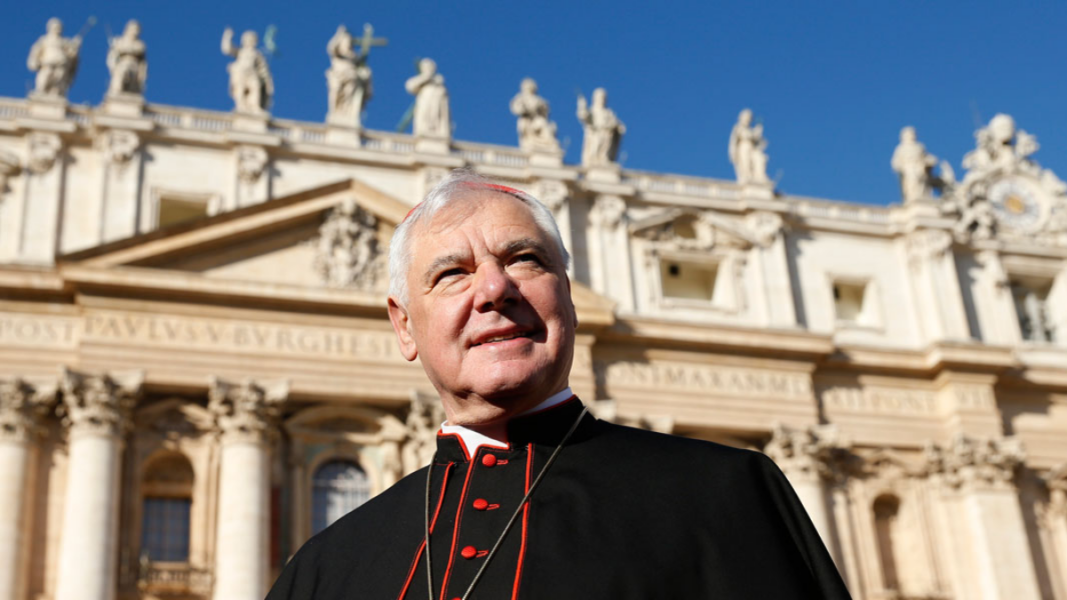
Cardinal Gerhard Ludwig Müller, former prefect of the Dicastery for the Doctrine of the Faith, analyzed the current situation of the Church and Europe in an interview granted to The Catholic Herald on the occasion of the start of the Advent season. In his statements, he addressed the spiritual meaning of this liturgical time, the European secularization process, the reception of Vatican II, the situation of the Society of Saint Pius X, and the ecclesial implications of the German Synodal Way.
Advent as a time of purification and hope
Referring to Advent, the cardinal emphasized that this season cannot be reduced to an external preparation for Christmas. He recalled that the liturgical year makes the history of salvation present and that Christian hope is based exclusively on Christ. In this sense, he stated: «Preparing for Christmas cannot consist solely of buying gifts and getting carried away by a certain seasonal romanticization.»
Müller warned against the temptation to trust in ideological or political solutions presented as salvific. «We cannot place our hope—neither in life nor in death—in the false prophets and pseudo-messiahs of ideological and political manufacture,» he noted, emphasizing that recent history has shown the consequences of those false promises.
Europe and the process of de-Christianization
In his analysis of the European situation, the cardinal held that contemporary secularism does not imply the disappearance of the religious, but a substitution of Christianity with a form of secular self-redemption. «European secularism is not devoid of religion; it is a soft—and sometimes violent—form of de-Christianization,» he explained.
In his view, the decisive issue for Christians is not the cultural context in which they live, but fidelity to God. «For us, the decisive point is not whether we live in a secular or religious environment, but that we place our trust in God through faith, hope, and charity,» he affirmed.
Vatican II and its correct interpretation
Asked about the debates on Vatican II, Müller clearly rejected the opposition between its letter and its spirit. «This distinction is an insult to the theological intelligence of every Catholic,» he declared. As he explained, appealing to a supposed «spirit of the Council» in opposition to its official texts introduces categories foreign to the faith and has no relation to the action of the Holy Spirit in the Church.
The cardinal insisted that the conciliar doctrine must be read in continuity with the apostolic Tradition and not as a rupture.
The Society of Saint Pius X and the unity of the Church
Regarding the Society of Saint Pius X, Müller affirmed that progress cannot be made in dialogue without full recognition of Vatican II as a valid ecumenical council. He rejected the sede vacante theses and the idea that this group represents the last defense of authentic Catholic faith.
«There is no justification for distancing oneself from the Catholic Church,» he noted, recalling that the Church, as Saint Augustine already emphasized, is made up of saints and sinners. In this context, he affirmed that ecclesial unity is based on Christ and is expressed visibly in the Petrine ministry, today exercised by Pope Leo XIV.
Criticism of the German Synodal Way
The former prefect was especially critical of the German Synodal Way, to which he denied any magisterial authority. «The organization of the so-called Synodal Way has no doctrinal authority nor is it a constituent assembly,» he affirmed, emphasizing that it cannot establish a «national Church» apart from universal communion.
Müller warned that certain proposals promoted in this process do not represent a legitimate development of doctrine, but a rupture with Revelation. «It is a heretical attempt to replace the Christian understanding of the human person with gender ideology,» he affirmed, also pointing out that the ecclesial crisis in Germany is reflected in the massive loss of faithful, the closure of seminaries, and the decrease in vocations.
He also recalled the words of Pope Francis in his 2019 letter to German Catholics, in which he warned that the Church «is not renewed by adapting to the spirit of the times, but by rediscovering the Gospel.»
A call for doctrinal clarity
Throughout the interview, Cardinal Müller insisted that the credibility and unity of the Church depend on fidelity to Revelation and a clear teaching of the faith. In his view, only a Church rooted in Christ and in Tradition can face the challenges of the contemporary world without losing its identity.