


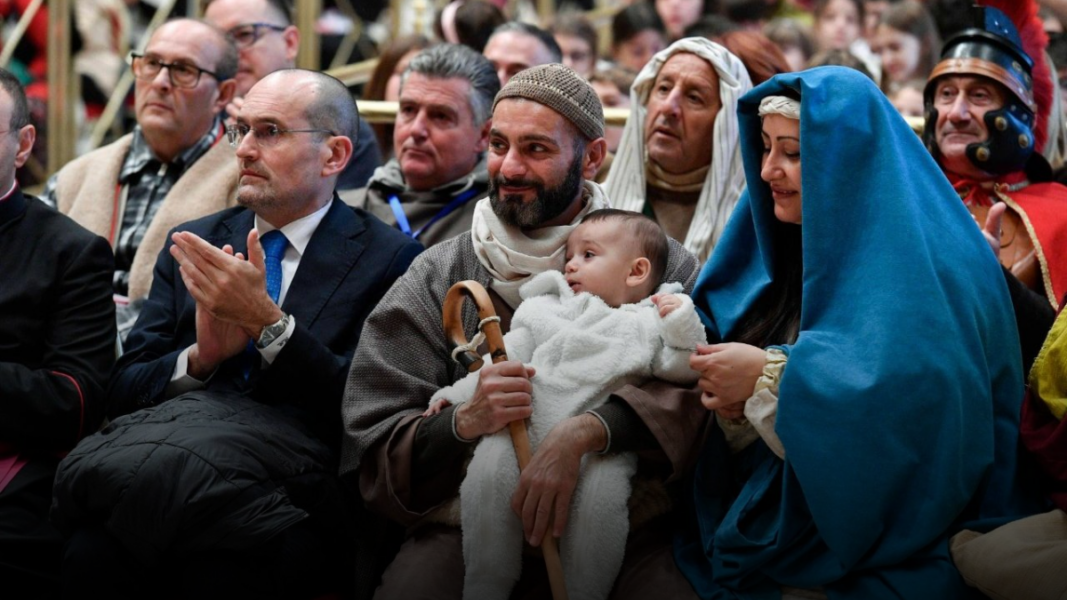
The Pope received this Saturday, December 13, in the Vatican Blessing Hall, the actors of the “Living Nativity” of the Basilica of Saint Mary Major and the nativity craftsmen, on the occasion of the Christmas celebrations. During the meeting, the Pontiff emphasized the value of the nativity scene as a living expression of Christian faith and as a testimony to the Mystery of the Incarnation, rooted in tradition and in the cultures of the peoples.
A tradition born of Christian faith and culture
In his greeting, published by the Holy See, the Pope recalled that the participants had come from various places to bring to the tomb of Saint Peter the representation of the birth of Christ, as it has been transmitted for centuries by generations of Christians. He highlighted that the nativity scene has known how to assume the features of different cultures and landscapes, without losing its essential reference to the mystery of God made man.
Leo XIV evoked the historical bond between the Liberian Basilica—known as the “Bethlehem of the West” for preserving the relic of the Holy Crib—and the origin of the nativity tradition, inspired by Saint Francis of Assisi after his journey to the Holy Land and the celebration of the first “Christmas of Greccio” in 1223.
The nativity scene as an announcement of the God who comes without power or violence
The Pontiff recalled that the representation of the birth of the Lord refers to the God who enters history “without weapons and without force,” to overcome human pride, violence, and ambition, and to lead him to his true identity. In this sense, he pointed out that the nativity scene is not only a pious reenactment, but a theological announcement that challenges personal and social life.
Quoting Saint John Paul II and Benedict XVI, Leo XIV insisted that the contemplation of the Child of Bethlehem invites Christians to a path of conversion and to a renewed life according to the example of Christ, marked by humility and closeness to all people.
Pilgrims of hope in everyday life
The Pope also referred to the procession of the living nativity that would traverse the streets of Rome as a visible and joyful sign of Christian faith. He pointed out that, through gestures, songs, and symbols, the participants would bear witness to the beauty of being disciples of Jesus Christ, the light that illuminates those who live in darkness and guides steps along the path of peace.
Addressing the actors and nativity makers directly, Leo XIV defined them as “pilgrims of hope,” called not only in that moment, but in everyday life, to be bearers of consolation and inspiration for those they encounter: children and adults, young people and the elderly, families, lonely people or those going through suffering, as well as those who work tirelessly for a better world.
Keeping alive a tradition that announces salvation
In the final part of his greeting, the Pope emphasized that the nativity scene reminds Christians that they are part of a history of salvation in which no one is alone. Quoting Saint Augustine, he recalled that God became man so that man could participate in divine life and find his definitive dwelling in heaven.
Leo XIV encouraged those present to spread this message and to keep the nativity tradition alive, which he described as a gift of light for a world in need of hope. Finally, he thanked them for their commitment, imparted his blessing to them and their families, and wished them a holy Christmas.
We leave below the words of Leo XIV:
Dear brothers and sisters, good morning, welcome!
I greet His Eminence Cardinal Makrickas and all of you, who today will bring to life the “Living Nativity” of Saint Mary Major.
You have come from various places to bring to the Tomb of Peter the testimony of the thousand faces with which, for centuries, generations of Christians represent the Mystery of the Incarnation, often with the features of their own culture and the landscapes of their land. From here, then, you will set out to cross the Holy Door and celebrate the Eucharist in the Liberian Basilica, called the “Bethlehem of the West,” where the Holy Crib is venerated.
It was precisely that ancient relic which, along with the journey to the Holy Land, inspired Saint Francis, in 1223, to celebrate for the first time the “Christmas of Greccio,” the beginning of the Nativity tradition. Since then, throughout the world, the custom has spread of representing the Nativity of the Lord in the most diverse ways, of the God who “comes without weapons, without force, […] to overcome human pride, violence, greed for possession […] and to lead us to our true identity” (Benedict XVI, Catechesis, December 23, 2009).
Pope Francis said that before the Nativity, “while we contemplate the Christmas scene, we are invited to set out spiritually, drawn by the humility of the One who has become man to meet every man” (Apostolic Letter Admirabile signum, December 1, 2019, 1). It is precisely so: from the grotto of Bethlehem, where Mary, Joseph, and the Child are in their disarming poverty, we begin anew to start a new life following in the footsteps of Christ. You will bear witness to this this afternoon, with the procession that will traverse the streets of the city. This, with its choreographies, costumes, and music, will be a joyful sign of how beautiful it is to be disciples of Jesus, the God made man, the sun that rises “to shine on those who sit in darkness and in the shadow of death, to guide our feet into the way of peace” (Lk 1:79).
This makes you—today, and then always, as a mission for your everyday life—pilgrims of hope, bearers of consolation and inspiration for all those you meet: for the little ones and the great ones, for families, young people, and the elderly you will encounter on your path; for those who rejoice and those who suffer, for those who are alone, for those who feel alive in their heart the desire to love and be loved, and for those who, even with fatigue, continue working diligently and perseveringly in building a better world.
The Nativity, dear ones, is an important sign: it reminds us that we are part of a wonderful adventure of Salvation in which we are never alone and that, as Saint Augustine said, “God became man so that man might become God, […] so that man, inhabitant of the earth, might find a dwelling in the heavens” (Sermo 371, 1). Spread this message and keep this tradition alive. You are a gift of light for our world, which has such a great need to continue hoping. Thank you, thank you all truly for your commitment! I bless you and your families from my heart. Merry Christmas!