


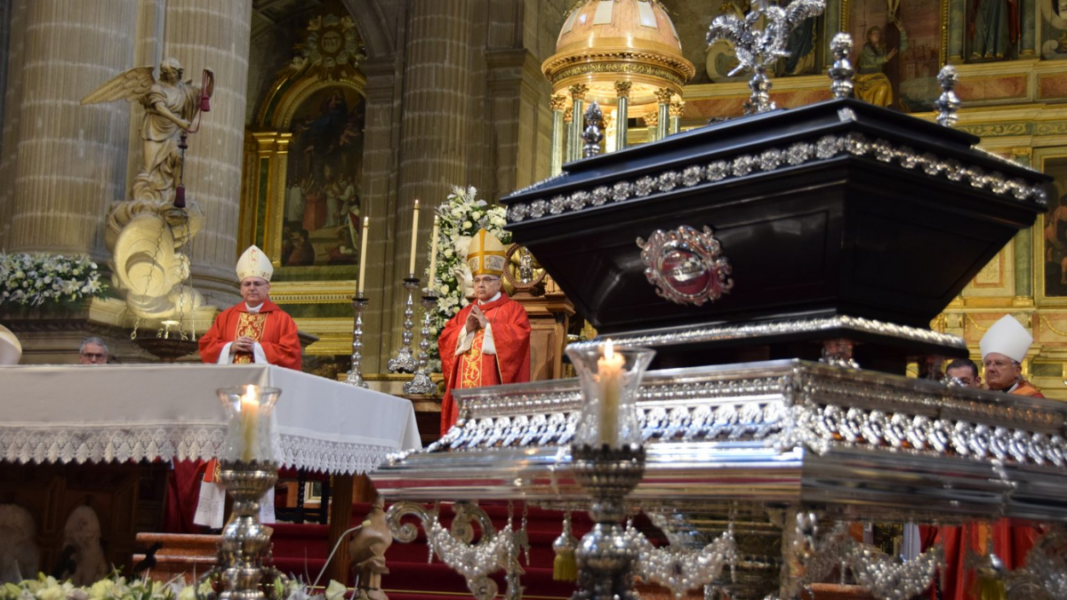
The Church celebrated this weekend in Jaén the beatification of 124 martyrs killed between 1936 and 1938 out of hatred for the faith, in one of the bloodiest episodes of religious persecution in Spain during the Civil War.
The solemn ceremony took place this Saturday, December 13, in the Cathedral of the Assumption of Jaén and was presided over by Cardinal Marcello Semeraro, prefect of the Dicastery for the Causes of the Saints, as the envoy of Pope Francis, who approved the martyrdom decree last June. Numerous faithful, family members of the martyrs, and a wide representation of the Spanish episcopate attended the celebration.
The Mass was concelebrated by nearly twenty bishops, including the Bishop of Jaén, Msgr. Sebastián Chico Martínez, along with the emeritus bishops Ramón del Hoyo López and Amadeo Rodríguez Magro, as well as around 150 priests from the diocese of Jaén and neighboring territories.
The new blesseds belong to the Diocese of Jaén and were killed in odium fidei during the early years of the Civil War. The group consists of 109 diocesan priests, one Poor Clare nun, and 14 laypeople, including a married couple. The beatification cause confirms that all of them died for refusing to renounce their faith.
A persecution that spread throughout the entire diocese
The vice-postulator of the cause, the priest Andrés Nájera, explained that the religious persecution spread throughout practically the entire diocese of Jaén and particularly affected priests dedicated to pastoral and educational work, as well as lay faithful with a visible and active connection to the Church. He also recalled the systematic destruction of temples, parish archives, and religious symbols during those years.
The beatification cause has given a face to anti-Christian violence that did not distinguish ages or states of life. Many of the martyrs were detained solely for their priestly condition or for their public commitment to the faith, without any participation in armed conflicts or political militancy.
Concrete faces of Christian fidelity
Among the most significant profiles is that of the doctor Pedro Sandoica y Granados, a layman well-known in Villargordo for his dedication to the poor and his active parish life, executed in September 1936. Also noteworthy is that of the priest Felipe Vallejos Molina, parish priest in Porcuna, who was brutally tortured before being murdered for his apostolic work.
Read also: Francisco de Paula Padilla, the priest who gave his life for a father of six children
The beatification also includes the testimony of Mother Isabel María Aranda Sánchez, Poor Clare abbess of Martos, the only religious in the group, murdered in January 1937 after resisting the abuses of her captors. Alongside her, the Church recognizes the martyrdom of the laywoman Obdulia Puchol Merino, a widow and Franciscan tertiary, known for her intense charitable work, beheaded on the Immaculate Conception Day of 1936.
Read also: Antonio Montañés Chiquero, parish priest faithful until the end in 1936
The group of martyrs also includes especially significant stories from a family and pastoral perspective. Such is the case of the married couple formed by Teresa Basulto Jiménez and Mariano Martín Portela, murdered on the so-called “death train” in August 1936. Teresa was the sister of the then Bishop of Jaén, Manuel Basulto, who was already beatified in 2013.
Read also: Manuel Izquierdo Izquierdo, octogenarian parish priest martyred after cruel torture
Other emblematic names are those of the priests Juan Ángel Román Pulido, an elderly parish priest who remained with his faithful until the end; Manuel Valdivia Chica, whose hands the militiamen amputated before killing him; and Bernardo Cruz Pérez, parish priest of Torredonjimeno, victim of one of the most violent executions documented in the diocese.
A message of hope and reconciliation
During the homily, it was emphasized that the beatification is celebrated in the context of the Jubilee Year dedicated to hope, recalling that the martyrs did not take part in the violence or ideological struggles, but rather faced death by forgiving their executioners. Words of Benedict XVI were evoked about the redemptive value of suffering accepted out of love for the truth and justice.
The celebration concluded with one of the most significant moments of the day: the unveiling of the painting representing the 124 new blesseds, a work by the Jaén artist Francisco Galán, accompanied by the ringing of the Cathedral bells and the display of the martyrs’ faces from the temple’s interior balconies. Afterward, the solemn entrance of the reliquary containing the remains of the martyrs took place.
With this beatification, the number of 20th-century martyrs recognized by the Church in Spain rises to 2,254, of which 11 have been canonized.