


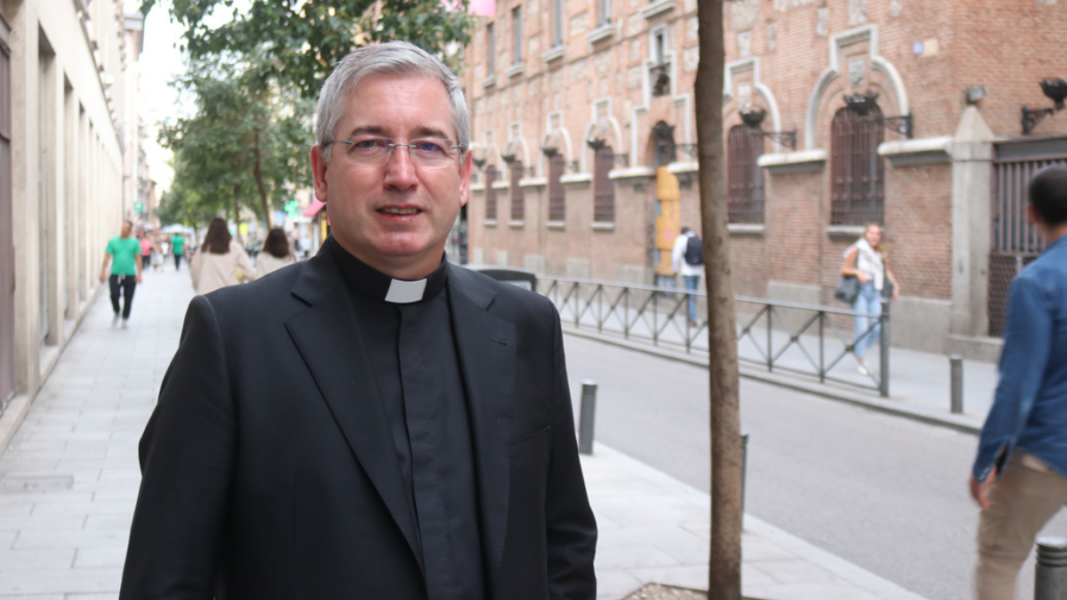
In his pastoral letter Our seminarians, the Bishop of San Sebastián, Fernando Prado Ayuso, affirms with conviction that, although there is no young man in the diocesan seminary today, the diocese does have seminarians, because God “is already preparing them in the hidden.” His message, laden with a spiritual and hopeful tone, invites the diocese to contemplate the situation with the eyes of faith.
This letter, in the midst of Advent, wants to be an invitation to trust that God, who never forgets his Church, will give us shepherds in his time. God already has these young seminarians in his heart.
Prado’s letter arises from a understandable desire not to succumb to discouragement. “Those who think we have no seminarians are very much mistaken,” he writes, because the Lord “works in silence and with the patient rhythm of love.” The bishop insists that those future priests “already have a face,” even though no one can see them today. The key, according to him, lies in living this time as a gestation, in a waiting that must exercise the patience of faith.
Vocations arise where faith is lived without complexes
The invitation to wait is fine, but the global ecclesial situation shows that the vocational issue does not respond solely to a generic spiritual factor. Where the doctrine is proclaimed without ambiguity, where the liturgy is celebrated with dignity, and where Christian life is lived without complexes, vocations arise. In the United States, several diocesan seminaries have broken enrollment records this year; France, after decades of decline, records a significant surge of young people asking to enter seminaries and religious communities. And the institutes linked to the Traditional Mass—FSSP, ICRSS, IBP—continue to grow with generations of young people who embrace the priesthood with naturalness.
This phenomenon, perfectly documented, raises a question that the Bishop of San Sebastián’s letter mentions only indirectly: what makes priestly vocation grow? Simple waiting? A soft and encouraging discourse? Or a clear, virile, sacrificial, and uncomplexed proclamation of the Catholic priesthood as the Church has received it?
Normal, mature, and sincere candidates
In this sense, Prado’s letter contains valid insights. It affirms that a seminarian should not simply aspire to “be ordained,” but to “be a true priest.” And it demands that the diocese form shepherds configured to Christ and not mere managers. But current ecclesial experience indicates something more: when sacramental life is strong, when the liturgy is not trivialized, when doctrine is presented without discounts, and when priests live their identity with clarity, young people respond.
The letter is right to point out that the Church “does not want perfect candidates,” but normal, mature, and sincere ones. It is a realistic pastoral appreciation. As tradition teaches, vocation is born from the encounter with Christ, from the inspiration of the Holy Spirit, and from an ecclesial environment that does not fear proposing the radicality of the priesthood, its sacrificial character, its life of prayer, its interior discipline, and its supernatural mission.
A hope that demands Truth
The Bishop of San Sebastián invites the diocese to pray, to accompany, to create a propitious climate for vocations to be born. But we know that it must be a climate where faith is presented undiluted and the awareness that the Church has the revealed Truth, which is Jesus Christ, is announced with the strength proper to it. On the other hand, where the liturgy is “ground up” in experiments, where language is softened so as not to discomfort, and where the proclamation is adapted to the world’s taste, vocation simply dilutes.
Leo XIV recalled this recently in his letter on Christian archaeology: “A disembodied theology becomes ideological.” And in the vocational sphere, something similar happens: a disembodied, soft proclamation, accommodated to the world, becomes sterile.
There is something profoundly true in the bishop’s message: God continues to call. But the Church, upon hearing that call, must respond with a clear voice, leave behind the complexes, and recover the ardor of those who know that the priesthood is not a career or a refuge, but a total surrender to God’s call. Prado himself describes it:
The call to priestly ministry does not arise from mere need, but from love; it does not respond to a strategy, but to a mystery. It is the initiative of a God who continues to say with force: “Come and follow me” (Mt 9,9).
>>Read the full letter<<