


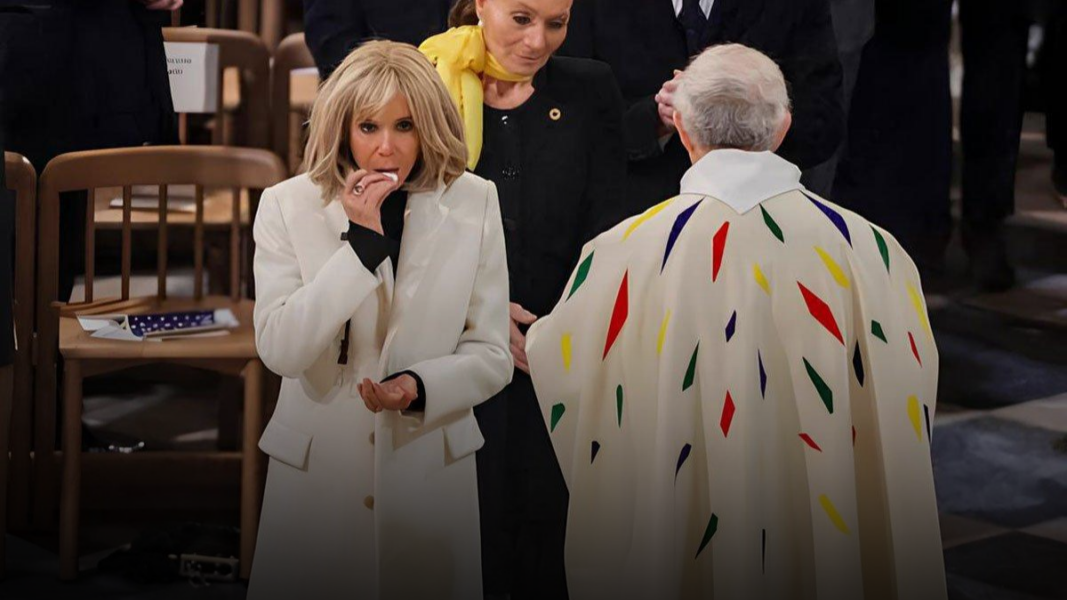
The French priest Guy Pagès has addressed an open letter to Pope Leo XIV demanding direct intervention regarding what he describes as a “profanation of the Eucharist.” It concerns an episode that occurred a year ago during the Mass of reopening of Notre Dame Cathedral, on December 8, 2024. During the broadcast, Brigitte Macron is seen receiving Communion in the hand. For the priest, known in France for his critical work on Islam and his defense of the Catholic magisterium, the episode constitutes a grave scandal in the French Church.
The Communion of the First Lady: a gesture broadcast live and without warnings
During the celebration presided over by the Archbishop of Paris, Laurent Ulrich, Brigitte Macron—civilly married to President Emmanuel Macron, divorced from her first husband, and with no public record of a religious marriage—received Communion from the hands of Auxiliary Bishop Philippe Marsset.
The television broadcast clearly showed the moment, while the commentator stated that the First Lady “had every right” to receive Communion. Emmanuel Macron did not approach to receive the Eucharist, citing “respect for secularism.”
Pagès recalls that Brigitte Macron publicly supports abortion, euthanasia, and LGBT claims, and that, in her marital situation, she should not have approached for Communion, in accordance with canon 915 of the Code of Canon Law. In his view, the ministers of the Mass had the obligation to discreetly deny Communion to avoid a public scandal.
A scandal that remains open a year later
A year later, the priest denounces that neither the Archdiocese of Paris nor the Holy See have provided explanations about the incident. Pagès criticizes the lack of reaction from the hierarchy, which—in his opinion—has treated the Eucharist “with indifference toward political power.”
Between June and October of this year, he sent two letters to the Dicastery for Divine Worship, with copies to the Dicasteries for the Doctrine of the Faith and for Bishops, as well as to the French Episcopal Conference, but received no response from any.
The priest argues that omitting the application of canon law endangers the faith of the faithful and favors the loss of the sense of the sacrament. Pagès cites article 183 of Redemptionis Sacramentum, a document that insists on the obligation to avoid all Eucharistic abuses, and recalls that the Church has already suffered gravely for not rigorously applying its own discipline in traumatic situations of the past.
A theological and moral denunciation: “How can this not attract the wrath of God?”
In his letter, Pagès draws a parallel between the profanation of the Eucharist and the abuses committed against minors, as Benedict XVI emphasized in 2019. He assures that the lack of respect toward the Body of Christ paves the way for other deeper disorders within the Church.
The priest warns that allowing these public Communions, knowing the moral situation of the person, leads the faithful “to ignore and despise Jesus in the Eucharist,” destroys the Church’s credibility before the world, and “discourages the desire to evangelize.” With dramatic forcefulness, he asks: “How can this not attract the wrath of God?”
Final petition to Leo XIV: sanctions and a restoration of discipline
Pagès asks Pope Leo XIV to sanction those who allowed the sacrilege, recalling that suspension is the penalty provided for clerics who administer the sacraments against Church norms.
Additionally, he asks the Pope to promote a restoration of Eucharistic discipline, including Communion on the tongue and kneeling, as Benedict XVI taught by his example.
For the priest, the lack of measures will lead to a “trivialization” of sacrileges, which will gravely harm the faithful and priests. He concludes his letter by invoking St. Tarcisius, martyr of the Eucharist, to assist the Pope in the defense of the sacrament.