


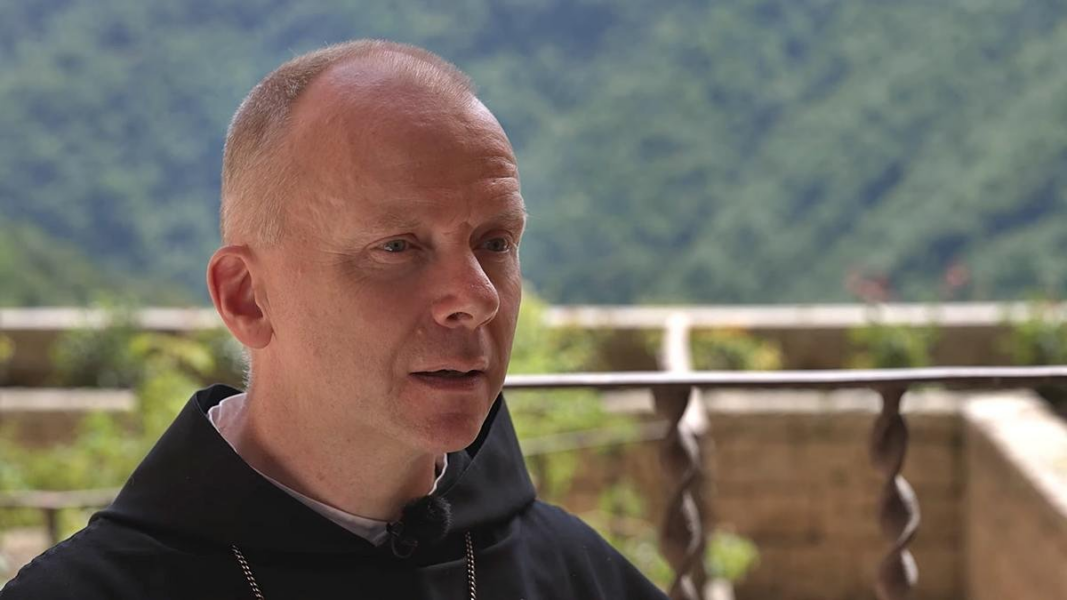
The bishop of Trondheim (Norway), Erik Varden, has become one of the most listened-to voices in European Catholicism. His spiritual journey—a teenage conversion triggered by Mahler’s Second Symphony—and his Cistercian monastic formation have led him to deeply read the contemporary soul. His books and lectures, far from superficialities, have become a guide for those seeking meaning in the face of the cultural fragility that dominates the West.
In an interview with Aceprensa, the Norwegian prelate analyzes the spiritual thirst of our time, the need to recover the proper language of faith, and the renewed interest in liturgy and tradition.
A post-secular era that demands firm witnesses
Varden maintains that we are already in a “post-secular” time, especially visible in northern Europe. “I believe that is the case,” he states. Although many Catholics wish to believe that the cultural crisis is a passing episode, he warns that the response should not be self-deception, but testimony. “Everything depends on how we welcome this providential moment now, what kind of testimony we give, what kind of teaching we proclaim.”
For Varden, the rapidity of cultural change cannot lead the Church to live on the defensive. The key lies in assuming the evangelizing mission without diluting Catholic identity.
“People are drawn to Catholicism because it is true”
The bishop explains that the growing interest in the Church responds to a real need for certainties. “I believe people are drawn because it is true. That is a fundamental reason,” he states. Distrust in political, economic, and cultural institutions leaves many young people without lasting points of reference: “People are seeking parameters that promise to withstand the flood.”
To those who claim that this religious curiosity is merely an emotional refuge, Varden responds clearly: “I encounter these conversions almost daily… Such a claim does not correspond to the empirical evidence.”
Youth and liturgy: a search for beauty without labels
Varden recognizes that there is a renewed interest in traditional liturgy among young people of various sensibilities, although he does not consider it a uniform phenomenon or a generational conflict. For him, the key lies in the faithful celebration of the mysteries: “Do the red and say the black.” That is, follow the rubrics of the Missal and let the liturgy speak without personal additions.
He rejects the tendency to classify this phenomenon as “backward” or contrary to the Second Vatican Council. He cites the Chartres pilgrimage as an example: “The young people who attended were simply impossible to categorize… Some might go to a charismatic service on Saturday, have Mass in Latin on Sunday, and go to work with Caritas on Monday.”
Varden concludes: “As long as we keep insisting on pigeonholing people into these narrow categories, we are not going to understand what is happening.”
Overcoming the logic of progressives vs. conservatives
The bishop admits that ideological polarization has long been infiltrating the Church, but he calls for disarming it “gently, kindly, and perhaps even with humor.” He quotes the Benedictine Elmar Salman, who rejected that dichotomy by saying: “Io preferisco pensarmi classico e liberante” (“I prefer to consider myself classical and liberating”).
For Varden, faith cannot become a political tool: “We must be very careful about the instrumentalization of Christian symbols… It is not permissible to instrumentalize faith for any secular purpose.”
Recovering the Church’s own language
One of Varden’s most insistent reflections is the need for the Church to speak again in its own language. After decades of trying to imitate the world, the result has been irrelevance: “If we speak the language of Scripture, of the liturgy, of the sacraments, we can say amazingly fresh, original, and beautiful things. And people do listen to them.”
The prelate links this recovery of authenticity to the necessary response to the abuses: “We must be truthful and pursue that work of reparation in justice and with tears… Perhaps that experience can teach us to be more humble and more hospitable.”
Chastity, suffering, and the body: topics that young people do seek
Varden confesses to being surprised by the reception of his book on chastity: “For a long time, I did not go a day without receiving letters and emails.” The same happens with his reflections on redemptive suffering. In his experience, young people do not shy away from difficult questions: “I am finding a lot of openness and a real desire to address these questions.”
He relates this search to the current confusion about the body and identity: “It has everything to do with… how to deal with the body’s hunger, desires, and hopes.”
Literature and music: places where the soul recognizes itself
To explain the human condition, Varden even turns to the epic of Gilgamesh: “It is simply wonderful to be able to point to this text that is almost 3,000 years old and say: ‘Well, look at that guy. He is just like you.’”
For him, true literature can “save lives” because it reminds the reader that they are not alone. And on music, he states: “It brings us as close to eternity as is possible in this life… it expresses the ineffable.”
“The greatest challenge is to truly believe that we are loved”
In the end, Varden summarizes the spiritual drama of our time in a phrase that runs through all his work: “The greatest challenge is to truly believe that we are loved.” And he adds that the most urgent thing that human beings must understand today is “their potential for eternal life.”