


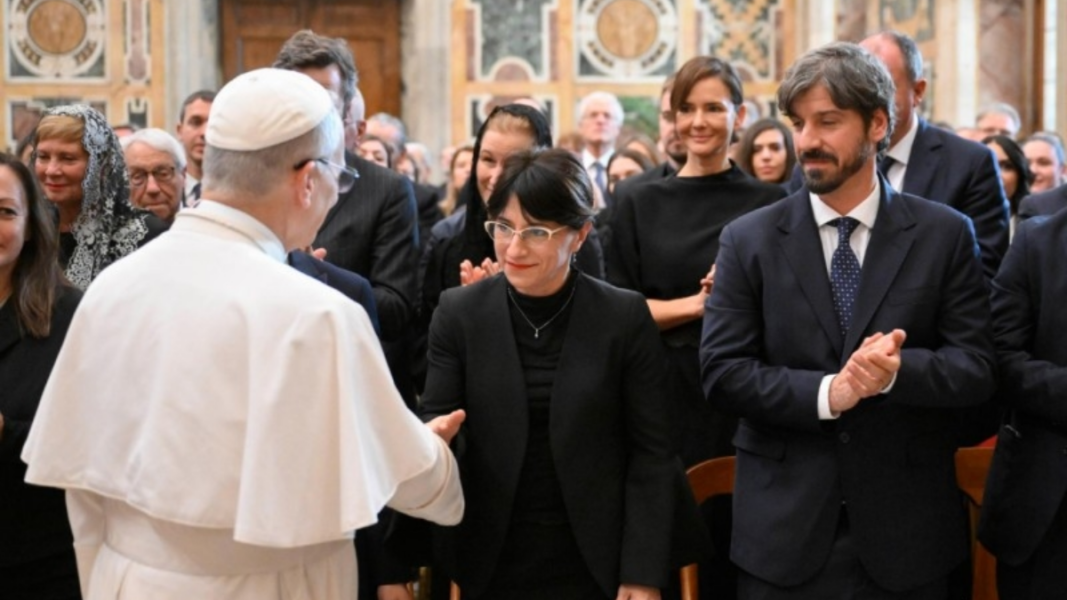
Pope Leo XIV received in audience, in the Apostolic Palace, the community of the Pontifical Institute of Christian Archaeology on the occasion of the centenary of its foundation. The institution—created by Pius XI in 1925 through the Motu proprio I primitivi cemeteri di Roma cristiana—was conceived to promote the scientific study of the monuments and testimonies of the early Church, especially the catacombs and the first places of Christian worship.
In his speech, the Pope recalled that Christian archaeology has a specific epistemological scope, linked to the first centuries of Christianity. He emphasized that the term “Christian” does not indicate a confessional perspective, but the scientific identity of a discipline dedicated to the historical origins of the Church. Therefore, he encouraged the Institute to defend its specificity against trends that seek to dilute it within medieval archaeology.
The Pontiff highlighted that the study of ancient structures, inscriptions, and objects of the early Church constitutes fertile ground for ecumenical dialogue, as it refers to a period prior to the divisions. He recalled his recent experience in İznik—the ancient Nicaea—where, together with representatives of other Churches, he commemorated the first Ecumenical Council. The presence of Christian archaeological remains, he assured, was “exciting and motivating” for everyone.
Likewise, Leo XIV invited archaeologists to join the so-called “cultural diplomacy,” a field capable of dismantling prejudices, building bridges, and fostering concord. He emphasized that the current world needs scientists who, through the study of the Christian past, contribute to the construction of the common good and the overcoming of cultural and ideological borders.
We leave below the complete speech of Leo XIV:
Eminence,
Monsignor Rector, Monsignor Secretary,
dear teachers, employees, and students:
Today marks one hundred years since my venerable predecessor Pius XI, in the Motu proprio I primitivi cemeteri di Roma cristiana, recalled how “the Roman Pontiffs have always considered it their strict duty to safeguard and protect” the sacred heritage, in particular the “underground cemeteries commonly known as Catacombs,” without neglecting “the basilicas that arose within the walls of the City of Rome with their magnificent mosaics, the innumerable series of inscriptions, the paintings, the sculptures, the funerary and liturgical furnishings.” In the same document, Pius XI mentioned the “never sufficiently praised Giovanni Battista de Rossi” and the “tireless investigator of the sacred Roman antiquities Antonio Bosio,” that is, the initiators of Christian archaeology.
On that occasion, the Pope had decided to add to the Pontifical Commission of Sacred Archaeology and to the Pontifical Roman Academy of Archaeology the Pontifical Institute of Christian Archaeology, with the aim of “guiding young willing volunteers, from every country and nation, toward studies and scientific research on the monuments of Christian antiquities.” A century later, that mission is more alive than ever, thanks also to the international congresses of Christian archaeology, through which the Institute promotes studies in a discipline that characterizes not only the historical sciences, but also the faith and Christian identity.
In this commemoration, with an apostolic letter dated today, I have wished to propose some reflections on the importance of archaeology. Now I simply wish to offer some clarifications.
First of all, the teaching of “Christian Archaeology,” understood as the study of the monuments of the first centuries of Christianity, has its own epistemological status due to its specific chronological, historical, and thematic coordinates. However, we observe that in other contexts this teaching is inserted into the field of medieval archaeology. On this matter, I suggest that you be defenders of the specificity of your discipline, in which the adjective “Christian” does not seek to be an expression of a confessional perspective, but qualifies the discipline itself with its own scientific and professional dignity.
Christian archaeology, moreover, is a field of study that concerns the historical period of the united Church, so it can be a valid instrument for ecumenism: indeed, the various Confessions can recognize their common origins through the study of Christian antiquities and thus foster the longing for full communion. To this end, I have been able to live this experience precisely in my recent apostolic journey, when in İznik, the ancient Nicaea, I commemorated the first Ecumenical Council together with representatives of other Churches and Ecclesial Communities. The presence of the remains of the ancient Christian buildings was exciting and stimulating for all of us. On this topic, I have appreciated the study day that you have organized in collaboration with the Dicastery for Evangelization.
I exhort you, likewise, to participate, through your studies, in that “cultural diplomacy” of which the world has such great need in our days. Through culture, the human spirit overcomes the borders of nations and transcends the barriers of prejudices to place itself at the service of the common good. You too can contribute to building bridges, fostering encounters, and nurturing concord.
As I recalled in the apostolic letter, in 1925 the “Jubilee of Peace” was celebrated; now we are celebrating the “Jubilee of Hope.” Therefore, your Institute, in a certain sense, is ideally stretched between peace and hope. And, in fact, you are bearers of peace and hope wherever you carry out your excavations and research, so that, upon recognizing your white and red banner with the image of the Good Shepherd, doors may open to you not only as bearers of knowledge and science, but also as heralds of peace.
Finally, I would like to evoke a passage from the speech of Saint John Paul II On the Common Christian Roots of the European Nations, in which he said: “Europe needs Christ and the Gospel, because here are the roots of all its peoples. Be also you listeners of this message!” (November 6, 1981). Among the roots of society and the European Nations is certainly Christianity, with its literary and monumental sources; and the work of archaeologists is a response to the call that I have just recalled.
Thank you, dearest ones, for your commitment! May the Pontifical Institute of Christian Archaeology continue with renewed impetus its precious service to the Church and to culture. I entrust this wish to the intercession of the Most Holy Mary and from the heart I impart the apostolic blessing. Thank you.