


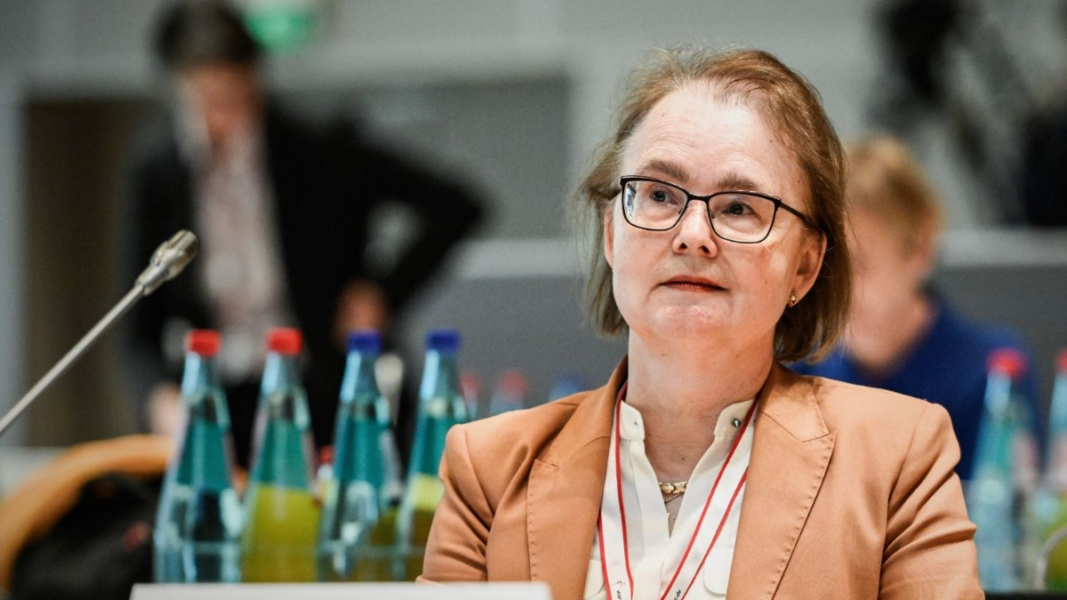
Margit Eckholt is one of the most influential theologians in Germany and a prominent figure in the Synodal Way. Professor of Dogmatics at the University of Osnabrück, she has positioned herself for years in favor of reinterpreting the ministries with a focus on greater female protagonism, becoming a reference for the German reformist sectors. Her participation in synodal documents and her insistence on reviewing tradition have habitually placed her at the center of the ecclesial debate.
In this context, the publication of the final report of the Vatican commission on the female diaconate—which concludes that it is not possible to admit women to the diaconate as a degree of the sacrament of Holy Orders—has generated reactions of discontent among several lay groups in Germany. But Eckholt, far from accepting the conclusion as a doctrinal limit, proposes a reading that relativizes its scope.
Eckholt: “It’s not a stop”
In an interview conducted by the German medium Katholisch.de, the theologian explains that the text should not be interpreted as a definitive brake, but as a document “that invites us to keep thinking.” She argues that the report, prepared during three sessions from 2016, simply “prepares” a future pontifical decision, and that, therefore, the debate remains “open.”
The commission, however, clearly states that in light of Scripture, Tradition, and the Magisterium, the possibility of a sacramental female diaconate is ruled out. Despite this, Eckholt insists that the internal vote—seven in favor of maintaining that thesis, one against—cannot be considered conclusive.
Implicit questioning of the magisterium
Eckholt acknowledges that the report reaffirms as definitive the teaching of John Paul II in Ordinatio sacerdotalis, which excludes the priestly ordination of women. However, her interpretation is critical: she considers that this teaching can still “be reviewed” from contemporary categories of anthropology and ecclesial symbolism. She even suggests that historical theology presents “broader” foundations than those currently assumed by the Magisterium.
This approach—characteristic of the German Synodal Way—directly tensions what the Church has repeatedly affirmed about the impossibility of conferring ordination on women.
The alternative: more laity, new ministries… and the permanent debate
The report points to strengthening lay ministries rather than opening the door to a sacramental female diaconate. Eckholt, however, interprets this path not as a solution but as an intermediate step, stating that no lay alternative will be able to replace the ultimate goal of a full female diaconate. She even warns that maintaining a sacramental male diaconate while the female one would be only lay would be “incomprehensible.”
Expectations before Pope Leo XIV
The report is already in the hands of Pope Leo XIV. Eckholt asks the “evangelical Freimut” Pontiff—parresia—, that is, greater freedom to continue discussing the possibility of the female diaconate, as well as the international participation of theologians and pastoral agents favorable to change.
Despite the clear message of the report, Eckholt insists that it is only “a first step,” and that the Church must overcome, in her words, “a gender fixation that is no longer convincing today.”