


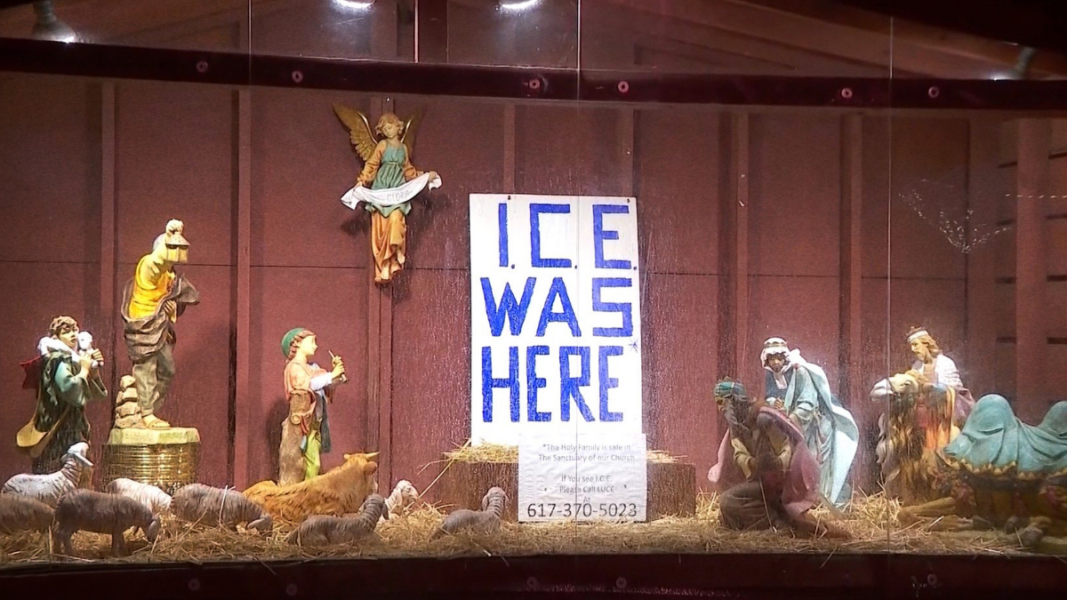
The pastor of St. Susanna parish in Dedham (Massachusetts) keeps a nativity scene on display with messages against the U.S. immigration service (ICE), despite the Archdiocese of Boston ordering its removal for considering it inappropriate and contrary to the sacred use of liturgical objects. The situation has caused a direct clash between the parish priest, Father Stephen Josoma, and Archbishop Richard Henning, generating an unresolved ecclesiastical conflict.
A Nativity Scene Turned into a Political Manifesto
On November 29, the parish installed a nativity scene without the figures of Jesus, Mary, and Joseph, accompanied by the message “ICE Was Here” (“ICE was here”) and a phone number to report the presence of immigration agents. The missing figures were moved inside the church as a symbolic gesture.
According to the National Catholic Register, the archdiocese spokesperson stated on Friday that the display must be removed immediately, pointing out that God’s people have the right to find in the church a space for prayer, not a stage for political messages. He also recalled that canonical norms prohibit using sacred objects for purposes other than worship, which includes the representation of the Child Jesus in the nativity scene.
According to the archdiocese, the parish did not request authorization to alter the meaning of the nativity scene or to place a political message in a sacred space.
The Pastor Defies the Order and Demands a Meeting with the Archbishop
Despite the instruction, Father Josoma declared in a press conference that the nativity scene will remain until he can dialogue with Archbishop Henning. He assures that the display is not sacrilegious nor does it cause scandal to the faithful, but rather reflects the injustices stemming from the current U.S. government’s immigration policies.
The priest stated that the division generated does not come from the nativity scene, but from the country’s political polarization. In his Sunday homily, he acknowledged having received a letter from the archbishop asking him to remove the signs and the display, but indicated that the final decision would be discerned together with the parish council and the Pax Christi group.
An Unexpected Conflict After Years of Permissiveness
Father Josoma noted that Archbishop Henning’s reaction was “a surprise,” especially because his predecessor, Cardinal Seán O’Malley, never intervened to remove similar displays in previous years, when St. Susanna’s nativity scenes included messages about gun violence, immigration detention centers, and climate change.
This difference in criteria between episcopal administrations has been interpreted by some faithful as a shift in the archdiocese’s stance regarding the political use of sacred symbols.
The Pastoral Argument: “The Lord’s Table Must Reflect the World”
The priest defended his action by assuring that liturgy and social life cannot be separated. According to his interpretation, the nativity scene is an opportunity to raise awareness about realities of suffering, and its message would be aligned with a recent statement from the U.S. Episcopal Conference on the climate of fear and anxiety among immigrants.
Father Josoma asked the community to pray for the situation and thanked the support of former parishioners who attended Sunday Mass.
The Perspective of Canon Law: The Archbishop Has Authority to Intervene
An expert consulted by the National Catholic Register explained that, although the pastor has ordinary authority over his parish, the bishop can intervene when there is a risk of scandal or misuse of sacred objects. He cited canon 1311 §2, which obliges the bishop to avoid scandal, and recalled that the archbishop warned the pastor in writing about a possible canonical infraction.
If the priest persists in his refusal, the archbishop could apply penal remedies. He also clarified that the parish council has no authority to decide on this matter, as its function is only consultative (canon 536 §2).