


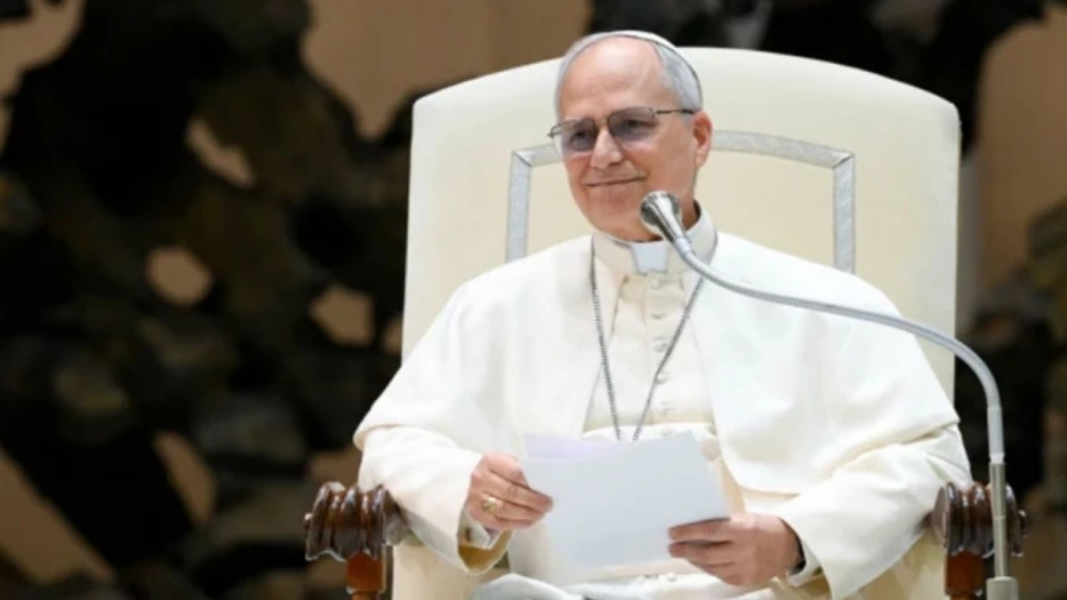
In a General Audience marked by the jubilee catechesis on Christian hope, Pope Leo XIV meditated on one of the great questions that traverse human existence: the meaning of death and the light that Christ’s Resurrection casts upon it. Gathered in St. Peter’s Square with thousands of pilgrims, the Pontiff recalled that contemporary society has turned death into a taboo, hiding it behind distractions or technological promises of immortality, characteristic of transhumanism, which cannot respond to the longing for eternity inscribed in the human heart.
Leo XIV emphasized that Christ’s Easter constitutes the definitive answer to the ancestral fear of death, because it reveals that it is not the end, but a passage to full life. In his reflection, he evoked the classical teaching of St. Alphonsus Liguori, for whom the awareness of death educates the heart and orients decisions toward what is essential. The Pope warned against the illusion of a life prolonged indefinitely by technical means, asking whether an existence without death would really be a happy life.
The Pontiff, visibly affected by the news of the escalation of the conflict between Thailand and Cambodia, called for an immediate ceasefire and showed his closeness to the affected populations. The catechesis concluded with the central affirmation that structures the entire Jubilee Year: only Christ’s Resurrection illuminates the mystery of death and turns fear into hope, opening the believer to the certainty of an eternity prepared by divine Love.
We leave below the complete message of Leo XIV:
Dear brothers and sisters, good morning!Welcome everyone!
The mystery of death has always raised profound questions in human beings. In fact, it seems to be the most natural and, at the same time, the most unnatural event that exists. It is natural, because all living beings on earth die. It is unnatural because the desire for life and eternity that we feel for ourselves and for the people we love makes us see death as a condemnation, as a «nonsense».
Many ancient peoples developed rites and customs related to the worship of the dead, to accompany and remember those who were heading toward the supreme mystery. Today, however, a different tendency is observed. Death seems like a kind of taboo, an event that must be kept at a distance; something to be spoken of in a low voice, so as not to disturb our sensitivity and tranquility. Often, for this reason, even visiting cemeteries is avoided, where those who have preceded us rest in anticipation of the resurrection.
What, then, is death? Is it really the last word on our life? Only human beings ask this question, because only they know that they must die. But being aware of it does not save them from death; rather, in a certain sense, it «weighs» on them more than on all other living creatures. Animals suffer, undoubtedly, and realize that death is near, but they do not know that death is part of their destiny. They do not question the meaning, the end, or the outcome of life.
Upon noting this aspect, one might think that we are paradoxical creatures, unhappy, not only because we die, but also because we have the certainty that this event will occur, although we ignore how and when. We discover ourselves to be conscious and, at the same time, powerless. Probably from there come the frequent repressions, the existential flights in the face of the question of death.
St. Alphonsus Liguori, in his famous writing entitled Preparation for Death, reflects on the pedagogical value of death, highlighting that it is a great teacher of life. Knowing that it exists and, above all, meditating on it teaches us to choose what to really do with our existence. To pray, to understand what is good with a view to the kingdom of heaven, and to let go of the superfluous that, on the other hand, ties us to ephemeral things, is the secret to living authentically, with the awareness that our passage through the earth prepares us for eternity.
However, many current anthropological visions promise immanent immortality and theorize about the prolongation of earthly life through technology. It is the scenario of “transhumanism”, which is making its way on the horizon of the challenges of our time. Could science really defeat death? But then, could the same science guarantee us that a life without death is also a happy life?
The event of Christ’s resurrection reveals to us that death does not oppose life, but is a constitutive part of it as a passage to eternal life. Jesus’ Easter makes us taste, in this time still full of sufferings and trials, the fullness of what will happen after death.
The evangelist Luke seems to capture this foreshadowing of light in the darkness when, at the end of that afternoon in which the darkness had enveloped Calvary, he writes: «It was the day of Preparation, and the sabbath was beginning» (Lk 23:54). This light, which anticipates the morning of Easter, already shines in the darkness of the sky that still seems closed and silent. The lights of the sabbath, for the first and only time, announce the dawn of the day after the sabbath: the new light of the Resurrection. Only this event is capable of illuminating to the depths the mystery of death. In this light, and only in it, what our heart desires and hopes for becomes reality: that death is not the end, but the passage to full light, to a happy eternity.
The Risen One has preceded us in the great trial of death, emerging victorious thanks to the power of divine Love. Thus He has prepared for us the place of eternal rest, the house in which we are awaited; He has given us the fullness of life in which there are no longer shadows or contradictions.
Thanks to Him, who died and rose again out of love, with St. Francis we can call death «sister». To await it with the certainty of the resurrection preserves us from the fear of disappearing forever and prepares us for the joy of endless life.