


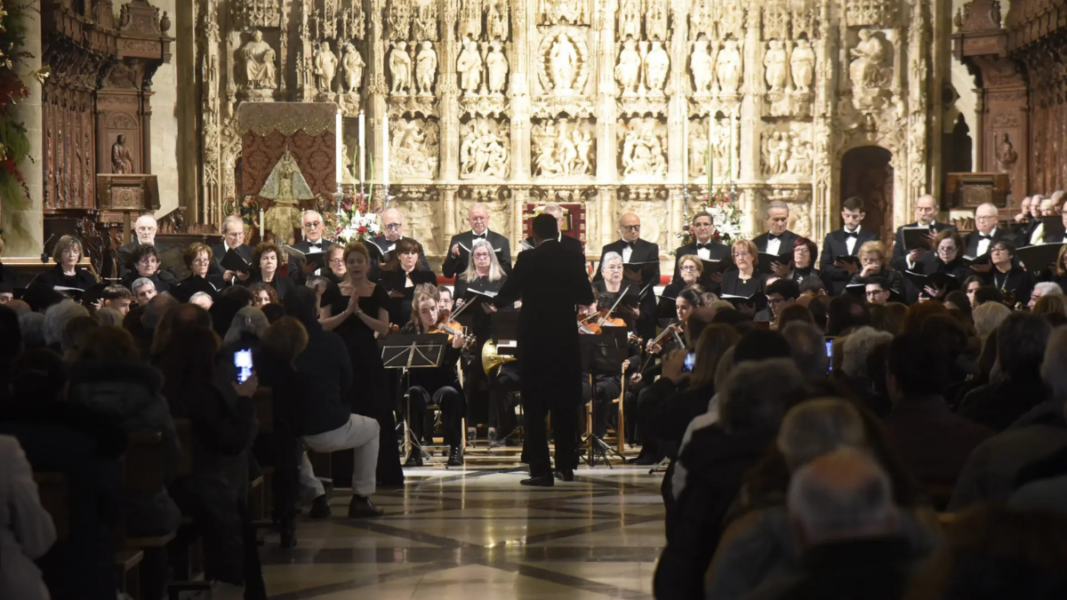
The celebration of the Tota Pulchra once again brought together numerous faithful in the Cathedral of Huesca on the occasion of the solemnity of the Immaculate Conception. This tradition, documented in the cathedral manuscript Consueta Oscensis, has been part of the local religious identity since the 16th century and is linked to the vow made by the municipal Council and the cathedral Chapter in 1619. Its origins date back to 1450, when the people of Huesca made a vow to the Immaculate during a plague epidemic.
Institutional Participation and Development of the Ceremony
According to El Diario de Huesca, the ceremony was attended by representatives of the cathedral Chapter, municipal authorities led by Mayor Lorena Orduna, and members of the Ramón y Cajal Institute, heir since 1845 to the ancient Sertorian University. The liturgical procession began to the rhythm of the Marian hymn Ave Maris Stella and led into the celebration of the Eucharist.
More than a thousand people attended the event, which maintained the usual structure of this festivity in the Oscense Cathedral.
Musical Interpretation of the Tota Pulchra
The musical part was directed by José Vicente Pardo Bellido, professor at the Huesca Conservatory. Musicians from various orchestras participated, as well as the choirs of the Cathedral’s Music Chapel, parish choirs, the Ars Musicae Choir, and the soloists Marina Lansac, Alejandro Escuer, and María Jesús Ramón.
The interpretation of the Tota Pulchra, a work composed by Giovanni Cesare Aldega and belonging to the second vespers of the Immaculate Conception, constituted the central moment of the event. The Latin text, which includes expressions taken from the Song of Songs, was performed before a silent assembly.
After this piece, the Salve Regina by Hilarión Eslava was performed, in accordance with the musical program planned for the celebration.
Content of the Homily
In the homily, Monsignor Pedro Aguado Cuesta recalled the historical importance of the vow to the Immaculate in the local religious identity. He noted that the tradition predates the dogmatic definition promulgated in 1854 and highlighted various aspects of Mary’s figure, whom he described as a believer, mother, educator, disciple, and witness.
The bishop invited those present to live Advent by attending to current social needs and concluded by asking that the vow to the Immaculate inspire attitudes of service and solidarity throughout the year.
Closing of the Celebration
The ceremony concluded with the performance of the Gaudeamus Igitur, the university hymn historically associated with the Sertorian University of Huesca (1354–1845). This closing is a habitual part of the celebration and underscores the connection between the religious tradition and the city’s academic past.